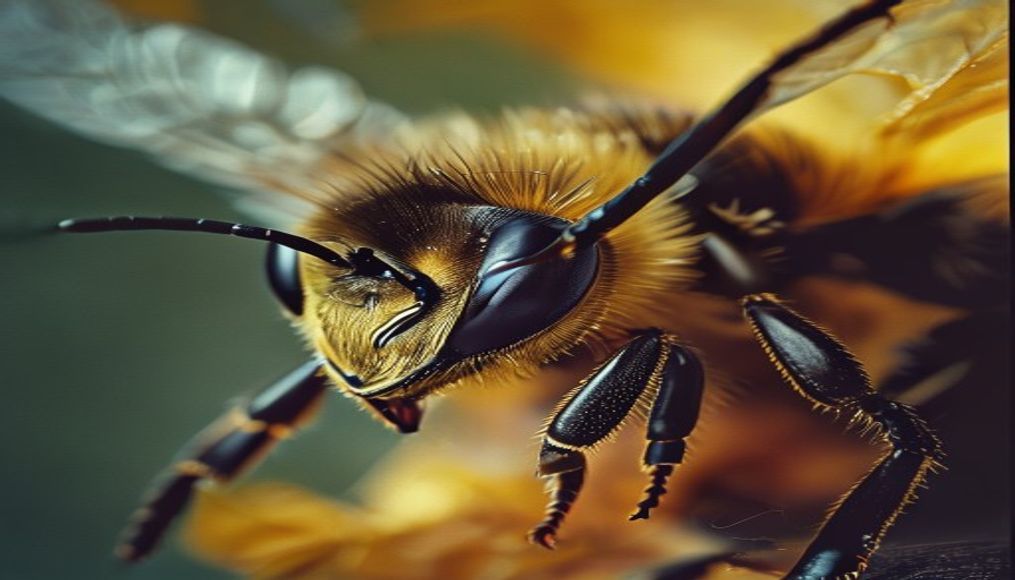
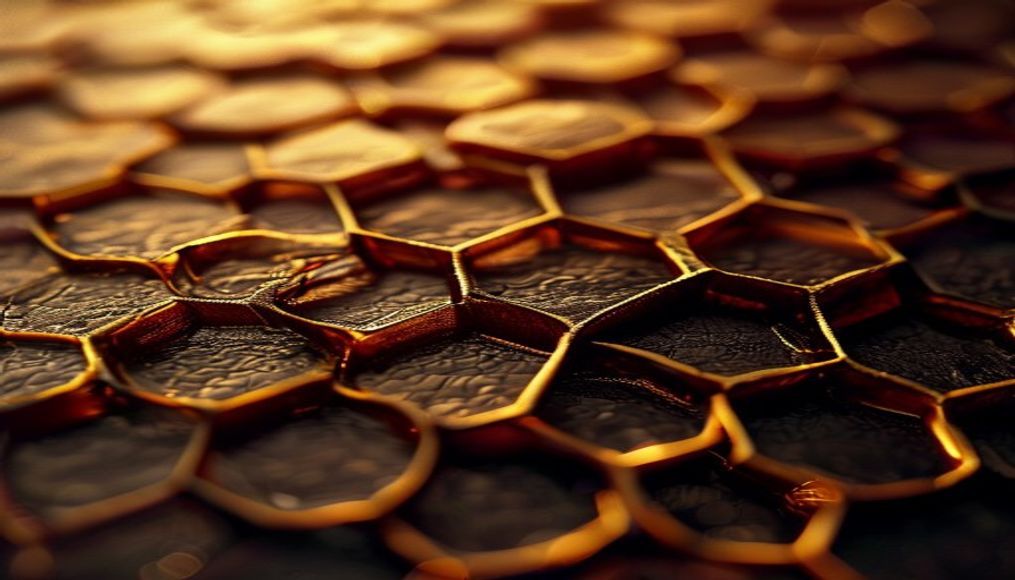
Honeycomb hexagonal pattern
1344×768 · AVIF · CC BY 4.0
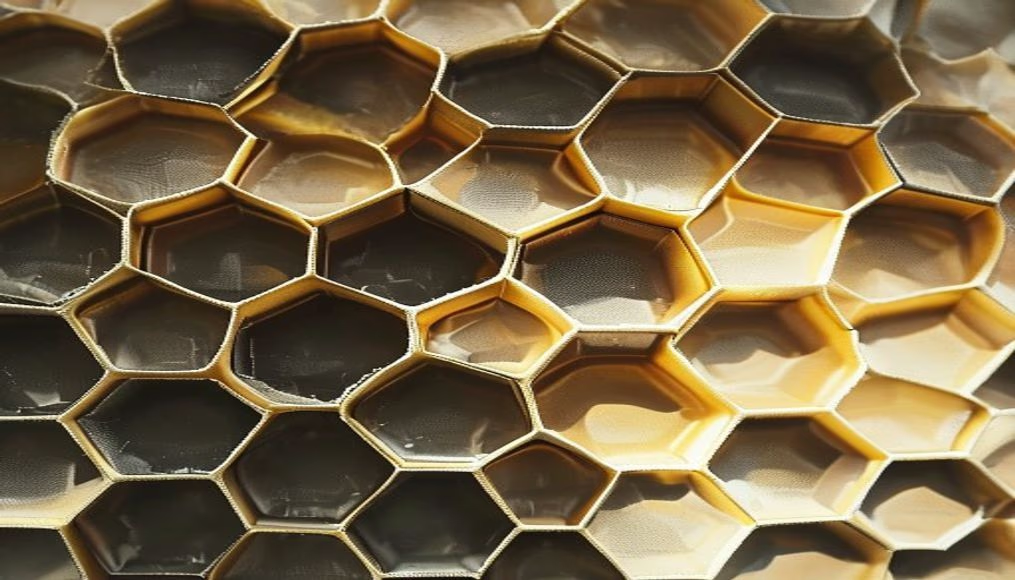
The hexagonal pattern of honeycombs is a marvel of natural engineering, combining material economy with maximum structural strength.
About this subject
Honeycombs built by honeybees (Apis mellifera) exhibit a geometric arrangement of hexagonal cells that has fascinated mathematicians and biologists for centuries. This shape is not random: the regular hexagon allows storing the maximum amount of honey with the least expenditure of wax. Studies show that among shapes that tessellate perfectly (triangles, squares, hexagons), the hexagon offers the best area-to-perimeter ratio, reducing wax needed by up to 30% compared to circles or rectangles.
The construction of cells begins with wax secretion from the wax glands of worker bees. The wax is molded while still pliable, and the hexagonal shape emerges naturally due to surface tension and the pressure exerted by bees during building. Interestingly, cells are tilted about 13 degrees to prevent honey from leaking. Each cell has thin walls (approximately 0.1 mm) but can support up to 2 kg of honey when the comb is full.
From a mathematical standpoint, the honeycomb conjecture, proved in 1999 by mathematician Thomas Hales, states that a hexagonal partition of the plane is the most efficient way to divide equal areas with the smallest total perimeter. This efficiency has inspired engineering applications such as honeycomb structures in aerospace and packaging design. Additionally, the hexagonal pattern appears in other natural contexts, such as wasp nests and basalt column formations.
The cultural and economic importance of honeycomb extends beyond beekeeping. The honey stored in these cells is an ancient food with antibacterial properties, while beeswax is used in candles, cosmetics, and encaustic art. The hexagonal pattern has become a symbol of organization and efficiency in nature, often cited in debates on intelligent design and biomimicry.
Frequently Asked Questions
Why do bees build hexagonal honeycombs instead of circles?
Hexagons allow storing more honey with less wax because they eliminate gaps between cells. Circles would leave empty spaces, wasting material and space.
What is the advantage of the hexagonal shape for the comb's structure?
The hexagon distributes mechanical stress evenly, making the comb very strong. A single hive can contain tens of thousands of cells without collapsing.
How do bees produce the wax to build the combs?
Worker bees have wax glands on their abdomen that secrete small wax scales. They chew the wax to soften it and shape the cells using their mandibles and legs.
Direct URL
https://pub-c7d6a6ea828543ac903a74a341ccb2e1.r2.dev/imagens/honeycomb-hexagonal-pattern-minimalist-composition-p3.avifHow to credit
Include a visible link back to UtilizAí. Copy one of the snippets below:
<a href="https://xn--utiliza-eza.com/en/midia/imagens/honeycomb-hexagonal-pattern-minimalist-composition-p3">Honeycomb hexagonal pattern</a> by <a href="https://xn--utiliza-eza.com">UtilizAí</a>, licensed under <a href="https://creativecommons.org/licenses/by/4.0/">CC BY 4.0</a>.
[Honeycomb hexagonal pattern](https://xn--utiliza-eza.com/en/midia/imagens/honeycomb-hexagonal-pattern-minimalist-composition-p3) by [UtilizAí](https://xn--utiliza-eza.com), CC BY 4.0
License: CC-BY-4.0