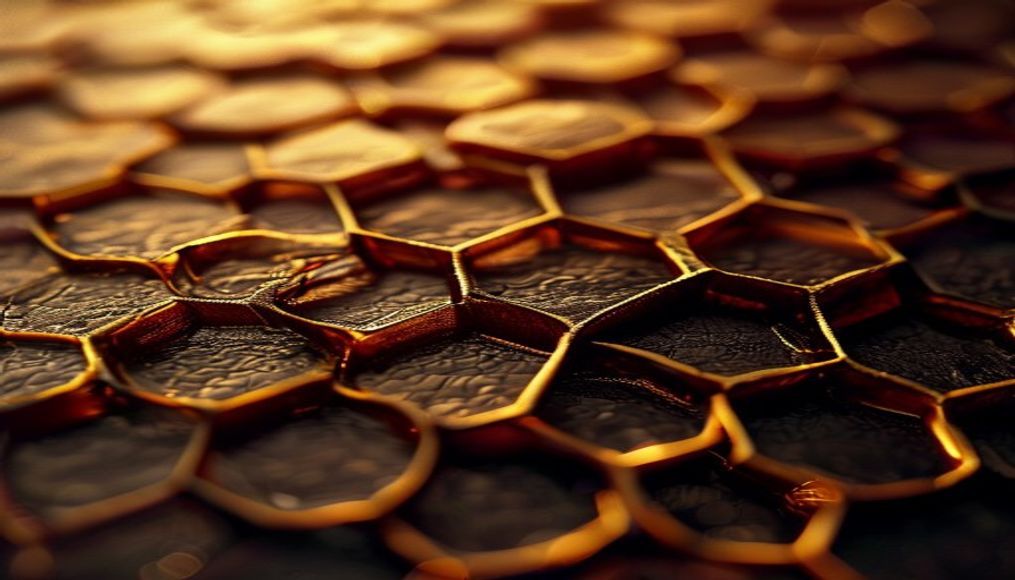
Honeycomb hexagonal pattern
1344×768 · AVIF · CC BY 4.0

Bee honeycombs consist of hexagonal cells that maximize storage space and minimize wax usage, a classic example of natural engineering efficiency.
About this subject
Honeybees construct honeycombs with hexagonal cells, a structure that optimizes the storage of honey, pollen, and brood. The hexagonal shape allows a perfect fit without gaps, using the least amount of wax possible. Each cell has internal angles of 120 degrees, ensuring strength and stability. Wax is produced by the bees themselves from abdominal glands, requiring significant energy expenditure: to produce one kilogram of wax, bees consume about eight kilograms of honey. This mathematical efficiency inspired the "honeycomb conjecture," proven mathematically in the 20th century, which states that the hexagonal structure is the most efficient division of a plane into equal areas with the smallest perimeter. In beekeeping, frames with honeycombs are removed for honey extraction and then reused by the bees. Drone aerial shots reveal the impressive symmetry of the honeycombs, highlighting the natural organization of hives. Culturally, the honeycomb symbolizes collective work, order, and sweetness, appearing in coats of arms and logos worldwide. The temperature inside the hive, maintained between 32°C and 35°C, is crucial for proper wax production and larval rearing.
Frequently Asked Questions
Why do bees build hexagonal honeycombs?
Bees use the hexagonal shape because it allows storing more honey with minimal wax, while also providing structural strength. It is the most efficient way to fill space without gaps.
How long does it take bees to build a honeycomb?
A strong colony can build a complete honeycomb in about 2 to 3 days, depending on nectar availability and temperature. The process involves wax secretion and molding by worker bees.
What is the honeycomb conjecture?
It is a mathematical theorem that proves the hexagonal division is the most efficient way to partition the plane into equal-area cells with the smallest total perimeter. It was proven by Thomas Hales in 1999.
Direct URL
https://pub-c7d6a6ea828543ac903a74a341ccb2e1.r2.dev/imagens/honeycomb-hexagonal-pattern-aerial-drone-shot-p1.avifHow to credit
Include a visible link back to UtilizAí. Copy one of the snippets below:
<a href="https://xn--utiliza-eza.com/en/midia/imagens/honeycomb-hexagonal-pattern-aerial-drone-shot-p1">Honeycomb hexagonal pattern</a> by <a href="https://xn--utiliza-eza.com">UtilizAí</a>, licensed under <a href="https://creativecommons.org/licenses/by/4.0/">CC BY 4.0</a>.
[Honeycomb hexagonal pattern](https://xn--utiliza-eza.com/en/midia/imagens/honeycomb-hexagonal-pattern-aerial-drone-shot-p1) by [UtilizAí](https://xn--utiliza-eza.com), CC BY 4.0
License: CC-BY-4.0