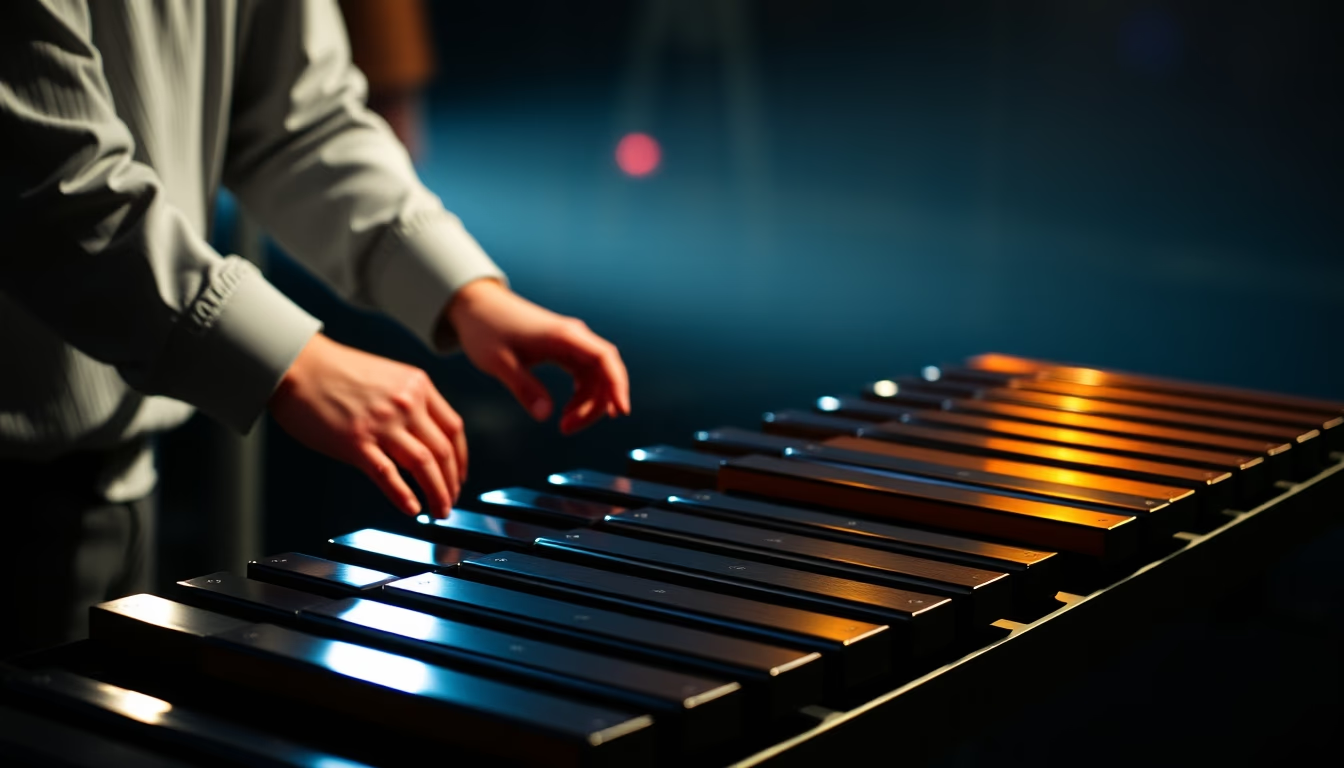
Harp golden frame strings
1344×768 · AVIF · CC BY 4.0

Harp with golden frame and gleaming strings: a plucked string instrument of ancient origin, symbol of elegance and musical tradition.
About this subject
The harp is a plucked string instrument whose origins date back over 5,000 years, with archaeological evidence found in Mesopotamia and Ancient Egypt. Unlike other string instruments, the harp's strings are positioned at an oblique angle to the soundbox, allowing the musician to pluck them with both hands. The golden frame, often adorned with carvings or gold leaf, is not merely decorative: it provides the necessary tension to support the strings, which can range from 22 to 47 in concert harps.
The modern concert harp, also called the pedal harp, was developed in the 19th century by Sébastien Érard, who introduced the pedal mechanism that alters the pitch of the strings. This advancement allowed the harp to become a chromatic instrument capable of playing in all keys. Earlier, simpler harps such as the Celtic harp (or folk harp) had manual levers for pitch changes and were used in traditional Irish and Scottish music.
In the orchestral context, the harp holds a special place, often associated with celestial or dreamlike passages. Composers such as Claude Debussy (Prélude à l'après-midi d'un faune), Maurice Ravel (Introduction et Allegro), and Hector Berlioz (Symphonie fantastique) wrote iconic parts for the instrument. Besides classical music, the harp also appears in jazz, pop, and film scores, such as in The Godfather and Beauty and the Beast.
Interestingly, the harp is the national symbol of Ireland, appearing on coins, coats of arms, and the Guinness logo. The traditional Celtic harp, with its curved frame and lack of a front pillar, differs visually from the concert harp, but both share the same musical essence. Crafting a concert harp can take up to two years, involving careful selection of woods such as maple, beech, and spruce, plus the metallic coating that results in the characteristic golden shine.
Frequently Asked Questions
How many strings does a concert harp have?
A standard concert harp has 47 strings: 6 steel strings (higher pitch) and 41 gut or nylon strings (mid and low range). The thinnest strings are clear (white or silver) and the thickest are dark (red or blue).
What is the difference between a Celtic harp and a concert harp?
The Celtic harp is smaller, with 22 to 38 strings, and uses manual levers to change pitch. The concert harp is larger, has 47 strings, and uses pedals to change pitch chromatically. The Celtic harp is typical of Irish and Scottish folk music.
Why is the harp considered a difficult instrument to play?
The harp requires fine motor coordination, as each hand plucks different strings, and the musician must memorize the location of all 47 strings without visual markers. Additionally, using pedals to change pitch during performance adds complexity.
Direct URL
https://pub-c7d6a6ea828543ac903a74a341ccb2e1.r2.dev/imagens/harp-golden-frame-strings-documentary-photography-p3.avifHow to credit
Include a visible link back to UtilizAí. Copy one of the snippets below:
<a href="https://xn--utiliza-eza.com/en/midia/imagens/harp-golden-frame-strings-documentary-photography-p3">Harp golden frame strings</a> by <a href="https://xn--utiliza-eza.com">UtilizAí</a>, licensed under <a href="https://creativecommons.org/licenses/by/4.0/">CC BY 4.0</a>.
[Harp golden frame strings](https://xn--utiliza-eza.com/en/midia/imagens/harp-golden-frame-strings-documentary-photography-p3) by [UtilizAí](https://xn--utiliza-eza.com), CC BY 4.0
License: CC-BY-4.0