Flying taxi concept urban
1344×768 · AVIF · CC BY 4.0
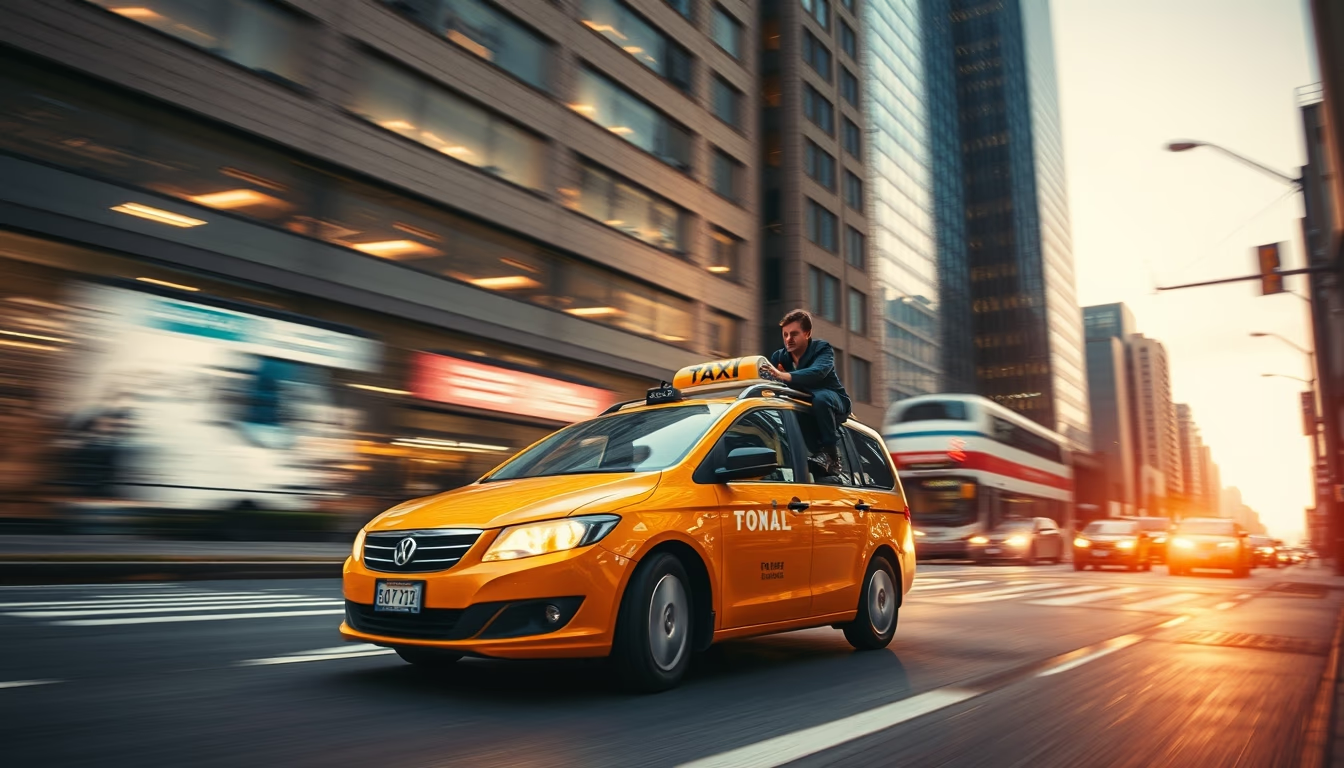
Flying cars are no longer science fiction: see how electric air taxis (eVTOLs) promise to transform urban transport by 2030.
About this subject
Air taxis, officially known as eVTOLs (electric vertical takeoff and landing vehicles), represent a new frontier in urban mobility. Unlike traditional helicopters, these vehicles are fully electric, quieter, and designed with multiple rotors for safety and efficiency. Companies such as Brazilian Eve Air Mobility (a subsidiary of Embraer), Chinese EHang, and German Volocopter are already conducting test flights and partnering with cities to launch commercial routes by 2026-2027.
The urban air taxi concept involves not only the vehicle but also an entire infrastructure of vertiports, helipads adapted for rapid recharging and boarding. Cities like São Paulo, Rio de Janeiro, Dubai, and Los Angeles are leading feasibility studies. São Paulo already has about 400 helipads that could be converted. The global eVTOL market is estimated to reach $1.5 trillion by 2040, according to Morgan Stanley.
However, regulatory and public acceptance challenges remain. Brazil's ANAC and the US FAA are working on specific certifications. Noise, though lower than helicopters, still concerns residents in dense areas. High-density batteries and ballistic parachute systems are among the technologies being developed to enhance safety.
Fun fact: the first manned eVTOL flight took place in 2011 by Opener (Canada). Today, more than 200 projects are underway worldwide, with the Vertical Aerospace VX4 model notable for a cruising speed of 240 km/h and a range of 160 km.
Frequently Asked Questions
When will air taxis be available to the public?
First commercial services are expected between 2026 and 2028 in select cities such as São Paulo, Rio de Janeiro, and Dubai. Test flights are already underway.
How much will an eVTOL ride cost?
Initial prices are estimated to be comparable to an executive taxi or helicopter, about $50 to $100 per short trip. With scale, prices should fall to Uber Black levels.
Are eVTOLs safe in case of mechanical failure?
Yes. They have multiple redundant rotors and ballistic parachute systems. In a failure, the vehicle can glide and land safely even with one or two inoperative motors.
Direct URL
https://pub-c7d6a6ea828543ac903a74a341ccb2e1.r2.dev/imagens/flying-taxi-concept-urban-magazine-editorial-p2.avifHow to credit
Include a visible link back to UtilizAí. Copy one of the snippets below:
<a href="https://xn--utiliza-eza.com/en/midia/imagens/flying-taxi-concept-urban-magazine-editorial-p2">Flying taxi concept urban</a> by <a href="https://xn--utiliza-eza.com">UtilizAí</a>, licensed under <a href="https://creativecommons.org/licenses/by/4.0/">CC BY 4.0</a>.
[Flying taxi concept urban](https://xn--utiliza-eza.com/en/midia/imagens/flying-taxi-concept-urban-magazine-editorial-p2) by [UtilizAí](https://xn--utiliza-eza.com), CC BY 4.0
License: CC-BY-4.0