Factory robot arm assembly
1344×768 · AVIF · CC BY 4.0
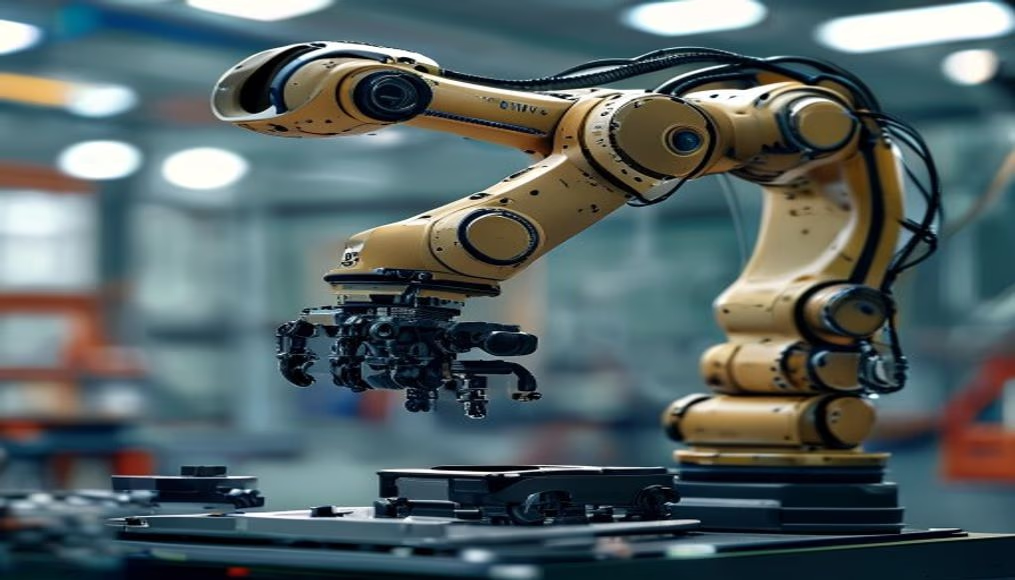
Robotic arms on assembly lines have revolutionized industrial production, combining mechanical precision with automation to manufacture everything from cars to consumer electronics.
About this subject
Industrial robotic arms are a cornerstone of modern manufacturing. These mechanical devices, typically with six degrees of freedom, perform repetitive tasks with high accuracy, such as welding, painting, assembly, and heavy material handling. The first industrial robotic arm, the Unimate, was patented in 1961 by American inventor George Devol and installed at General Motors to handle hot die-cast parts. Since then, technology has evolved dramatically: modern models use force sensors, computer vision, and artificial intelligence to adapt to environmental variations and interact safely with humans.
In practice, an assembly line equipped with robotic arms can operate 24/7 with error rates below 0.01%. Manufacturers such as ABB, Fanuc, and Kuka dominate the global market, supplying robots for automotive, electronics, and pharmaceutical sectors. In Brazil, industrial robotics adoption is growing steadily: according to the International Federation of Robotics, the country installed around 2,000 units in 2022, mainly in vehicle and parts plants.
Interestingly, most robot programming is done via teach pendants, handheld devices that allow operators to define trajectories and actions. However, the trend is moving toward offline programming using 3D simulation, reducing production downtime. Another recent advancement is cobots (collaborative robots), which work alongside human operators without safety cages thanks to torque sensors and automatic stop functions.
Economically, robotic automation increases productivity by 20% to 50% and reduces costs from rework and accidents. Yet it also sparks debates on technological unemployment and the need for workforce reskilling. Regardless, robotic arms remain an icon of the Fourth Industrial Revolution, turning factories into smart, connected environments.
Frequently Asked Questions
What is the main advantage of using robotic arms in factories?
The main advantage is increased productivity and precision. Robotic arms operate continuously without fatigue, perform repetitive tasks with minimal error, and reduce workplace accident risks, especially in hazardous activities like welding or handling toxic materials.
How are industrial robots programmed?
Traditionally, a teach pendant is used to record movements step by step. Nowadays, 3D simulation software enables offline programming, generating accurate trajectories without stopping production. More advanced models use learning by demonstration, where the robot imitates manually guided motions.
Does industrial robotics completely replace human labor?
No, it transforms work. Repetitive and dangerous tasks are automated, but new roles in supervision, maintenance, and programming emerge. Human-robot collaboration, as with cobots, shows that technology can augment human capabilities rather than replace them.
Direct URL
https://pub-c7d6a6ea828543ac903a74a341ccb2e1.r2.dev/imagens/factory-robot-arm-assembly-commercial-product-photography-v9.avifHow to credit
Include a visible link back to UtilizAí. Copy one of the snippets below:
<a href="https://xn--utiliza-eza.com/en/midia/imagens/factory-robot-arm-assembly-commercial-product-photography-v9">Factory robot arm assembly</a> by <a href="https://xn--utiliza-eza.com">UtilizAí</a>, licensed under <a href="https://creativecommons.org/licenses/by/4.0/">CC BY 4.0</a>.
[Factory robot arm assembly](https://xn--utiliza-eza.com/en/midia/imagens/factory-robot-arm-assembly-commercial-product-photography-v9) by [UtilizAí](https://xn--utiliza-eza.com), CC BY 4.0
License: CC-BY-4.0