Enzyme catalysis 3d
1344×768 · AVIF · CC BY 4.0
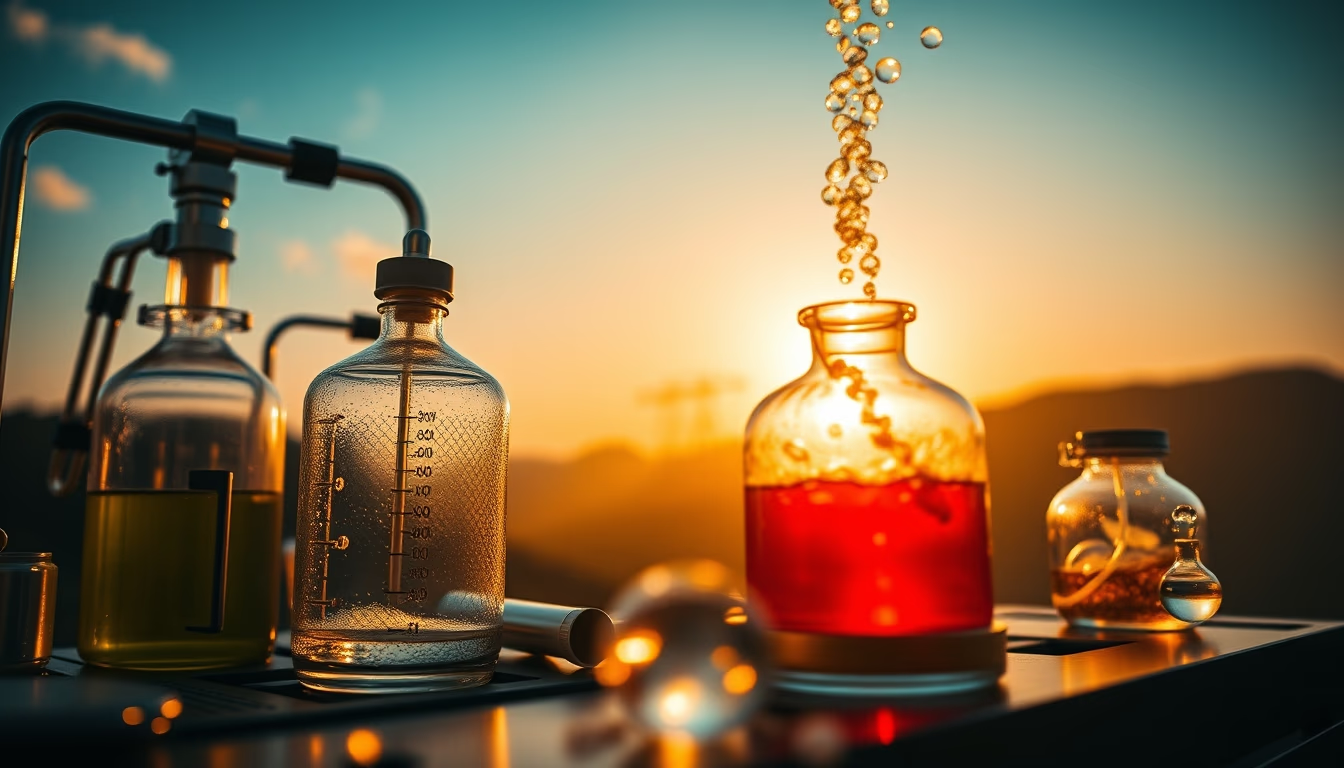
Enzyme catalysis is the process by which enzymes accelerate chemical reactions in living organisms by lowering the activation energy required.
About this subject
Enzymes are specialized proteins that act as biocatalysts, accelerating essential chemical reactions in living organisms. They work by lowering the activation energy, the energy barrier that molecules must overcome to react. This mechanism allows reactions to proceed at rates compatible with cellular metabolism, often millions of times faster than uncatalyzed reactions.
Two main models explain enzyme specificity: the lock-and-key model proposed by Emil Fischer in 1894, and the induced fit model suggested by Daniel Koshland in 1958. In the first, the enzyme's active site is complementary in shape to the substrate, like a key in a lock. In the induced fit model, substrate binding causes a conformational change in the enzyme, optimizing catalysis. Both highlight the high specificity of enzymes.
Factors such as temperature, pH, and substrate concentration influence enzymatic activity. Each enzyme has an optimal pH and temperature; deviations can denature it and reduce efficiency. Competitive and non-competitive inhibitors also regulate activity and are common drug targets. Beyond biological roles, enzymes are widely used in industries: food production (e.g., high-fructose corn syrup), pharmaceuticals, and biofuels, as well as in biological detergents.
Ongoing studies reveal complex catalytic mechanisms, including proximity and orientation effects, acid-base catalysis, and covalent catalysis. Advances in structural biology, such as X-ray crystallography and cryo-electron microscopy, allow visualization of enzymes in action, deepening our understanding of these molecular machines and inspiring the design of new synthetic catalysts.
Frequently Asked Questions
What is activation energy and how do enzymes lower it?
Activation energy is the minimum energy required for a chemical reaction to occur. Enzymes lower it by stabilizing the transition state through interactions like hydrogen bonds and van der Waals forces, speeding up the reaction without being consumed.
What are the main factors affecting enzyme activity?
Temperature, pH, and substrate concentration are key. Each enzyme has an optimal pH (e.g., pepsin works in acidic pH, trypsin in alkaline) and temperature (usually near 37°C in humans). Deviations can denature the enzyme, reducing activity.
How are enzyme inhibitors used as drugs?
Competitive inhibitors bind to the active site, blocking substrate; non-competitive inhibitors bind elsewhere, altering enzyme shape. Many drugs, such as aspirin (inhibits COX) and statins (inhibit HMG-CoA reductase), work as enzyme inhibitors to treat diseases.
Direct URL
https://pub-c7d6a6ea828543ac903a74a341ccb2e1.r2.dev/imagens/enzyme-catalysis-3d-travel-photography-p0.avifHow to credit
Include a visible link back to UtilizAí. Copy one of the snippets below:
<a href="https://xn--utiliza-eza.com/en/midia/imagens/enzyme-catalysis-3d-travel-photography-p0">Enzyme catalysis 3d</a> by <a href="https://xn--utiliza-eza.com">UtilizAí</a>, licensed under <a href="https://creativecommons.org/licenses/by/4.0/">CC BY 4.0</a>.
[Enzyme catalysis 3d](https://xn--utiliza-eza.com/en/midia/imagens/enzyme-catalysis-3d-travel-photography-p0) by [UtilizAí](https://xn--utiliza-eza.com), CC BY 4.0
License: CC-BY-4.0