Enzyme catalysis 3d
1344×768 · AVIF · CC BY 4.0
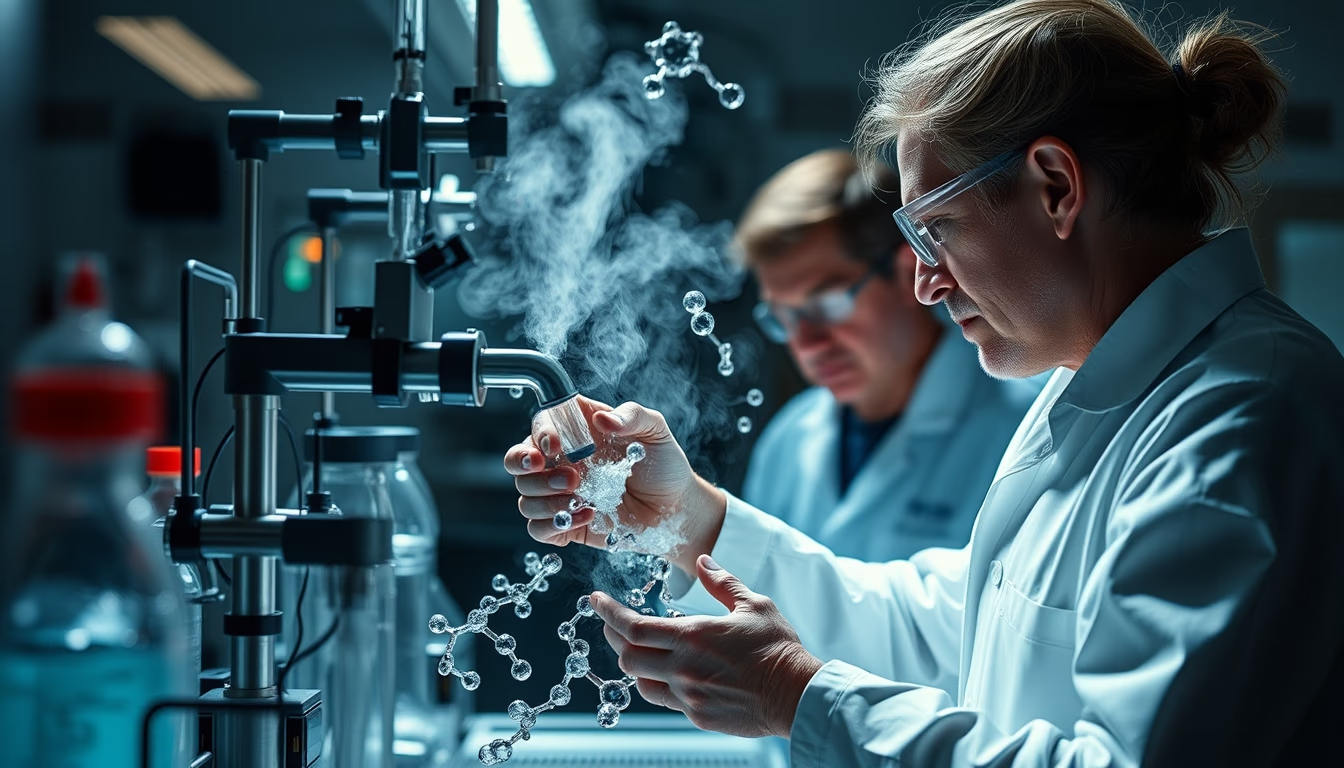
Enzyme catalysis speeds up chemical reactions in living organisms, crucial for processes like digestion and metabolism.
About this subject
Enzyme catalysis is a fundamental biological process where enzymes, specialized proteins, act as catalysts to accelerate chemical reactions. Without enzymes, many metabolic reactions would be extremely slow or unfeasible under cellular conditions. Enzymes lower the activation energy required for a reaction to occur, enabling organisms to perform vital functions efficiently.
The classic mechanism of enzyme catalysis involves substrate binding to the active site of the enzyme, forming an enzyme-substrate complex. Two models explain this interaction: the lock-and-key model, where the active site is pre-formed, and the induced fit model, where the enzyme undergoes conformational changes upon substrate binding. After catalysis, products are released and the enzyme remains unchanged, ready to be reused.
Enzyme specificity is remarkable: each enzyme catalyzes a particular reaction or a narrow set of reactions. Factors such as temperature, pH, and substrate concentration influence activity. For example, the enzyme lactase breaks down lactose into glucose and galactose, and its deficiency causes lactose intolerance. In biotechnology, enzymes are used in food production, pharmaceuticals, and biofuels, as well as bioremediation.
Enzyme catalysis also has important industrial applications. Enzymes like proteases and amylases are employed in detergents to remove stains. In medicine, enzyme inhibitors are drug targets, such as protease inhibitors used against HIV. The study of enzyme kinetics, via models like Michaelis-Menten, allows process optimization and understanding of metabolic diseases.
Frequently Asked Questions
What is enzyme catalysis?
Enzyme catalysis is the process by which enzymes accelerate chemical reactions in living organisms by lowering the activation energy required for the reaction.
What factors affect enzyme activity?
Enzyme activity is influenced by temperature, pH, substrate concentration, and the presence of inhibitors or activators. Each enzyme has specific optimal conditions.
How are enzymes used in industry?
Enzymes are used in detergents, food production, pharmaceuticals, and biofuels. Examples include amylases in baking and proteases in cheese manufacturing.
Direct URL
https://pub-c7d6a6ea828543ac903a74a341ccb2e1.r2.dev/imagens/enzyme-catalysis-3d-documentary-photography-p11.avifHow to credit
Include a visible link back to UtilizAí. Copy one of the snippets below:
<a href="https://xn--utiliza-eza.com/en/midia/imagens/enzyme-catalysis-3d-documentary-photography-p11">Enzyme catalysis 3d</a> by <a href="https://xn--utiliza-eza.com">UtilizAí</a>, licensed under <a href="https://creativecommons.org/licenses/by/4.0/">CC BY 4.0</a>.
[Enzyme catalysis 3d](https://xn--utiliza-eza.com/en/midia/imagens/enzyme-catalysis-3d-documentary-photography-p11) by [UtilizAí](https://xn--utiliza-eza.com), CC BY 4.0
License: CC-BY-4.0