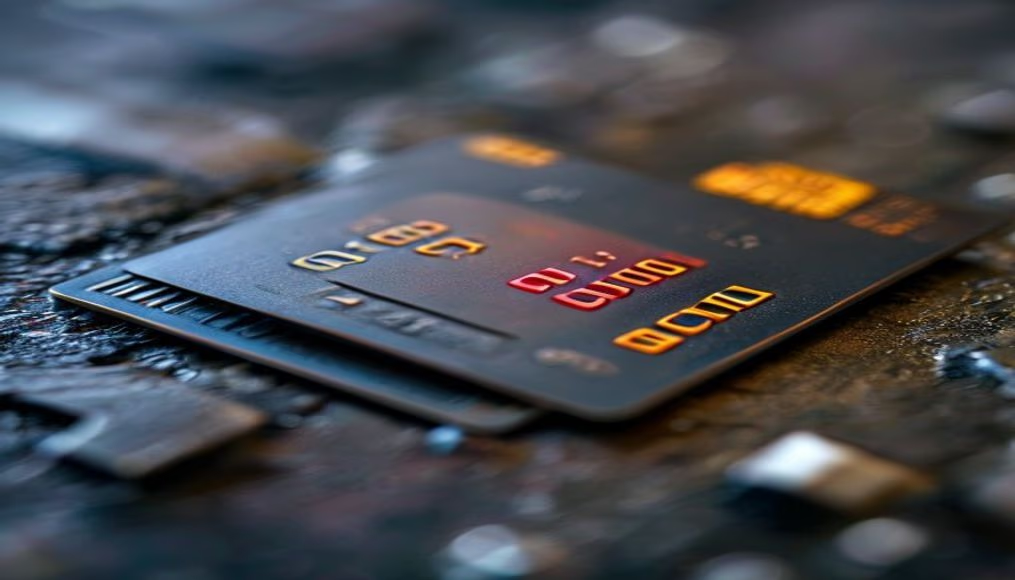
Credit card chip closeup macro photography of EMV chip
1344×768 · AVIF · CC BY 4.0

Close-up macro of an EMV chip on a credit card reveals intricate gold contacts and encapsulation, a symbol of global payment security.
About this subject
The EMV chip (Europay, Mastercard and Visa) is the global standard for payment card security, introduced in the 1990s to combat magnetic stripe fraud. Unlike the stripe, which stores static data, the chip generates a unique code for each transaction, making cloning virtually impossible. Currently, over 10 billion chip cards are in circulation, and Brazil adopted the standard from 2014, with full migration by 2018.
The gold-colored surface is not just aesthetic: the contacts are made of gold or gold alloy, a material that does not oxidize and ensures reliable electrical conductivity during terminal insertions. The black encapsulation protects the internal microcontroller, which runs cryptographic algorithms such as DES, 3DES or RSA. The pad layout follows ISO 7816 standard, with specific positions for power, clock, reset and data.
Interestingly, EMV technology was jointly developed by Europay, Mastercard and Visa, but is now managed by EMVCo, which also includes American Express, Discover, JCB and UnionPay. The chip enabled the adoption of contactless payments (NFC), as many modern chips integrate an antenna for wireless communication. Despite the security, side-channel attacks (such as power analysis) can exploit poorly implemented chips, but they are rare in commercial cards.
In Brazil, the EMV chip drastically reduced in-person fraud, but crimes migrated to the online environment (CNP). The macro image shows the precision engineering that protects billions of daily transactions.
Frequently Asked Questions
What does EMV stand for?
EMV stands for Europay, Mastercard and Visa, the three companies that created the standard. Today, the technology is managed by EMVCo, which also includes American Express, Discover, JCB and UnionPay.
Why is the chip on a credit card gold?
The contacts are made of gold or gold alloy because this material does not oxidize and maintains good electrical conductivity, ensuring reliable connection even after thousands of uses.
Is the EMV chip fraud-proof?
The chip makes physical cloning very difficult, but it does not eliminate all risks. Online fraud (card-not-present) and side-channel attacks can occur, although they are rare in commercial cards.
Direct URL
https://pub-c7d6a6ea828543ac903a74a341ccb2e1.r2.dev/imagens/credit-card-chip-closeup-macro-photography-of-emv-chip-editorial-portrait-bright-midday-sun.avifHow to credit
Include a visible link back to UtilizAí. Copy one of the snippets below:
<a href="https://xn--utiliza-eza.com/en/midia/imagens/credit-card-chip-closeup-macro-photography-of-emv-chip-editorial-portrait-bright-midday-sun">Credit card chip closeup macro photography of EMV chip</a> by <a href="https://xn--utiliza-eza.com">UtilizAí</a>, licensed under <a href="https://creativecommons.org/licenses/by/4.0/">CC BY 4.0</a>.
[Credit card chip closeup macro photography of EMV chip](https://xn--utiliza-eza.com/en/midia/imagens/credit-card-chip-closeup-macro-photography-of-emv-chip-editorial-portrait-bright-midday-sun) by [UtilizAí](https://xn--utiliza-eza.com), CC BY 4.0
License: CC-BY-4.0