Modern bank vault closed door
1344×768 · AVIF · CC BY 4.0
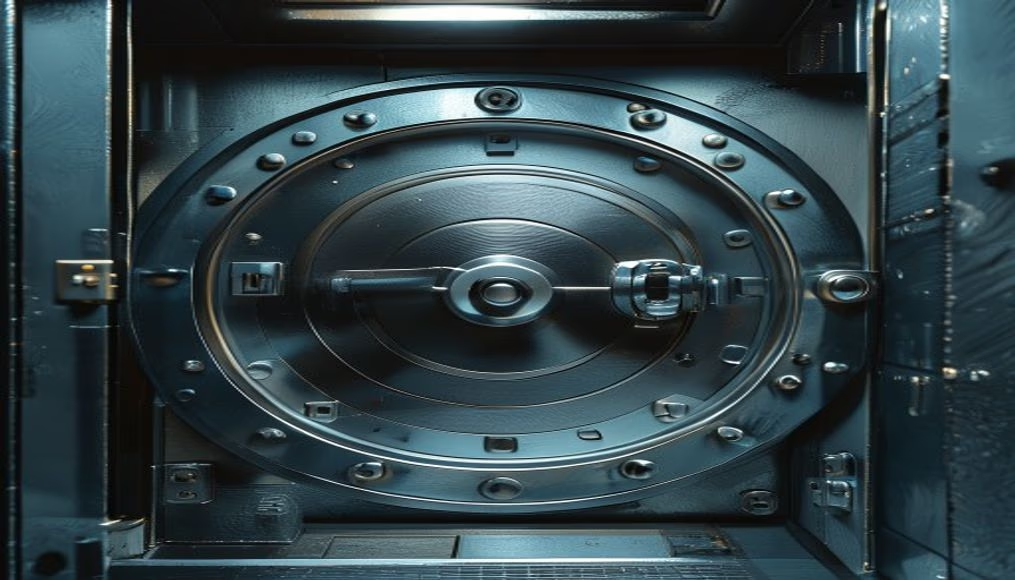
Modern bank vault closed door, symbol of financial security and high-protection technology.
About this subject
Modern bank vault doors represent the pinnacle of security engineering. Unlike older models that relied solely on mechanical combinations and solid steel, current versions employ composite materials such as tempered steel alloys and fiber-reinforced concrete, capable of resisting drilling, explosions, and thermal attacks. The typical thickness of these doors ranges from 20 to 40 centimeters, and they can weigh over 10 tons.
Internally, locking systems use multiple steel bolts (usually 3 to 5) that extend in different directions, anchoring the door to the chamber frame. Closure technology includes time locks, motion sensors, gas and heat detectors, as well as biometric systems (fingerprint, iris recognition) combined with alphanumeric codes. Many modern vaults are designed to withstand an intrusion attempt for at least 30 minutes, sufficient time for security response.
Culturally, the image of a closed vault door evokes trust and inviolability. Banks use these vaults not only to protect cash but also important documents, artworks, and customer items. The strategic location of the vault within the branch, often in basements or restricted access areas, reinforces the perception of security. Interestingly, some modern vaults incorporate decompression systems to prevent implosion in case of fire, maintaining the integrity of the contents.
In Brazil, the ABNT NBR 13498 standard establishes requirements for bank vaults, classifying them by security level. The most advanced models may include electromagnetic neutralization devices to block scanners or plasma cutting equipment. The junction of tradition and innovation makes the vault door an architectural landmark in financial buildings.
Frequently Asked Questions
How do time locks work on bank vaults?
Time locks are mechanisms that prevent the vault from opening before a preset time, even with the correct combination. They use high-precision internal clocks and can be programmed for multiple opening windows, ensuring the vault can only be accessed during banking hours.
What is the typical thickness of a modern vault door?
Thickness varies between 20 and 40 centimeters, depending on the security level. High-security vault doors can be up to 1 meter thick using composite materials like steel and special concrete.
Do modern vaults still use mechanical combinations?
Yes, many modern vaults combine mechanical systems (combination dials) with electronic and biometric ones. Redundancy increases reliability: if the electronic system fails, the mechanical combination allows access, as long as time locks are respected.
Direct URL
https://pub-c7d6a6ea828543ac903a74a341ccb2e1.r2.dev/imagens/modern-bank-vault-closed-door-street-photography-v11.avifHow to credit
Include a visible link back to UtilizAí. Copy one of the snippets below:
<a href="https://xn--utiliza-eza.com/en/midia/imagens/modern-bank-vault-closed-door-street-photography-v11">Modern bank vault closed door</a> by <a href="https://xn--utiliza-eza.com">UtilizAí</a>, licensed under <a href="https://creativecommons.org/licenses/by/4.0/">CC BY 4.0</a>.
[Modern bank vault closed door](https://xn--utiliza-eza.com/en/midia/imagens/modern-bank-vault-closed-door-street-photography-v11) by [UtilizAí](https://xn--utiliza-eza.com), CC BY 4.0
License: CC-BY-4.0