Cipher disk cryptography
1344×768 · AVIF · CC BY 4.0
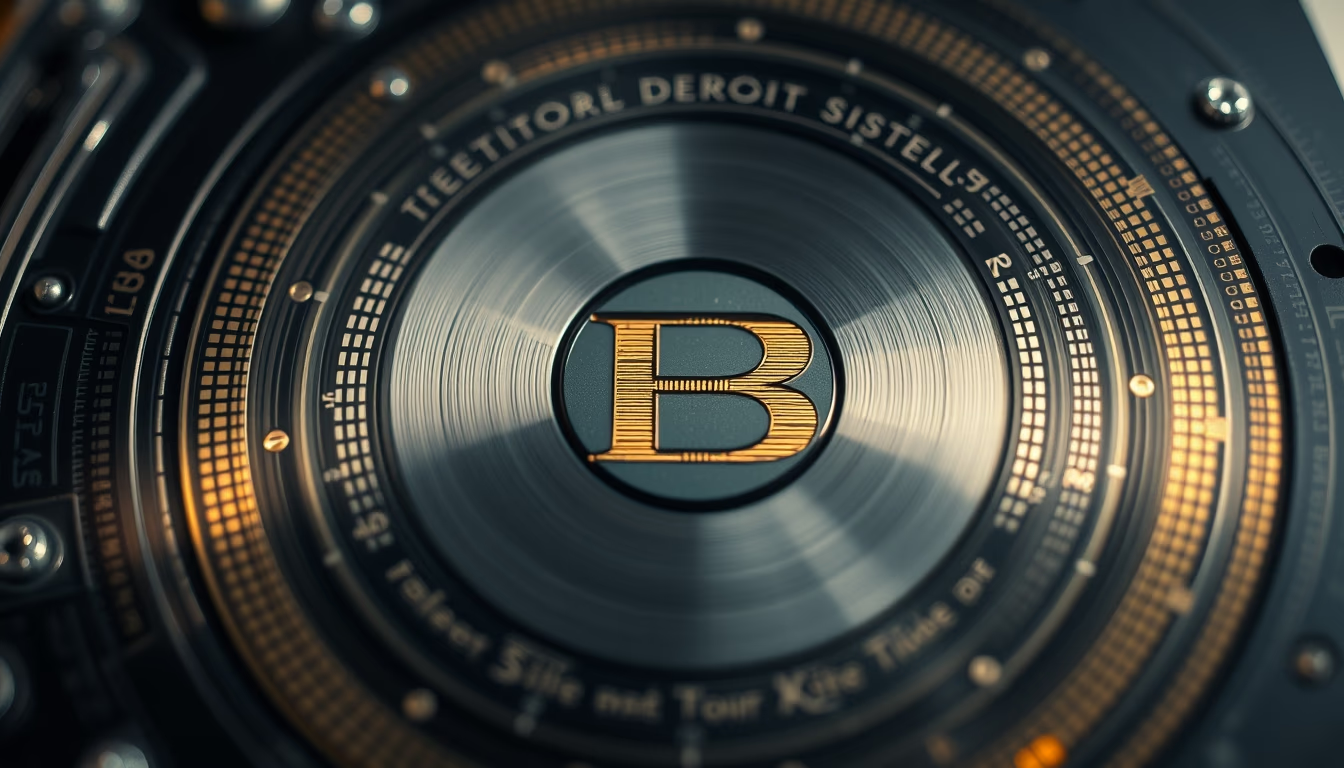
The cipher disk is a manual encryption device used since the 15th century to encode secret messages by rotating concentric disks.
About this subject
The cipher disk, also known as the Alberti cipher disk after its inventor Leone Battista Alberti in 1467, is one of the earliest cryptographic devices in history. It consists of two concentric disks: a stationary outer ring (usually with the alphabet in standard order) and a movable inner ring (with the alphabet scrambled or in a different order). By aligning a letter on the outer disk with a letter on the inner disk, a polyalphabetic substitution cipher is defined, allowing the same plaintext letter to be enciphered differently throughout the message.
This principle was revolutionary because it thwarted simple frequency analysis common in monoalphabetic ciphers. Alberti's disk directly influenced the development of more complex ciphers, such as the Vigenère cipher, which uses a table based on cyclic shifts. Over the following centuries, versions of the cipher disk were used by diplomats, military personnel, and spies, including during the American Civil War and World War I.
The device is compact and portable, typically made of metal or cardboard, with a diameter of 5 to 15 centimeters. Some models include additional dials for numbers or symbols. Operation requires that sender and receiver pre-arrange a key (initial alignment of the disks) and the sequence of rotations for each character. Although now considered obsolete compared to digital cryptography, the cipher disk remains a milestone in the evolution of information security and is still used in educational contexts to demonstrate basic encoding concepts.
Frequently Asked Questions
How does the cipher disk work?
The cipher disk consists of two concentric disks with letters. By rotating the inner disk, the letter correspondence changes, creating a polyalphabetic substitution cipher. Each plaintext letter is replaced by the aligned letter on the outer disk, and the rotation may vary per character.
Who invented the cipher disk and when?
The cipher disk was invented by Italian polymath Leone Battista Alberti in 1467. He is considered the father of modern Western cryptography.
Is the cipher disk still used today?
Not for actual security, as it is easily broken by modern methods. However, it is widely used in classrooms and educational activities to teach basic cryptography concepts.
Direct URL
https://pub-c7d6a6ea828543ac903a74a341ccb2e1.r2.dev/imagens/cipher-disk-cryptography-documentary-photography-fresh5.avifHow to credit
Include a visible link back to UtilizAí. Copy one of the snippets below:
<a href="https://xn--utiliza-eza.com/en/midia/imagens/cipher-disk-cryptography-documentary-photography-fresh5">Cipher disk cryptography</a> by <a href="https://xn--utiliza-eza.com">UtilizAí</a>, licensed under <a href="https://creativecommons.org/licenses/by/4.0/">CC BY 4.0</a>.
[Cipher disk cryptography](https://xn--utiliza-eza.com/en/midia/imagens/cipher-disk-cryptography-documentary-photography-fresh5) by [UtilizAí](https://xn--utiliza-eza.com), CC BY 4.0
License: CC-BY-4.0