Cell sorting facs machine
1344×768 · AVIF · CC BY 4.0
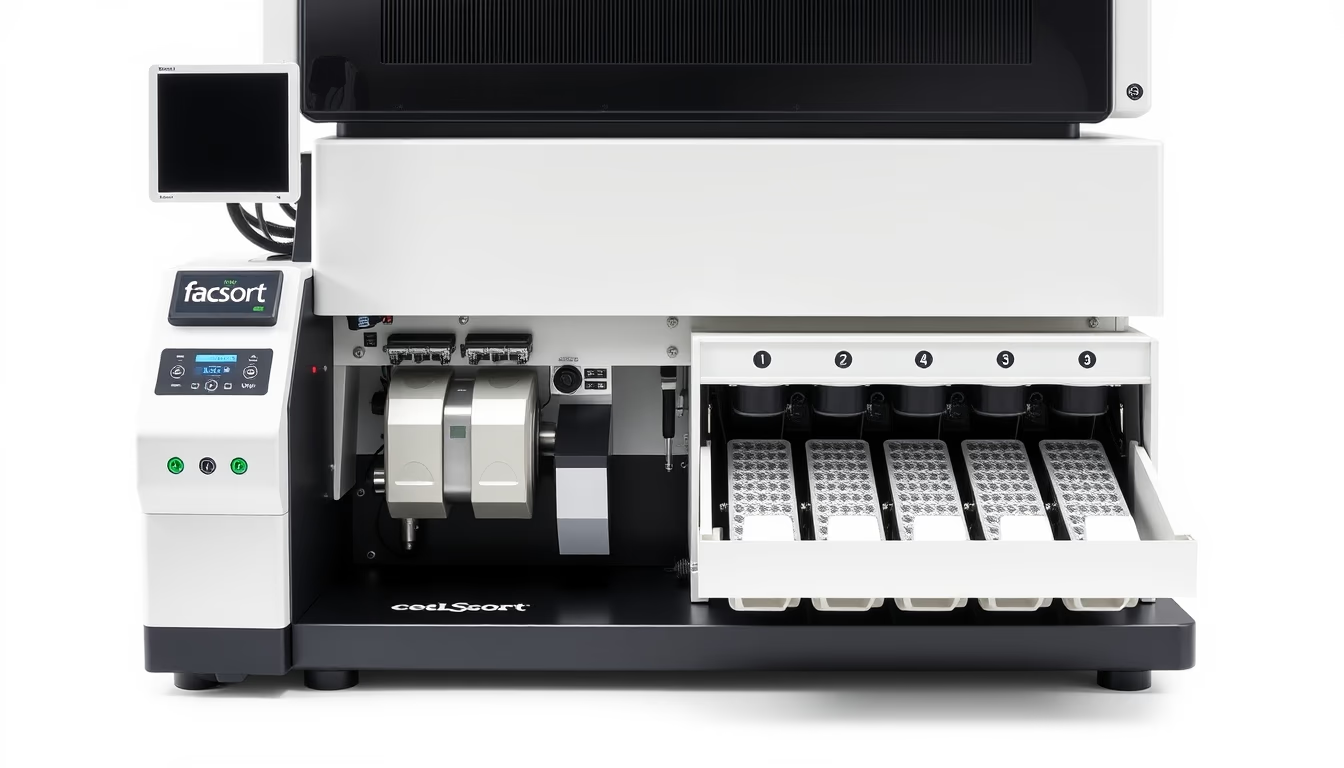
The FACS (Fluorescence-Activated Cell Sorting) machine is an essential tool in cell biology for separating specific cell populations based on fluorescent markers.
About this subject
FACS, or Fluorescence-Activated Cell Sorting, is an advanced flow cytometry technology that allows not only analysis but also physical separation of individual cells with high precision. The process begins by labeling cells with antibodies conjugated to fluorochromes, which emit fluorescence when excited by specific lasers. The machine directs cells through a laminar flow, where each cell is interrogated individually. Based on fluorescent signals and light scatter, an electrostatic deflection system sorts droplets containing the cells of interest into separate collection tubes.
The ability to isolate pure cell subpopulations is fundamental for numerous biomedical applications. In immunology, FACS is routinely used to separate T cells, B cells, and natural killers for functional and signaling studies. In stem cell research, it enables purification of cells with specific markers for tissue regeneration. It is also crucial in oncology for isolating circulating tumor cells or drug-resistant cancer cells. Additionally, FACS plays a vital role in the production of cell therapies such as CAR-T, where immune cells are genetically modified and need to be precisely selected.
Historically, the development of FACS dates back to the 1960s and 1970s, with pioneering contributions from Leonard Herzenberg and colleagues at Stanford University. Since then, the technology has evolved significantly: while early instruments sorted only a few hundred cells per second, modern systems can classify tens of thousands of cells per second, using multiple lasers and detectors to analyze 20 or more parameters simultaneously. This evolution has enabled increasingly complex applications, such as single-cell transcriptome analysis and the discovery of new cell types.
It is important to distinguish FACS from conventional flow cytometry: the latter only analyzes and provides data, while FACS includes physical separation, allowing cells to be recovered for culture, functional experiments, or sequencing. The purity and viability of collected cells are typically above 95%, making FACS indispensable in research and clinical laboratories that require highly purified cell populations.
Frequently Asked Questions
What does FACS stand for?
FACS stands for Fluorescence-Activated Cell Sorting. It is a flow cytometry technique that separates cells based on their fluorescent properties.
What is the difference between FACS and regular flow cytometry?
Regular flow cytometry only analyzes and provides data about cells, while FACS adds the ability to physically separate cells of interest, allowing their collection for further use.
What are the main applications of FACS?
FACS is widely used in immunology to isolate lymphocyte subpopulations, in stem cell research, in purifying tumor cells, and in the production of cell therapies such as CAR-T. It is also employed in diagnostics and cell cycle studies.
Direct URL
https://pub-c7d6a6ea828543ac903a74a341ccb2e1.r2.dev/imagens/cell-sorting-facs-machine-commercial-product-photography-p11.avifHow to credit
Include a visible link back to UtilizAí. Copy one of the snippets below:
<a href="https://xn--utiliza-eza.com/en/midia/imagens/cell-sorting-facs-machine-commercial-product-photography-p11">Cell sorting facs machine</a> by <a href="https://xn--utiliza-eza.com">UtilizAí</a>, licensed under <a href="https://creativecommons.org/licenses/by/4.0/">CC BY 4.0</a>.
[Cell sorting facs machine](https://xn--utiliza-eza.com/en/midia/imagens/cell-sorting-facs-machine-commercial-product-photography-p11) by [UtilizAí](https://xn--utiliza-eza.com), CC BY 4.0
License: CC-BY-4.0