Cell division microscope
1344×768 · AVIF · CC BY 4.0
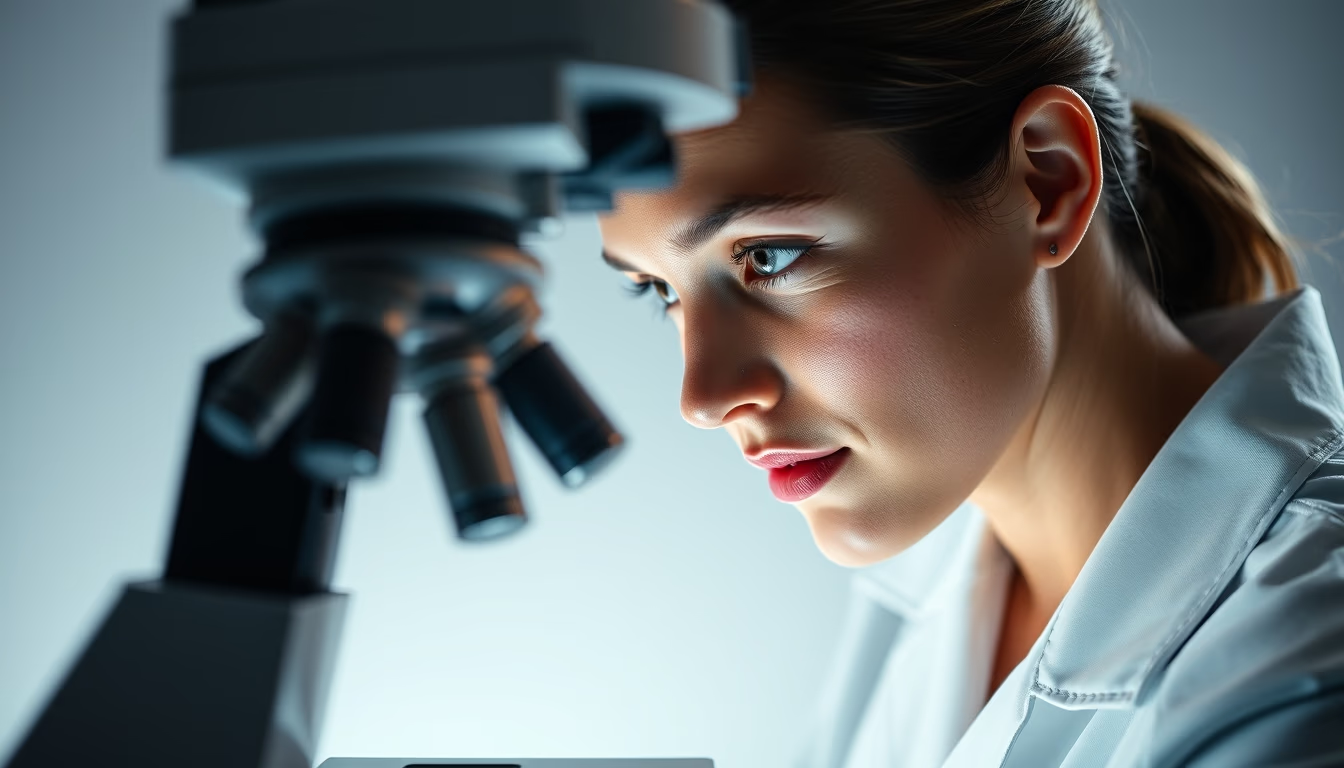
Cell division is the process by which a cell divides into two, essential for growth and tissue repair.
About this subject
Cell division is a fundamental process in all living organisms, enabling growth, development, and cellular renewal. In eukaryotic cells, mitosis is the type of division that produces two daughter cells genetically identical to the parent. The cell cycle consists of interphase (preparation) and the mitotic phase (actual division). During interphase, the cell duplicates its DNA and organelles. Mitosis is subdivided into prophase, metaphase, anaphase, and telophase, followed by cytokinesis, which separates the cytoplasm.
The discovery of the cell division mechanism dates back to the 19th century, with Rudolf Virchow formulating the principle "omnis cellula e cellula" (every cell arises from another cell). Optical microscopy allowed observation of chromosomes and the mitotic spindle. Today, advanced techniques such as fluorescence microscopy and time-lapse imaging reveal molecular details of the process.
Cell division is crucial in medical contexts: tumor growth is associated with uncontrolled proliferation; anticancer therapy often targets mitotic phases. Additionally, tissue regeneration such as skin and liver relies on cell division. In unicellular organisms, division is the primary mode of asexual reproduction.
Interesting fact: a human cell can complete mitosis in about 1-2 hours, but the full cell cycle lasts approximately 24 hours. Errors in division can lead to aneuploidies, such as in Down syndrome.
Frequently Asked Questions
What are the phases of mitosis?
Mitosis has four main phases: prophase, metaphase, anaphase, and telophase. In prophase, chromosomes condense and the mitotic spindle forms. In metaphase, chromosomes align at the equatorial plate. In anaphase, sister chromatids separate and move to poles. In telophase, nuclei reorganize and cytokinesis divides the cell.
Why is cell division important?
It is essential for organism growth, replacement of dead or damaged cells (e.g., skin and blood), tissue regeneration, and in unicellular organisms, reproduction.
What happens if cell division fails?
Errors in division can produce cells with an abnormal number of chromosomes (aneuploidy), linked to diseases such as cancer and genetic syndromes (e.g., Down syndrome). Cell cycle checkpoints attempt to correct errors, but are not always effective.
Direct URL
https://pub-c7d6a6ea828543ac903a74a341ccb2e1.r2.dev/imagens/cell-division-microscope-studio-editorial-portrait-p7.avifHow to credit
Include a visible link back to UtilizAí. Copy one of the snippets below:
<a href="https://xn--utiliza-eza.com/en/midia/imagens/cell-division-microscope-studio-editorial-portrait-p7">Cell division microscope</a> by <a href="https://xn--utiliza-eza.com">UtilizAí</a>, licensed under <a href="https://creativecommons.org/licenses/by/4.0/">CC BY 4.0</a>.
[Cell division microscope](https://xn--utiliza-eza.com/en/midia/imagens/cell-division-microscope-studio-editorial-portrait-p7) by [UtilizAí](https://xn--utiliza-eza.com), CC BY 4.0
License: CC-BY-4.0