CD discs spinning artistic
1344×768 · AVIF · CC BY 4.0

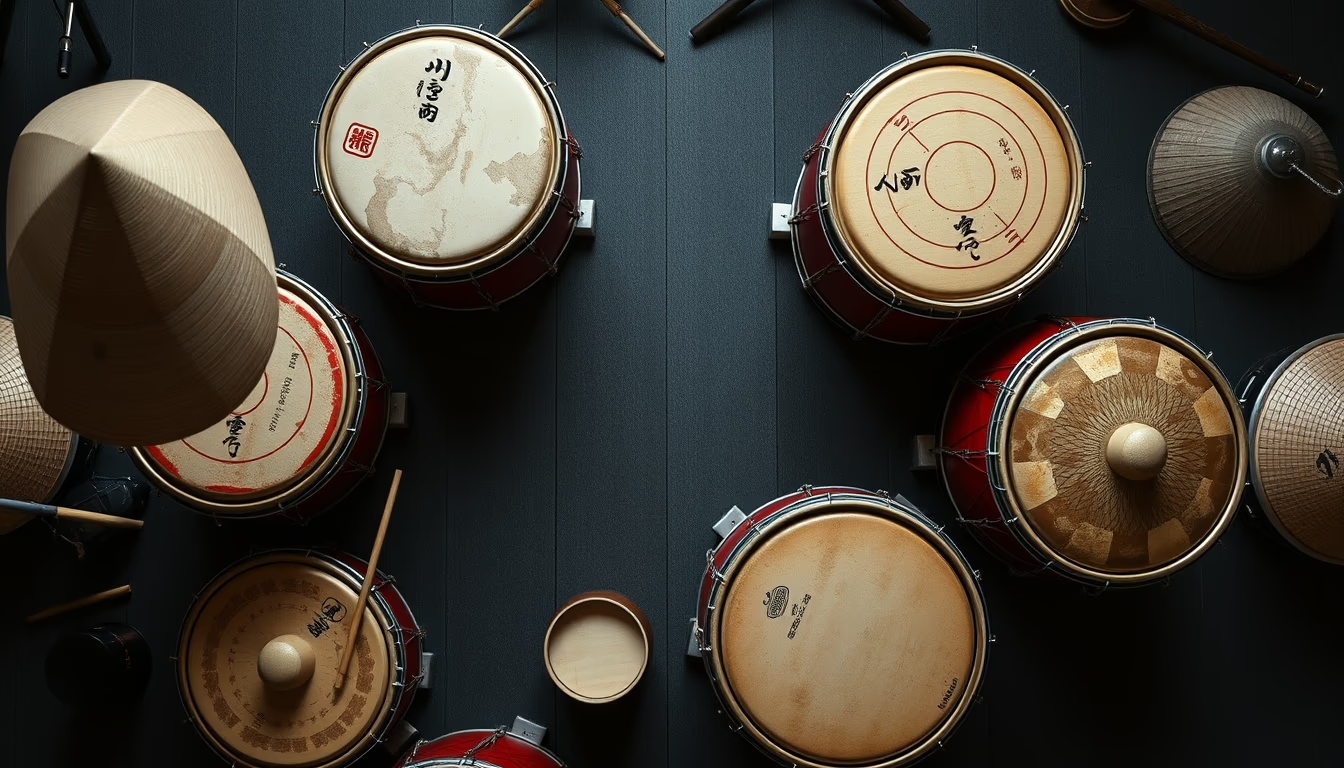
CDs, compact discs that revolutionized music in the 1980s, are explored in artistic compositions and minimalist performances, celebrating their aesthetics and digital legacy.
About this subject
The compact disc (CD) was commercially introduced in 1982 by Philips and Sony, ushering in the digital audio era. With a diameter of 120 mm and a capacity of 74 minutes of music, its standard was set to accommodate Beethoven's Ninth Symphony. The first pressed CD was Billy Joel's '52nd Street'. Throughout the 1990s and 2000s, CDs dominated the music market, selling billions of copies, but the rise of digital streaming reduced their commercial use.
The minimalist aesthetic of CDs, with their iridescent shine and smooth surface, inspires contemporary artists. In music performances, DJs use CDJs (CD players) to manipulate tracks in real time, creating loops and effects. In visual installations, discs are suspended or arranged in geometric patterns, generating light reflections that evoke movement and nostalgia.
Interestingly, the 74-minute capacity emerged because Sony's then-president Norio Ohga wanted to ensure a complete symphony could fit on a single disc. The CD also allowed features like track skipping and repeat, revolutionary for music consumption. Despite declining sales, the format is still used by audiophiles and in specific markets such as Japan and Germany, where uncompressed audio quality is valued.
In minimalist art, CDs are often used as ready-made objects, exploiting their circular shape and light-diffracting properties. Works like Christian Marclay's 'Spinning Discs' or installations by Céleste Boursier-Mougenot use the rotation of CDs to create sounds or hypnotic visual patterns. The object's simplicity contrasts with the technological complexity it represents, making the CD an icon of the analog-digital era.
Frequently Asked Questions
Why do CDs have a 74-minute capacity?
The capacity was set to accommodate Beethoven's Ninth Symphony, as requested by Sony's president Norio Ohga, who wanted the complete work on a single disc. The final 74-minute specification was a technical compromise between Philips and Sony.
Are CDs still used today?
Yes, although mass consumption has declined, CDs are still used by audiophiles, in markets like Japan and Germany, and in niches such as classical and jazz music, where uncompressed audio quality is valued. They are also employed in visual arts and performances.
How are CDs used in minimalist artistic compositions?
Artists arrange CDs in geometric patterns, spin them to create light reflections, or suspend them to generate shadows and movement. The reflective surface and circular shape allow for hypnotic visual effects, while rotation can be powered by motors or wind.
Direct URL
https://pub-c7d6a6ea828543ac903a74a341ccb2e1.r2.dev/imagens/cd-discs-spinning-artistic-minimalist-composition-p2.avifHow to credit
Include a visible link back to UtilizAí. Copy one of the snippets below:
<a href="https://xn--utiliza-eza.com/en/midia/imagens/cd-discs-spinning-artistic-minimalist-composition-p2">CD discs spinning artistic</a> by <a href="https://xn--utiliza-eza.com">UtilizAí</a>, licensed under <a href="https://creativecommons.org/licenses/by/4.0/">CC BY 4.0</a>.
[CD discs spinning artistic](https://xn--utiliza-eza.com/en/midia/imagens/cd-discs-spinning-artistic-minimalist-composition-p2) by [UtilizAí](https://xn--utiliza-eza.com), CC BY 4.0
License: CC-BY-4.0