Beetle iridescent green
1344×768 · AVIF · CC BY 4.0
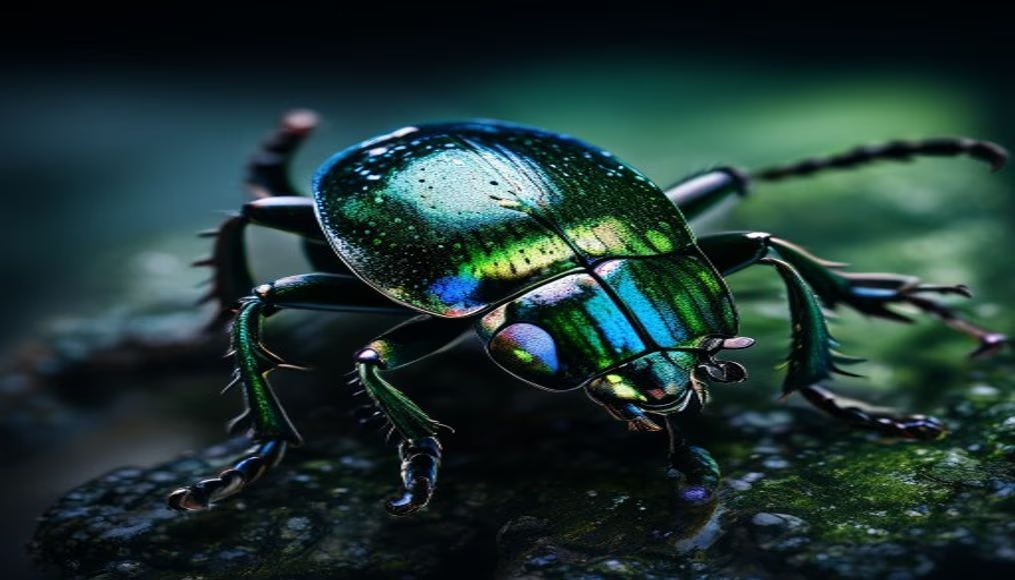
Iridescent green beetles display a rare optical phenomenon caused by nanoscale structures in their shells that refract light, creating shimmering colors.
About this subject
The iridescent green coloration in beetles is not produced by pigments but by microscopic structures in their exoskeletons that interfere with light. This phenomenon, known as structural coloration, occurs when thin layers of chitin and air are arranged in patterns that reflect specific wavelengths. In beetles like those from the family Buprestidae, commonly called jewel beetles, and scarabs (Scarabaeidae), the green iridescence is especially striking. These species are found in tropical forests of South America, Africa and Asia, where sunlight filtered through the canopy enhances their metallic hues.
The evolutionary function of iridescence varies. In many cases, it serves as camouflage against predators, mimicking shiny leaves or water surfaces. In others, it is used in mating rituals: males display their colors to attract females. Studies show that iridescence can also act as a warning signal to predators, indicating toxicity or unpleasant taste. Species like the green rose chafer (Cetonia aurata) are common in European gardens and exhibit a greenish sheen that changes with the viewing angle.
Culturally, iridescent beetles have always fascinated humans. Ancient Egyptians used green scarabs in amulets, believing in their protective powers. In contemporary art, their wings are used in jewelry and embroidery, as in Mexican traditions of escarabajos. Fine art photography often highlights these insects to explore textures and reflections. Conservation of their habitats, especially rainforests, is crucial as many species are threatened by deforestation and illegal collection trade.
Frequently Asked Questions
Why do iridescent green beetles change color when tilted?
The color change is due to structural coloration: nanoparticles in the shell reflect light at specific angles. Tilting alters the light path, revealing different wavelengths like blue, purple or gold.
Which iridescent green beetle is most famous in Brazil?
The green rose chafer (Cetonia aurata) is common in Brazilian gardens, but native species like the giant jewel beetle (Euchroma gigantea) are famous for their intense metallic green and are found in the Amazon.
Does green iridescence protect the beetle from predators?
Yes, in many cases. It can serve as camouflage against green backgrounds or as a warning signal (aposematism) if the beetle is toxic. Some predators learn to avoid brightly colored prey.
Direct URL
https://pub-c7d6a6ea828543ac903a74a341ccb2e1.r2.dev/imagens/beetle-iridescent-green-fine-art-photography-p0.avifHow to credit
Include a visible link back to UtilizAí. Copy one of the snippets below:
<a href="https://xn--utiliza-eza.com/en/midia/imagens/beetle-iridescent-green-fine-art-photography-p0">Beetle iridescent green</a> by <a href="https://xn--utiliza-eza.com">UtilizAí</a>, licensed under <a href="https://creativecommons.org/licenses/by/4.0/">CC BY 4.0</a>.
[Beetle iridescent green](https://xn--utiliza-eza.com/en/midia/imagens/beetle-iridescent-green-fine-art-photography-p0) by [UtilizAí](https://xn--utiliza-eza.com), CC BY 4.0
License: CC-BY-4.0