Beaker with colored chemicals
1344×768 · AVIF · CC BY 4.0
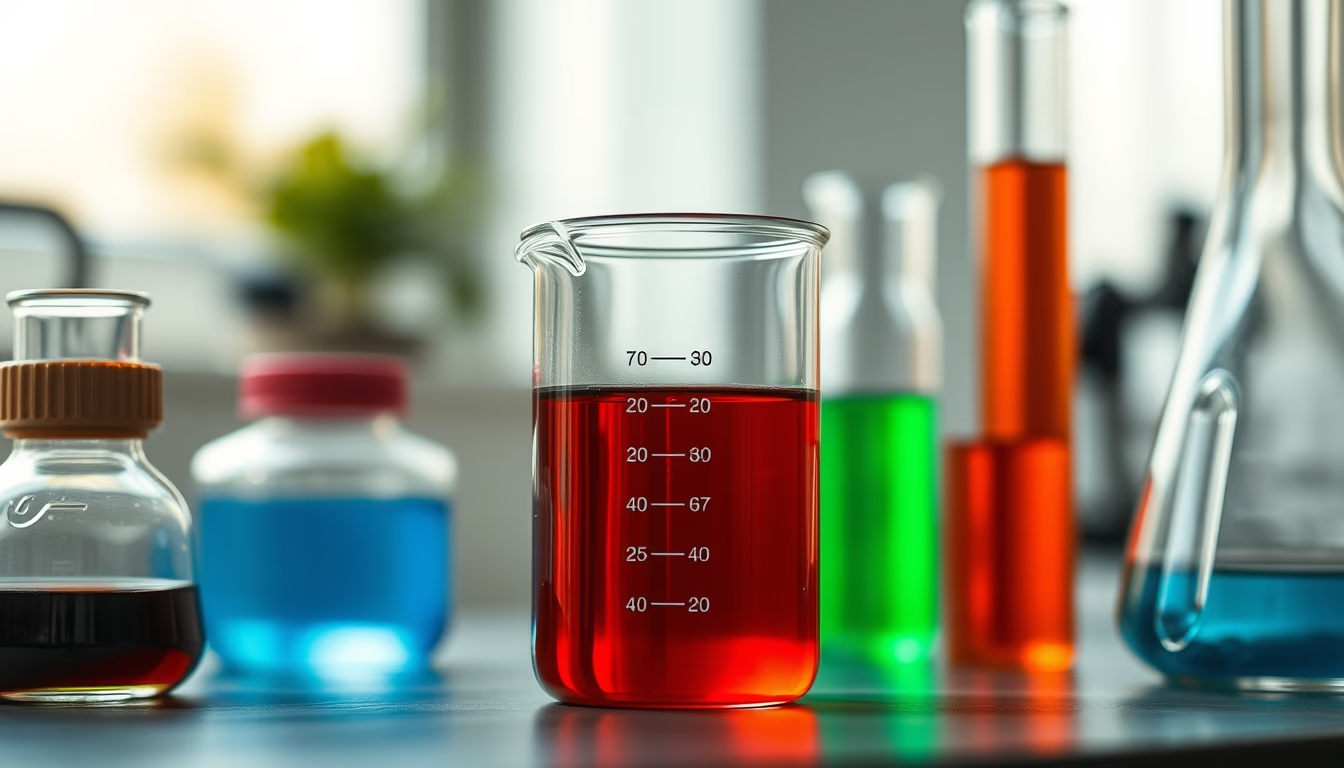
Glass beaker with layered colored liquids, a classic tool in chemistry and biology labs.
About this subject
The beaker is one of the most fundamental tools in chemistry, biology, and related laboratories. Typically made of borosilicate glass (such as Pyrex), it withstands thermal variations and moderate chemical attacks. Its cylindrical shape, with a wide mouth and a small spout for pouring, allows direct heating, stirring, and mixing of substances. The colored liquids in the image represent aqueous solutions with different indicators or dissolved salts, such as potassium permanganate (purple), copper sulfate (blue), and potassium dichromate (orange). These colors are often used in educational experiments to demonstrate oxidation-reduction reactions, pH, and solubility. In Brazil, beakers are common in high school and university chemistry labs, especially at institutions like USP and Unicamp, where undergraduate labs routinely perform titrations and solution preparation. Beaker capacities range from 50 mL to 2 L, and their graduated scale, though approximate, is useful for quick measurements. A curiosity: the modern beaker was patented by German chemist Friedrich August Kekulé in 1858, but similar versions existed since alchemy. The choice of colored liquids is not merely aesthetic; each color can indicate properties such as acidity (red for acidic pH with phenolphthalein) or the presence of metal ions. In analytical labs, beakers are used to prepare samples for spectrophotometry, where the absorbance of light by colored liquids is measured. Safety is also important: when heating, a wire gauze or heating mantle should be used to avoid thermal shock. The minimalist composition highlights the purity of colors and the simplicity of the equipment, evoking the essence of scientific experimentation.
Frequently Asked Questions
What is a beaker used for in a laboratory?
A beaker is used for mixing, heating, and measuring approximate volumes of liquids. Its wide mouth facilitates the addition of solids and the use of glass rods for stirring.
Why do the liquids in the beaker have different colors?
The colors come from dissolved substances, such as transition metal salts (blue copper, green nickel) or pH indicators (pink phenolphthalein in basic medium). Each color can identify an ion or chemical condition.
What is the difference between a beaker and an Erlenmeyer flask?
A beaker has a cylindrical shape with a wide mouth, ideal for mixing and heating. An Erlenmeyer flask has a conical shape and narrow neck, suitable for titrations and swirling without splashing.
Direct URL
https://pub-c7d6a6ea828543ac903a74a341ccb2e1.r2.dev/imagens/beaker-with-colored-chemicals-minimalist-composition.avifHow to credit
Include a visible link back to UtilizAí. Copy one of the snippets below:
<a href="https://xn--utiliza-eza.com/en/midia/imagens/beaker-with-colored-chemicals-minimalist-composition">Beaker with colored chemicals</a> by <a href="https://xn--utiliza-eza.com">UtilizAí</a>, licensed under <a href="https://creativecommons.org/licenses/by/4.0/">CC BY 4.0</a>.
[Beaker with colored chemicals](https://xn--utiliza-eza.com/en/midia/imagens/beaker-with-colored-chemicals-minimalist-composition) by [UtilizAí](https://xn--utiliza-eza.com), CC BY 4.0
License: CC-BY-4.0