Bacterial colony petri dish
1344×768 · AVIF · CC BY 4.0
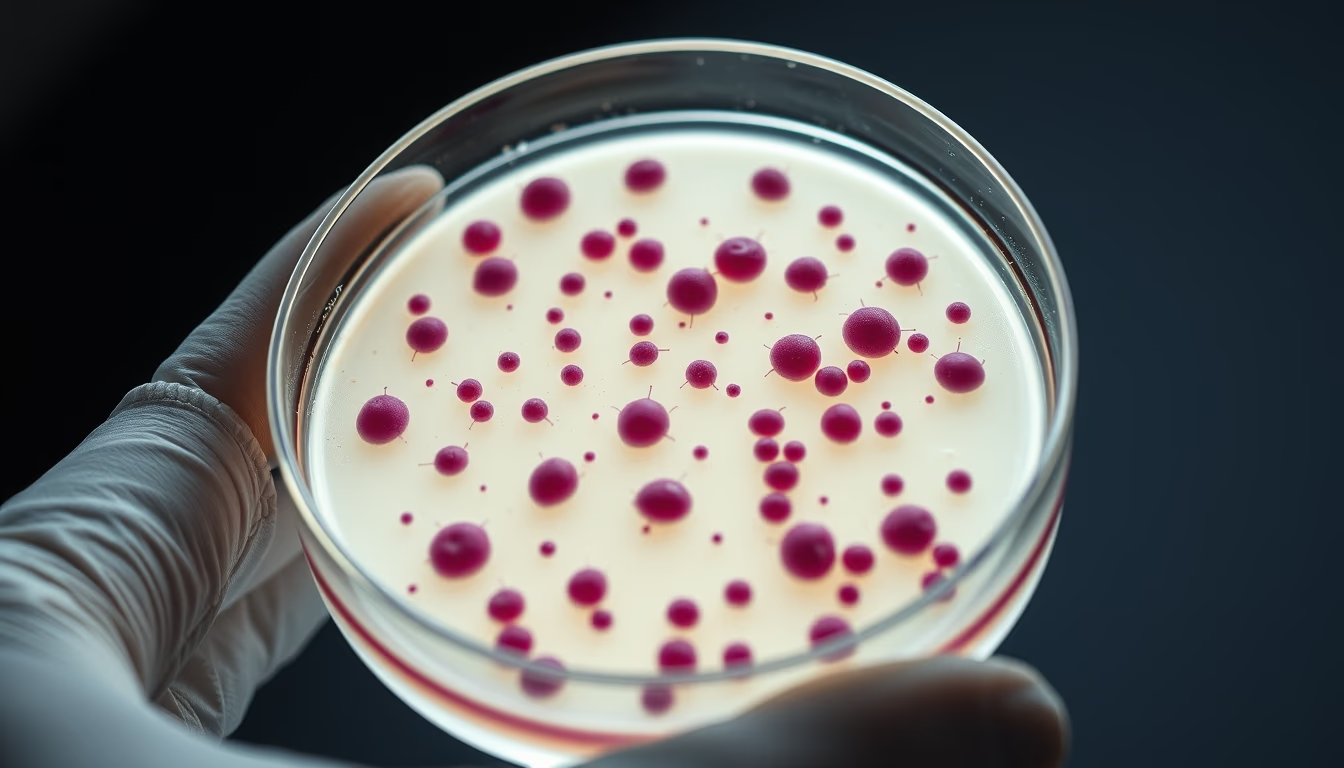
Bacterial colonies on a Petri dish reveal microbial growth patterns used in microbiology labs for identification and antibiotic resistance testing.
About this subject
A bacterial colony is a visible cluster of microorganisms originating from a single mother cell that multiplied on a solid culture medium. In microbiology labs, Petri dishes containing nutrient agar are inoculated with clinical, environmental, or food samples to isolate and identify bacteria. Each colony has its own characteristics: size, shape, margin, elevation, color, and texture, which aid in species differentiation.
The use of Petri dishes dates back to German bacteriologist Julius Richard Petri, an assistant to Robert Koch, who in 1887 adapted glass lids to cultivate microorganisms. Agar, extracted from seaweed, was introduced by Fanny Hesse, wife of scientist Walther Hesse, because it is not degraded by most bacteria and allows solid growth at incubation temperature. These innovations enabled the development of modern bacteriology.
In clinical practice, colony growth on plates is essential for antibiotic susceptibility tests, such as the disk diffusion method (Kirby-Bauer). Colony morphology, combined with Gram staining and biochemical tests, guides infection treatment. Different microorganisms produce distinct colonies: Staphylococcus aureus forms golden, hemolytic colonies, while Pseudomonas aeruginosa displays a blue-green color due to pyocyanin.
Beyond medicine, bacterial colony cultivation is fundamental in the food industry for quality control, environmental research for pollutant monitoring, and biotechnology for producing enzymes and recombinant proteins. Petri dishes with colonies are also used in educational experiments to demonstrate microbiology principles, such as the presence of microorganisms in the household environment.
Frequently Asked Questions
What is a bacterial colony?
A bacterial colony is a visible cluster of thousands or millions of genetically identical bacteria, originating from a single cell that reproduced asexually on a solid culture medium.
How do bacterial colonies form on a Petri dish?
After inoculating a sample on the agar surface, individual bacteria multiply by binary fission. Each cell gives rise to a visible colony after 24 to 48 hours of incubation at the appropriate temperature.
Why do bacterial colonies have different colors and shapes?
Colony characteristics (color, size, shape, margin, texture) depend on the bacterial species and its metabolic properties. For example, pigments like pyocyanin (blue) or prodigiosin (red) impart specific colors.
Direct URL
https://pub-c7d6a6ea828543ac903a74a341ccb2e1.r2.dev/imagens/bacterial-colony-petri-dish-studio-editorial-portrait-p3.avifHow to credit
Include a visible link back to UtilizAí. Copy one of the snippets below:
<a href="https://xn--utiliza-eza.com/en/midia/imagens/bacterial-colony-petri-dish-studio-editorial-portrait-p3">Bacterial colony petri dish</a> by <a href="https://xn--utiliza-eza.com">UtilizAí</a>, licensed under <a href="https://creativecommons.org/licenses/by/4.0/">CC BY 4.0</a>.
[Bacterial colony petri dish](https://xn--utiliza-eza.com/en/midia/imagens/bacterial-colony-petri-dish-studio-editorial-portrait-p3) by [UtilizAí](https://xn--utiliza-eza.com), CC BY 4.0
License: CC-BY-4.0