Bacterial colony petri dish
1344×768 · AVIF · CC BY 4.0
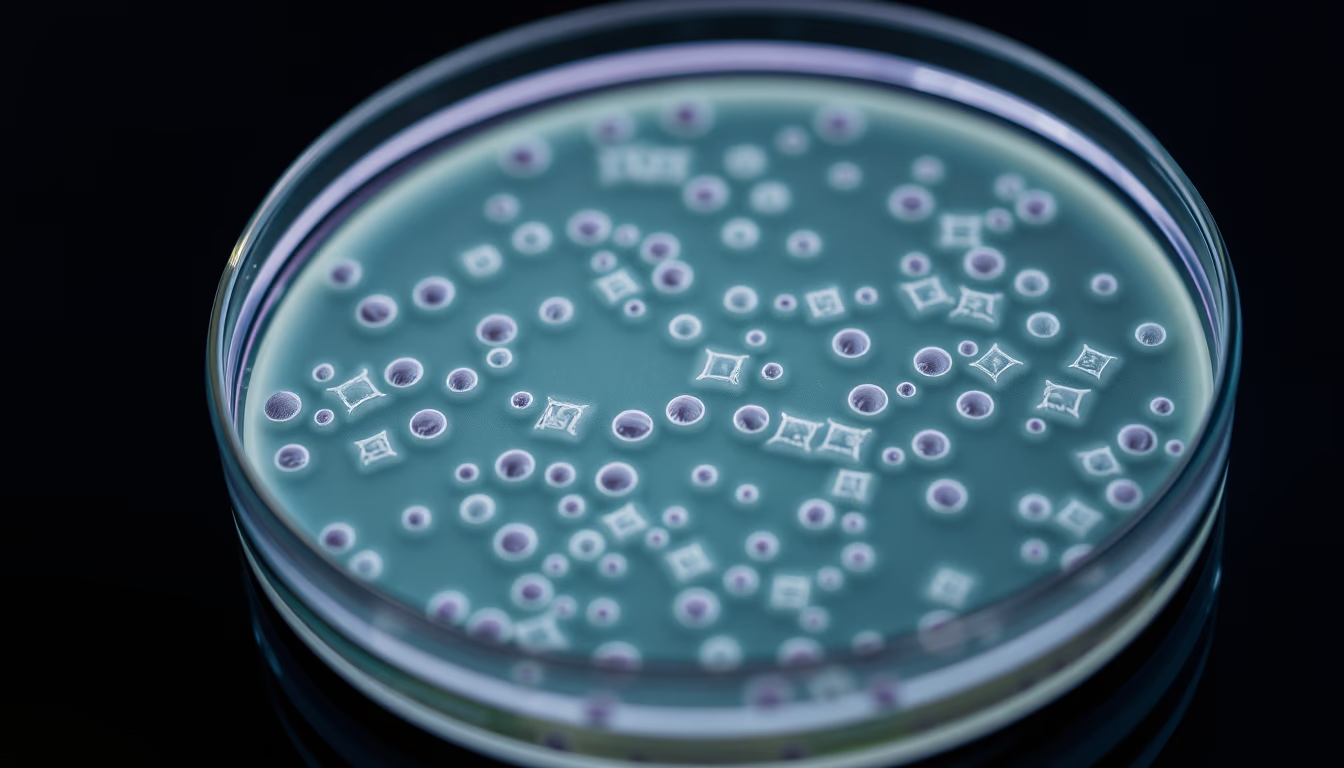
Bacterial colony grown on a Petri dish: understand how microorganisms form visible clusters on solid culture media.
About this subject
A bacterial colony is a visible cluster of millions of bacteria that originated from a single cell, growing on or within a solid culture medium, usually in a Petri dish. This growth occurs after 24 to 48 hours of incubation under controlled temperature and humidity. The streak plate technique allows the isolation of individual colonies, each representing a pure genetic and phenotypically homogeneous lineage. Observing colony characteristics, such as shape, margin, elevation, surface, color, and consistency, is fundamental for preliminary identification of bacterial species.
The Petri dish, invented in 1887 by German bacteriologist Julius Richard Petri, assistant to Robert Koch, revolutionized microbiology by enabling the cultivation of microorganisms on a semisolid agar medium. Agar, extracted from seaweed, is not digested by most bacteria and remains solid at incubation temperatures. Different culture media are used according to the need: nutrient agar is a general medium; blood agar allows detection of hemolysis; and selective media such as MacConkey agar differentiate enteric bacteria.
In laboratory practice, colony counting is used to estimate the number of viable microorganisms (Colony-Forming Units, CFU) in a sample, for example, in food, water, or clinical materials. Antibiotic sensitivity tests, like the Kirby-Bauer disk diffusion method, rely on observing inhibition zones around disks impregnated with antimicrobials. Colony morphology, combined with Gram staining and biochemical tests, forms the basis of classical bacterial identification.
Beyond clinical importance, the study of bacterial colonies is essential in biotechnology for selecting recombinant clones and in microbial ecology for assessing microbial populations in soil or water. The diversity of colony shapes and colors, from the opaque cream of Escherichia coli to the metallic green of Pseudomonas aeruginosa, illustrates the adaptive richness of the bacterial world.
Frequently Asked Questions
What is a bacterial colony?
It is a visible cluster of millions of bacteria, all descended from a single parent cell, growing on a solid culture medium such as agar in a Petri dish.
How are bacterial colonies cultivated in the laboratory?
The streak plate method is used with a bacteriological loop on a Petri dish containing sterilized culture medium. After incubation at 35-37°C for 24-48 hours, isolated colonies form.
Why are colony characteristics important?
Colony morphology (shape, margin, elevation, color, and texture) helps in the preliminary identification of bacterial species, guiding further tests such as Gram staining and biochemical assays.
Direct URL
https://pub-c7d6a6ea828543ac903a74a341ccb2e1.r2.dev/imagens/bacterial-colony-petri-dish-macro-closeup-p5.avifHow to credit
Include a visible link back to UtilizAí. Copy one of the snippets below:
<a href="https://xn--utiliza-eza.com/en/midia/imagens/bacterial-colony-petri-dish-macro-closeup-p5">Bacterial colony petri dish</a> by <a href="https://xn--utiliza-eza.com">UtilizAí</a>, licensed under <a href="https://creativecommons.org/licenses/by/4.0/">CC BY 4.0</a>.
[Bacterial colony petri dish](https://xn--utiliza-eza.com/en/midia/imagens/bacterial-colony-petri-dish-macro-closeup-p5) by [UtilizAí](https://xn--utiliza-eza.com), CC BY 4.0
License: CC-BY-4.0