Bacterial colony petri dish
1344×768 · AVIF · CC BY 4.0
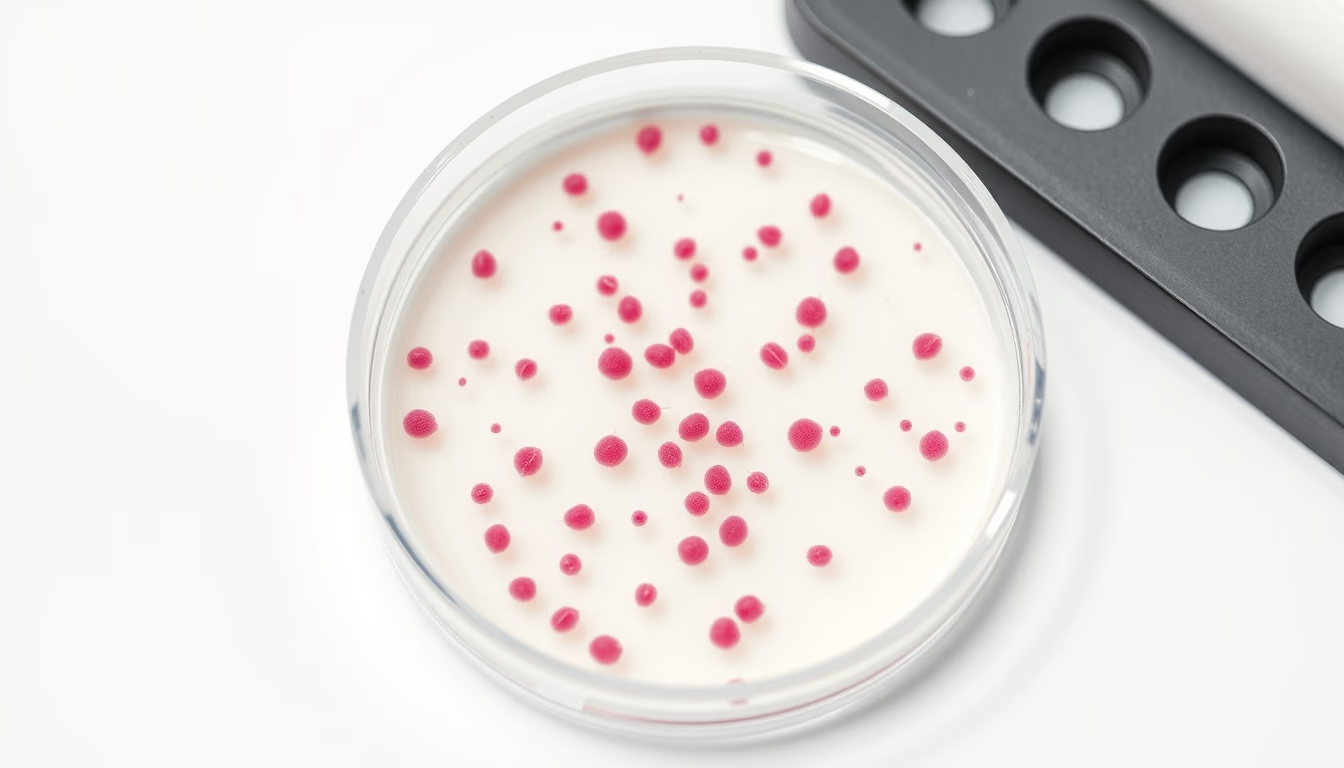
Petri dish with bacterial colonies growing on nutrient agar, demonstrating microbial culture in laboratory.
About this subject
Bacterial colonies observed in a petri dish are visible clusters of microorganisms growing on a solid culture medium, typically nutrient agar. Each colony originates from a single bacterial cell or a small cluster, which multiplies by binary fission to form a macroscopic aggregate. The shape, size, color, margin, and texture of colonies are important characteristics used for preliminary identification of bacterial species in clinical and environmental microbiology.
Cultivation in a petri dish is a fundamental technique developed by German bacteriologist Julius Richard Petri in 1887, who adapted a glass dish for use with solid culture media. Since then, it has become the standard method for isolating and enumerating bacteria, testing antibiotic effectiveness (antibiogram), and studying colonial morphology. Incubation conditions such as temperature, atmosphere (aerobic or anaerobic), and time directly influence colony growth and characteristics.
Colonies can display distinct colors due to the production of natural pigments, such as Pseudomonas aeruginosa producing pyocyanin (blue-green) or Serratia marcescens producing prodigiosin (red). Additionally, colonies can be smooth, rough, mucoid, translucent, or opaque, aiding in presumptive diagnosis. The study of bacterial colonies is essential for infection control, the food industry (detection of contaminants), and biotechnological research.
Frequently Asked Questions
What are bacterial colonies?
Bacterial colonies are visible clusters of bacteria growing on a solid culture medium such as agar. Each colony originates from a single bacterial cell that has multiplied by binary fission.
How are bacteria cultured in a petri dish?
Bacteria are cultured by inoculating a sample onto the surface of nutrient agar in a petri dish, followed by incubation under appropriate temperature and atmospheric conditions for 24 to 48 hours.
What is the purpose of bacterial culture in the laboratory?
Bacterial culture is used to identify microorganisms, test antibiotic sensitivity, quantify contamination in food, and conduct microbiological research.
Direct URL
https://pub-c7d6a6ea828543ac903a74a341ccb2e1.r2.dev/imagens/bacterial-colony-petri-dish-commercial-product-photography-p9.avifHow to credit
Include a visible link back to UtilizAí. Copy one of the snippets below:
<a href="https://xn--utiliza-eza.com/en/midia/imagens/bacterial-colony-petri-dish-commercial-product-photography-p9">Bacterial colony petri dish</a> by <a href="https://xn--utiliza-eza.com">UtilizAí</a>, licensed under <a href="https://creativecommons.org/licenses/by/4.0/">CC BY 4.0</a>.
[Bacterial colony petri dish](https://xn--utiliza-eza.com/en/midia/imagens/bacterial-colony-petri-dish-commercial-product-photography-p9) by [UtilizAí](https://xn--utiliza-eza.com), CC BY 4.0
License: CC-BY-4.0