Aurora borealis green sky
1344×768 · AVIF · CC BY 4.0
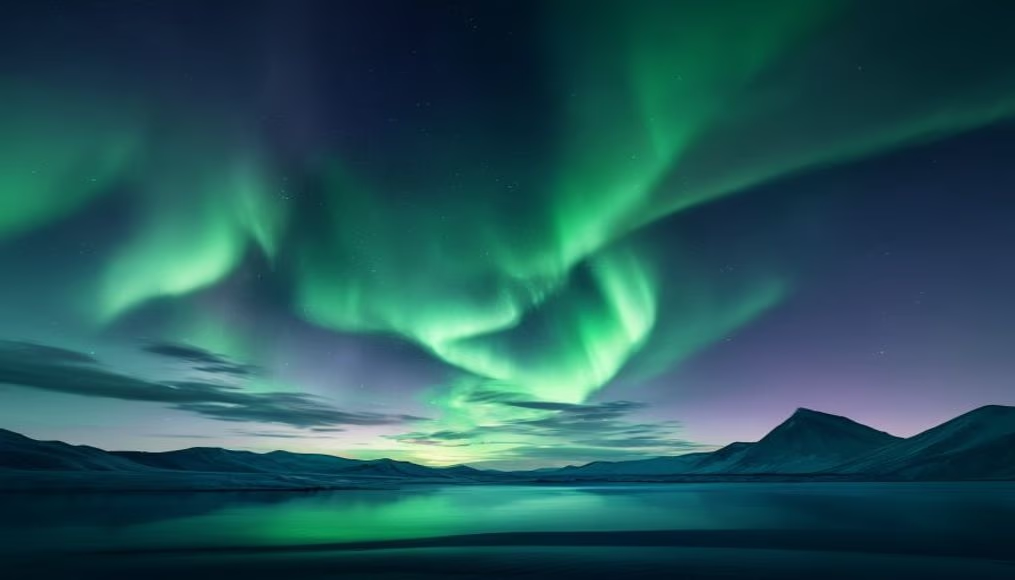
Green aurora borealis: a natural light display in polar skies, caused by solar particles interacting with Earth's atmosphere.
About this subject
The aurora borealis, or northern lights, is a luminous phenomenon occurring in polar regions. It results from charged solar wind particles colliding with atmospheric gases, exciting them and emitting light. The green color, most common, comes from oxygen at altitudes of 100, 300 km. The lights appear in various shapes such as curtains, arcs, or spirals, creating a unique spectacle.
The best time to observe auroras is from September to March, during the Northern Hemisphere winter. Locations near the Arctic Circle, such as Norway, Iceland, Canada, and Alaska, offer prime views. The southern lights (aurora australis) are visible from southern Australia and New Zealand. Optimal conditions require clear skies, complete darkness, and high solar activity, often measured by the Kp index.
Culturally, ancient peoples like the Vikings and Inuit attributed spiritual significance to the auroras. Scientifically, studying them advances understanding of Earth's magnetosphere and solar activity. Technologically, aurora photography demands advanced gear: cameras with high ISO sensitivity, wide-angle lenses, and sturdy tripods. The phenomenon's popularity boosts aurora tourism, driving travel and camera equipment industries.
Interestingly, aurora intensity follows the 11-year solar cycle. The solar maximum expected in 2024, 2025 increases chances of spectacular displays. Besides green, auroras can appear red, blue, or purple, depending on the gas (oxygen or nitrogen) and altitude. Real-time data from apps and websites helps enthusiasts predict occurrences and plan expeditions.
Frequently Asked Questions
What causes the green color in the aurora borealis?
The green color results from oxygen at altitudes of 100, 300 km. Oxygen molecules emit green light when they return to their ground state after collisions with solar particles.
What is the best time to see the northern lights?
The best period is from September to March, during the Northern Hemisphere winter, when nights are long and dark.
Where can I see auroras in the world?
Top locations near the Arctic Circle include Norway, Iceland, Canada, Alaska, Sweden, Finland, and Greenland. In the Southern Hemisphere, the aurora australis is visible from southern Australia, New Zealand, and Antarctica.
Direct URL
https://pub-c7d6a6ea828543ac903a74a341ccb2e1.r2.dev/imagens/aurora-borealis-green-sky-commercial-product-photography-v9.avifHow to credit
Include a visible link back to UtilizAí. Copy one of the snippets below:
<a href="https://xn--utiliza-eza.com/en/midia/imagens/aurora-borealis-green-sky-commercial-product-photography-v9">Aurora borealis green sky</a> by <a href="https://xn--utiliza-eza.com">UtilizAí</a>, licensed under <a href="https://creativecommons.org/licenses/by/4.0/">CC BY 4.0</a>.
[Aurora borealis green sky](https://xn--utiliza-eza.com/en/midia/imagens/aurora-borealis-green-sky-commercial-product-photography-v9) by [UtilizAí](https://xn--utiliza-eza.com), CC BY 4.0
License: CC-BY-4.0