AI neural network glowing nodes and connections in 3D space
1344×768 · AVIF · CC BY 4.0
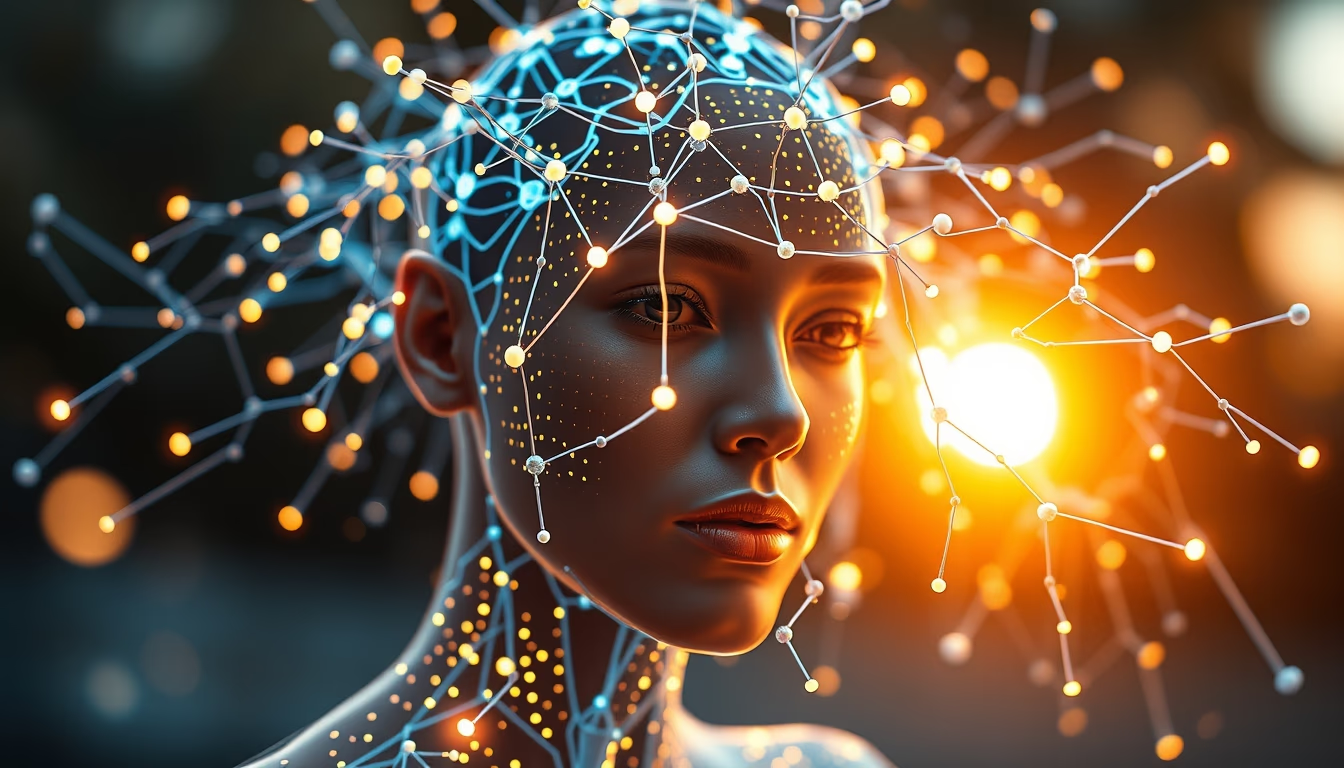
Artificial neural networks are computational structures inspired by the human brain, with nodes and connections that process data in deep learning.
About this subject
Artificial neural networks form the foundation of deep learning, a subfield of artificial intelligence that has revolutionized sectors such as computer vision, natural language processing, and medical diagnosis. Inspired by the human brain, these networks consist of layers of nodes (artificial neurons) interconnected by weighted synapses. Each connection has a weight that is adjusted during training, allowing the network to learn complex patterns from large volumes of data.
The concept of neural networks dates back to the 1940s with the McCulloch-Pitts model, but gained practical traction in the 2000s with increased computational power and data availability. Today, architectures like convolutional neural networks (CNNs) and recurrent neural networks (RNNs) are widely used. CNNs are essential in image recognition systems, while RNNs are applied in machine translation and time series analysis.
A curiosity: the term "deep learning" refers to the use of many hidden layers between the input and output of the network. The more layers, the greater the depth and abstraction capability. However, very deep networks can suffer from overfitting or vanishing gradients, problems that techniques like dropout and batch normalization help mitigate. Training these networks requires specialized hardware such as GPUs and TPUs, as well as large labeled datasets.
Globally, companies like Google, Meta, and OpenAI invest billions in neural network research, resulting in advances such as GPT-4 and DALL-E. In Brazil, institutions like USP and CBPF develop applied research in areas like agribusiness and healthcare, showing that the technology is cross-cutting and accessible.
Frequently Asked Questions
What are artificial neural networks?
They are computational models inspired by the human brain, composed of nodes (neurons) and weighted connections that learn patterns from data.
What is the difference between machine learning and deep learning?
Deep learning is a subfield of machine learning that uses neural networks with multiple hidden layers, allowing greater abstraction and learning capability.
Where are neural networks applied in daily life?
In facial recognition, virtual assistants (like Siri and Alexa), movie recommendations (Netflix), medical diagnostics, and autonomous cars.
Direct URL
https://pub-c7d6a6ea828543ac903a74a341ccb2e1.r2.dev/imagens/ai-neural-network-glowing-nodes-and-connections-in-3d-space-editorial-portrait-golden-hour-late-afternoon.avifHow to credit
Include a visible link back to UtilizAí. Copy one of the snippets below:
<a href="https://xn--utiliza-eza.com/en/midia/imagens/ai-neural-network-glowing-nodes-and-connections-in-3d-space-editorial-portrait-golden-hour-late-afternoon">AI neural network glowing nodes and connections in 3D space</a> by <a href="https://xn--utiliza-eza.com">UtilizAí</a>, licensed under <a href="https://creativecommons.org/licenses/by/4.0/">CC BY 4.0</a>.
[AI neural network glowing nodes and connections in 3D space](https://xn--utiliza-eza.com/en/midia/imagens/ai-neural-network-glowing-nodes-and-connections-in-3d-space-editorial-portrait-golden-hour-late-afternoon) by [UtilizAí](https://xn--utiliza-eza.com), CC BY 4.0
License: CC-BY-4.0