AI neural network glowing nodes and connections in 3D space
1344×768 · AVIF · CC BY 4.0
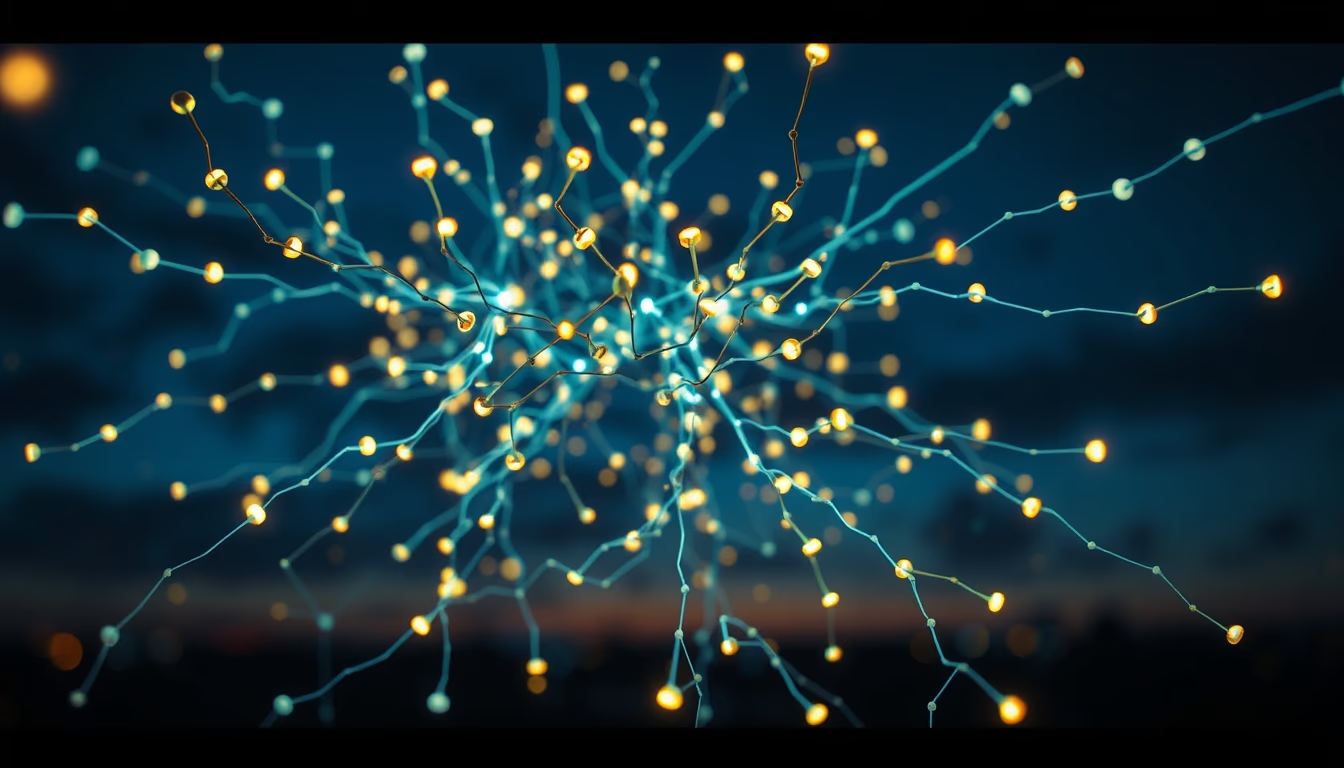
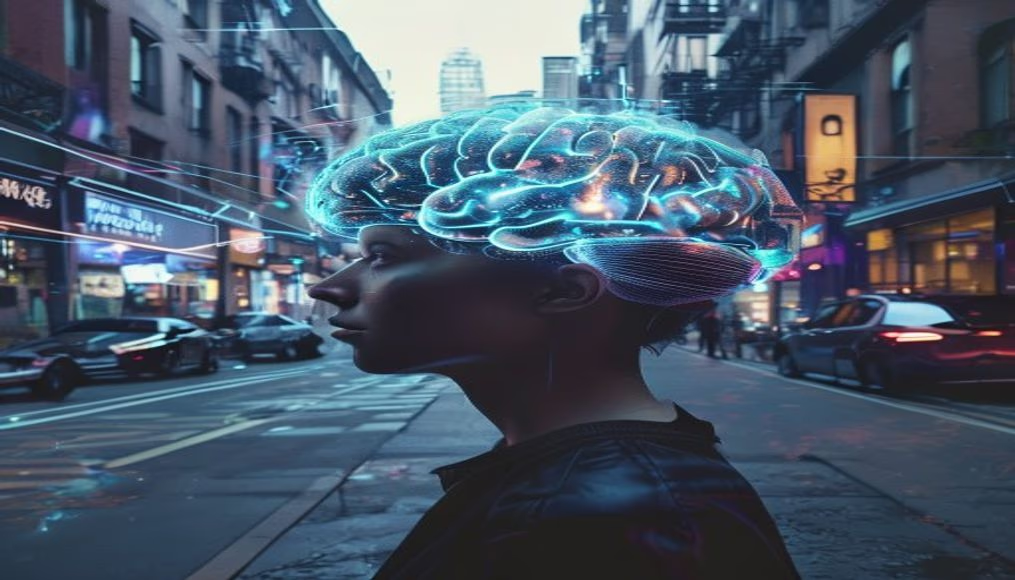
Artificial neural network depicted as glowing nodes and connections in a dark 3D space, evoking the inner workings of AI models.
About this subject
Artificial neural networks are the backbone of modern artificial intelligence. Inspired by the human brain, they consist of layers of artificial neurons connected by weighted synapses. Each glowing node in the image represents a neuron, and the luminous lines symbolize the synaptic connections through which data flows. The dark 3D space suggests the computational abstraction where these models operate, processing information in parallel to recognize patterns, make decisions, or generate content.
The concept of neural networks dates back to the 1940s with the McCulloch-Pitts model, but deep learning only took off in the 2010s thanks to GPUs and large datasets. Today, architectures like transformers (GPT, BERT) and convolutional neural networks (CNNs) power everything from virtual assistants to self-driving cars. The visual representation of nodes and connections is often used to explain how these systems work, though real complexity involves millions of parameters tuned during training.
In the context of documentary photography, the image captures the aesthetics of technology in blue and purple tones, reminiscent of the twilight blue hour. This color choice is not accidental: blue evokes calm and depth, while bright lights suggest activity and intelligence. The three-dimensional composition gives a sense of immersion, as if the observer is inside the network, witnessing data flow in real time.
Interestingly, the anomaly detection tag mentioned may refer to a specific use of neural networks: identifying unusual patterns in data, such as fraud or technical failures. Models like autoencoders are trained to reconstruct normal inputs; when an input diverges, reconstruction error increases, signaling an anomaly. This application is vital in cybersecurity, manufacturing, and healthcare, where detecting the unexpected can prevent disasters.
Frequently Asked Questions
What is an artificial neural network?
It is a computational model inspired by the human brain, composed of artificial neurons organized in layers. Each neuron receives inputs, applies weights and an activation function, and passes the result forward. Training adjusts these weights to minimize errors.
How does deep learning differ from traditional neural networks?
Deep learning uses networks with many hidden layers (deep), capable of learning complex hierarchical representations. This allows handling unstructured data like images, audio, and text, while shallow networks are limited to simpler problems.
What does anomaly detection mean in neural networks?
It is the task of identifying data points that deviate from the expected pattern. Models like autoencoders learn to reconstruct normal data; anomalies yield high reconstruction error. It is used in fraud, medical diagnosis, and industrial monitoring.
Direct URL
https://pub-c7d6a6ea828543ac903a74a341ccb2e1.r2.dev/imagens/ai-neural-network-glowing-nodes-and-connections-in-3d-space-documentary-photography-twilight-blue-hour.avifHow to credit
Include a visible link back to UtilizAí. Copy one of the snippets below:
<a href="https://xn--utiliza-eza.com/en/midia/imagens/ai-neural-network-glowing-nodes-and-connections-in-3d-space-documentary-photography-twilight-blue-hour">AI neural network glowing nodes and connections in 3D space</a> by <a href="https://xn--utiliza-eza.com">UtilizAí</a>, licensed under <a href="https://creativecommons.org/licenses/by/4.0/">CC BY 4.0</a>.
[AI neural network glowing nodes and connections in 3D space](https://xn--utiliza-eza.com/en/midia/imagens/ai-neural-network-glowing-nodes-and-connections-in-3d-space-documentary-photography-twilight-blue-hour) by [UtilizAí](https://xn--utiliza-eza.com), CC BY 4.0
License: CC-BY-4.0