AI neural network glowing nodes and connections in 3D space
1344×768 · AVIF · CC BY 4.0
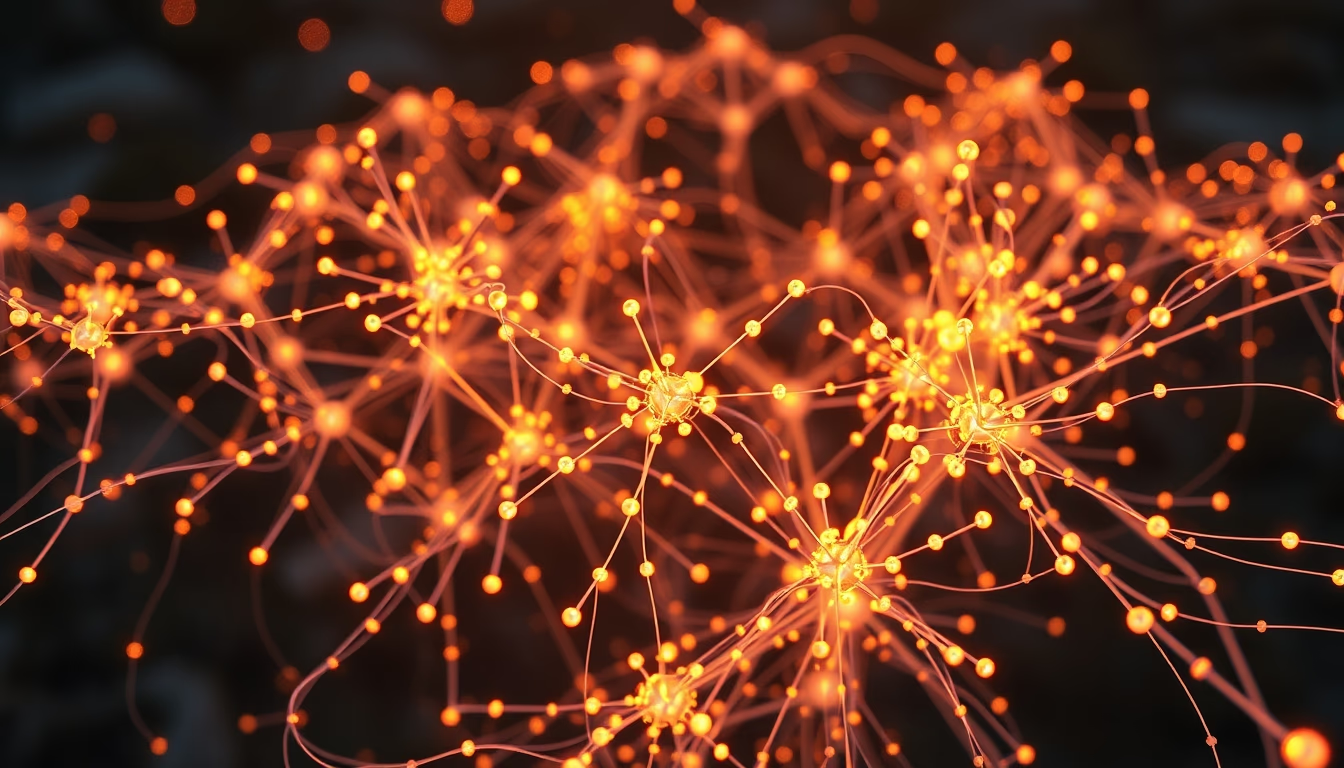
Artificial neural networks are computational structures inspired by the human brain, with interconnected nodes processing data for machine learning.
About this subject
Artificial neural networks form the backbone of deep learning, a subfield of artificial intelligence that revolutionized areas like computer vision and natural language processing. Inspired by biological neurons, these networks consist of layers of nodes (artificial neurons) connected by weighted synapses, which adjust their weights during training to minimize errors. The concept dates back to the 1940s with the McCulloch-Pitts model, but gained practical traction only in the 2010s, thanks to GPUs and large datasets.
Each node receives inputs, applies an activation function, and produces an output that feeds the next layer. Deep networks have dozens or hundreds of hidden layers, enabling extraction of increasingly abstract feature hierarchies. For example, in image recognition, early layers detect edges, middle layers detect shapes, and final layers detect complete objects. This process mirrors the human visual cortex.
In Brazil, neural network use grows in sectors like agribusiness (crop yield prediction), healthcare (medical imaging diagnosis), and finance (fraud detection). Despite the potential, challenges remain: need for large labeled datasets, high computational cost, and lack of interpretability, motivating research in explainable AI. The image, with its glowing nodes and connections in 3D space, symbolizes the complexity and dynamism of these systems.
Frequently Asked Questions
What differentiates a simple neural network from a deep neural network?
A simple neural network has few hidden layers (usually one), while a deep network has many layers, enabling it to learn more complex and abstract representations of data.
What are the main applications of neural networks in Brazil?
In Brazil, neural networks are used in agribusiness for crop yield prediction, in healthcare for diagnosing diseases from images, and in finance for detecting fraud in transactions.
How does an artificial neural network learn?
It learns by adjusting the weights of connections between neurons through a process called backpropagation, which minimizes the error between predicted and actual output using labeled data.
Direct URL
https://pub-c7d6a6ea828543ac903a74a341ccb2e1.r2.dev/imagens/ai-neural-network-glowing-nodes-and-connections-in-3d-space-aerial-drone-shot-golden-hour-late-afternoon.avifHow to credit
Include a visible link back to UtilizAí. Copy one of the snippets below:
<a href="https://xn--utiliza-eza.com/en/midia/imagens/ai-neural-network-glowing-nodes-and-connections-in-3d-space-aerial-drone-shot-golden-hour-late-afternoon">AI neural network glowing nodes and connections in 3D space</a> by <a href="https://xn--utiliza-eza.com">UtilizAí</a>, licensed under <a href="https://creativecommons.org/licenses/by/4.0/">CC BY 4.0</a>.
[AI neural network glowing nodes and connections in 3D space](https://xn--utiliza-eza.com/en/midia/imagens/ai-neural-network-glowing-nodes-and-connections-in-3d-space-aerial-drone-shot-golden-hour-late-afternoon) by [UtilizAí](https://xn--utiliza-eza.com), CC BY 4.0
License: CC-BY-4.0