AI neural network glowing nodes and connections in 3D space
1344×768 · AVIF · CC BY 4.0
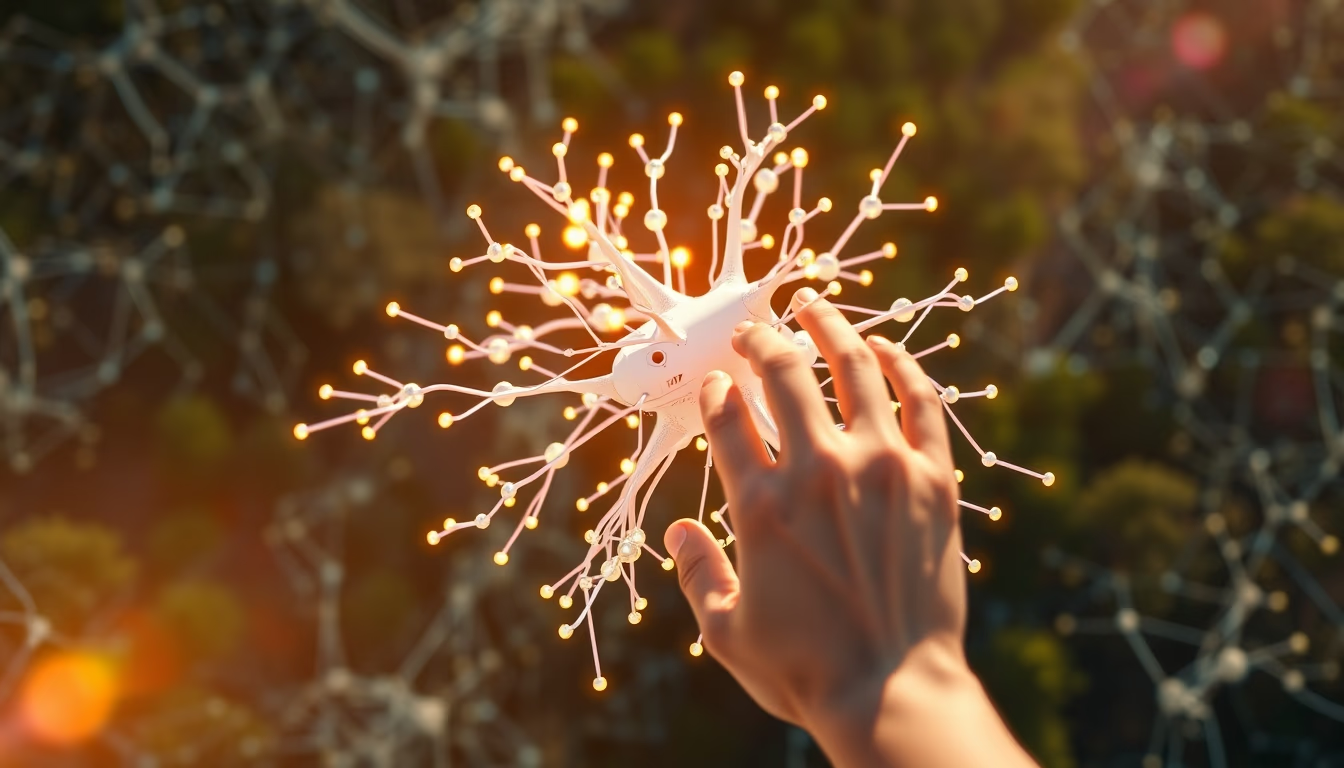
Artificial neural networks are computational models inspired by the human brain, capable of learning complex patterns from data.
About this subject
Artificial neural networks form the basis of deep learning, a subfield of artificial intelligence that has revolutionized areas such as computer vision, natural language processing, and speech recognition. They consist of layers of interconnected nodes, or artificial neurons, that process information similarly to biological neurons. Each connection has a weight that is adjusted during training, allowing the network to learn to map inputs to desired outputs.
The concept of neural networks dates back to the 1940s with the McCulloch-Pitts model, but they became practical only in the 2000s, thanks to increased computational power and the availability of large datasets. Today, applications range from medical diagnostics to recommendation systems on streaming platforms. The most common architecture is the feedforward neural network, where data flows in one direction, from the input layer to the output layer.
A notable curiosity is that deep neural networks can have hundreds of hidden layers, as in GPT-3, which has 175 billion parameters. Training these networks requires immense computational power, often using specialized GPUs or TPUs. Techniques such as dropout and batch normalization help prevent overfitting, ensuring the model generalizes well to new data.
However, neural networks also face challenges, such as lack of interpretability, they are often considered black boxes. Advances in explainable AI aim to make these decisions more transparent. Despite this, their impact is undeniable, driving innovations in autonomous vehicles, virtual assistants, and even artistic creation.
Frequently Asked Questions
What is an artificial neural network?
It is a computational model inspired by the human brain, composed of layers of interconnected nodes that process data and learn patterns by adjusting connection weights.
What are the applications of neural networks?
They are used in image and speech recognition, medical diagnostics, autonomous vehicles, recommendation systems, natural language processing, and more.
How do neural networks learn?
They learn by adjusting connection weights during training, minimizing the difference between predicted and actual outputs using algorithms like backpropagation.
Direct URL
https://pub-c7d6a6ea828543ac903a74a341ccb2e1.r2.dev/imagens/ai-neural-network-glowing-nodes-and-connections-in-3d-space-aerial-drone-shot-bright-midday-sun.avifHow to credit
Include a visible link back to UtilizAí. Copy one of the snippets below:
<a href="https://xn--utiliza-eza.com/en/midia/imagens/ai-neural-network-glowing-nodes-and-connections-in-3d-space-aerial-drone-shot-bright-midday-sun">AI neural network glowing nodes and connections in 3D space</a> by <a href="https://xn--utiliza-eza.com">UtilizAí</a>, licensed under <a href="https://creativecommons.org/licenses/by/4.0/">CC BY 4.0</a>.
[AI neural network glowing nodes and connections in 3D space](https://xn--utiliza-eza.com/en/midia/imagens/ai-neural-network-glowing-nodes-and-connections-in-3d-space-aerial-drone-shot-bright-midday-sun) by [UtilizAí](https://xn--utiliza-eza.com), CC BY 4.0
License: CC-BY-4.0