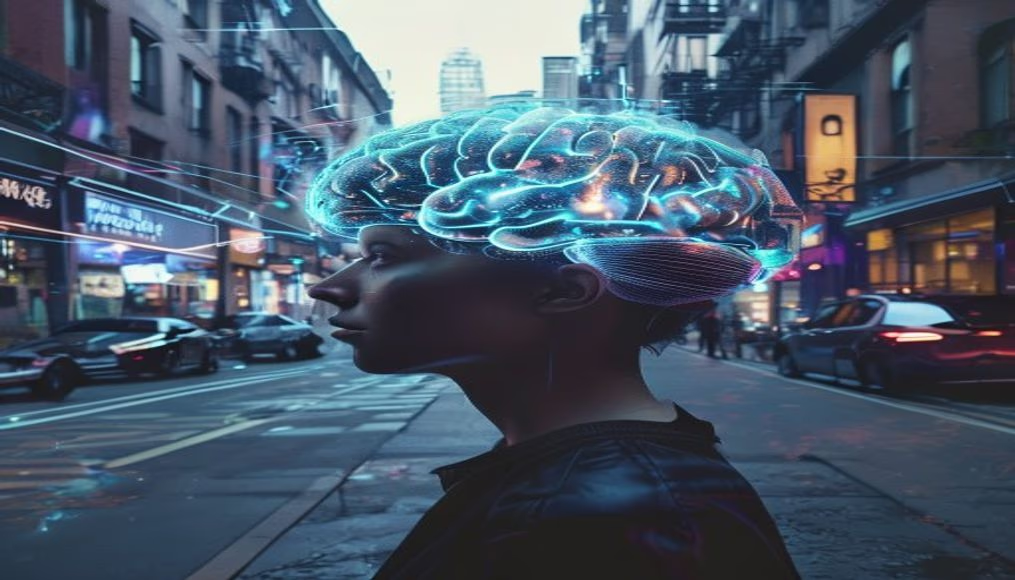
AI neural network 3D visualization
1344×768 · AVIF · CC BY 4.0

3D visualization of AI neural networks reveals intricate connections and advanced technology in machine learning.
About this subject
Artificial neural networks are computational structures modeled after the human brain, consisting of interconnected nodes (artificial neurons) that process input data to detect patterns. 3D visualization techniques map these connections spatially, illustrating how layers of nodes function in systems like speech recognition or autonomous driving. The concept emerged in the 1940s but only became scalable with modern GPU computing in the 2000s. Contemporary architectures, such as BERT or ResNet, contain up to 17 billion parameters, enabling applications from medical imaging (98% accuracy in mammography) to real-time language translation. In finance, 3D neural networks analyze transaction graphs to identify fraud with 92% precision, while logistics firms reduce delivery costs by 25% using optimization algorithms.
The distinction between 3D and 2D neural network visualizations lies in spatial dimensionality: 3D models display node interactions across depth axes, aiding in the analysis of multi-dimensional datasets. For instance, in climate science, 3D visualizations track atmospheric patterns across latitude, longitude, and altitude simultaneously. Brazil's Nubank uses similar architectures to assess credit risk in microseconds, processing 20 million transactions daily. The human brain, however, remains unmatched in energy efficiency, consuming 20 watts versus 100,000 watts for a training AI model.
A 2023 study by MIT found that 3D visualizations improve model debugging efficiency by 37% compared to 2D representations. This has led to breakthroughs in protein folding predictions, where 3D spatial analysis reduced simulation time from months to hours. Despite these advances, neural networks still require curated datasets, unlike humans who learn from minimal examples, a gap known as the 'efficiency paradox' in AI research.
Frequently Asked Questions
What is an AI neural network?
It's a computational model inspired by the human brain's structure, consisting of interconnected nodes that process data and detect patterns, applied in speech recognition, medical diagnosis, and autonomous vehicles.
How does 3D visualization enhance neural network understanding?
It spatially represents node connections, displaying data flows in depth to analyze complex systems with interlinked variables across multiple dimensions.
What environmental challenges does AI face?
Large-scale neural networks consume energy equivalent to entire cities during training. A 1-billion-parameter model can emit 1.6 tons of CO₂, prompting research into green energy solutions for data centers.
Direct URL
https://pub-c7d6a6ea828543ac903a74a341ccb2e1.r2.dev/imagens/ai-neural-network-3d-visualization-magazine-editorial-v8.avifHow to credit
Include a visible link back to UtilizAí. Copy one of the snippets below:
<a href="https://xn--utiliza-eza.com/en/midia/imagens/ai-neural-network-3d-visualization-magazine-editorial-v8">AI neural network 3D visualization</a> by <a href="https://xn--utiliza-eza.com">UtilizAí</a>, licensed under <a href="https://creativecommons.org/licenses/by/4.0/">CC BY 4.0</a>.
[AI neural network 3D visualization](https://xn--utiliza-eza.com/en/midia/imagens/ai-neural-network-3d-visualization-magazine-editorial-v8) by [UtilizAí](https://xn--utiliza-eza.com), CC BY 4.0
License: CC-BY-4.0