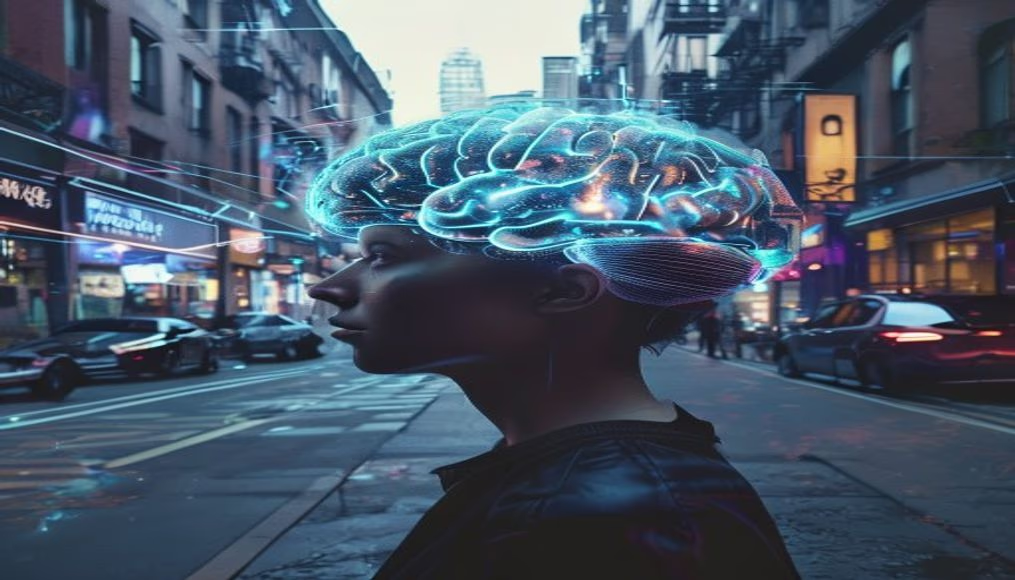
AI brain visualization holographic
1344×768 · AVIF · CC BY 4.0

Holographic brain visualizations combine artificial intelligence and neuroscience to map neural activity in real time, revolutionizing diagnostics and brain-machine interfaces.
About this subject
Holographic brain visualization assisted by artificial intelligence represents a significant advance in modern neuroscience. Techniques such as holographic tomography allow real-time three-dimensional imaging of neural activity without invasive procedures. AI algorithms process this data, identifying neuronal firing patterns and correlating them with specific cognitive functions. This approach has been applied in labs like the MIT Media Lab and the Allen Institute for Brain Science, where deep learning models are trained to decode neural signals with millimeter precision.
In the medical field, AI-driven brain holography opens doors to earlier and more accurate diagnoses of neurological diseases, such as Alzheimer's, epilepsy, and brain tumors. Recent studies from the University of California have shown that combining holography with machine learning can detect Alzheimer's biomarkers years before clinical symptoms appear. Additionally, the technique allows real-time monitoring of treatment efficacy, enabling personalized dosage adjustments.
Brain-computer interfaces (BCIs) are another area transformed by this technology. Thought-controlled neuroprosthetics, assisted communication for patients with severe paralysis, and even neural gaming are already experimental realities. Companies like Neuralink and Kernel are investing in holography to create non-invasive devices that read and write information to the brain. However, ethical and technical challenges persist, including neural data privacy and the need for higher spatial resolution.
The future promises interactive 3D holograms to assist neurosurgeons during operations, simulating instrument trajectories based on real-time neural maps. In basic research, holographic visualization will allow connecting artificial neural networks to biological ones, creating brain-machine hybrids with expanded computational capabilities. The integration of AI and holography moves towards democratizing access to cutting-edge neuroscience technologies.
Frequently Asked Questions
What is holographic brain visualization?
It is a technique that uses holograms to represent the brain's structure and activity in three dimensions, often combined with artificial intelligence to process neural data in real time.
How is AI used in this process?
Machine learning algorithms analyze holographic images to detect patterns, classify neural activities, and make predictions about cognitive functions or diseases.
What are the current practical applications?
They include early diagnosis of Alzheimer's and epilepsy, development of non-invasive brain-computer interfaces, and surgical planning guided by interactive holograms.
Direct URL
https://pub-c7d6a6ea828543ac903a74a341ccb2e1.r2.dev/imagens/ai-brain-visualization-holographic-travel-photography-v10.avifHow to credit
Include a visible link back to UtilizAí. Copy one of the snippets below:
<a href="https://xn--utiliza-eza.com/en/midia/imagens/ai-brain-visualization-holographic-travel-photography-v10">AI brain visualization holographic</a> by <a href="https://xn--utiliza-eza.com">UtilizAí</a>, licensed under <a href="https://creativecommons.org/licenses/by/4.0/">CC BY 4.0</a>.
[AI brain visualization holographic](https://xn--utiliza-eza.com/en/midia/imagens/ai-brain-visualization-holographic-travel-photography-v10) by [UtilizAí](https://xn--utiliza-eza.com), CC BY 4.0
License: CC-BY-4.0