5G antenna tower silhouette against deep blue twilight sky
1344×768 · AVIF · CC BY 4.0
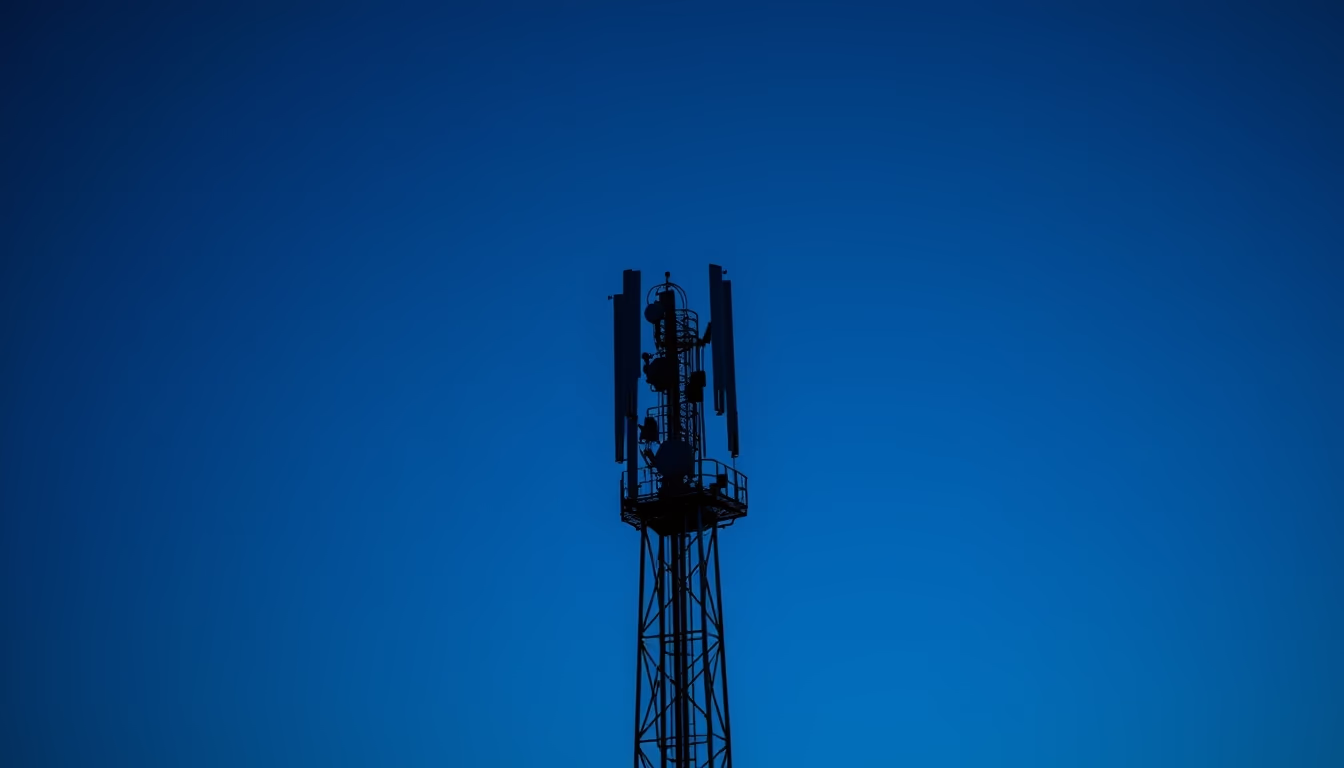
5G antenna tower silhouette against deep blue twilight sky, symbol of the new era of mobile connectivity in Brazil.
About this subject
5G antenna towers are the backbone of fifth-generation mobile networks, offering download speeds up to 20 Gbps, latency under 1 millisecond, and the ability to connect up to 1 million devices per square kilometer. In Brazil, 5G deployment officially began in July 2022, with activation in Brasília, followed by capitals like São Paulo, Rio de Janeiro, and Belo Horizonte. The technology uses higher frequency bands, such as 3.5 GHz, which require a denser network of antennas to ensure coverage and penetration in urban environments. Unlike previous generations, 5G antennas are compact and can be installed on lampposts, building facades, and street furniture, minimizing visual impact. The tower silhouette against the twilight sky symbolizes the transition to a hyperconnected world, enabling applications like autonomous vehicles, telemedicine, and smart cities. Despite controversies about health effects, Brazil's National Telecommunications Agency (Anatel) follows international safety standards, and studies by the World Health Organization indicate no evidence of risks from exposure within established limits.
Frequently Asked Questions
What is 5G technology and how does it differ from 4G?
5G is the fifth generation of mobile networks, offering speeds up to 100 times faster than 4G, latency under 1 ms, and massive support for IoT devices. While 4G uses frequencies below 6 GHz, 5G also operates in millimeter waves (24-100 GHz), enabling higher transmission capacity.
What are the main challenges for 5G expansion in Brazil?
Challenges include the need to install a large number of antennas for adequate coverage, especially in rural and low-density areas. There are also licensing issues, infrastructure costs, and the need for compatible devices, which are still expensive.
Does 5G pose any health risks?
According to the World Health Organization and Brazil's Anatel, there is no scientific evidence that exposure to radiofrequency electromagnetic fields within established limits causes adverse health effects. 5G antennas operate at higher frequencies but at very low power, following strict international standards.
Direct URL
https://pub-c7d6a6ea828543ac903a74a341ccb2e1.r2.dev/imagens/5g-antenna-tower-silhouette-against-deep-blue-twilight-sky-closeup-twilight-6.avifHow to credit
Include a visible link back to UtilizAí. Copy one of the snippets below:
<a href="https://xn--utiliza-eza.com/en/midia/imagens/5g-antenna-tower-silhouette-against-deep-blue-twilight-sky-closeup-twilight-6">5G antenna tower silhouette against deep blue twilight sky</a> by <a href="https://xn--utiliza-eza.com">UtilizAí</a>, licensed under <a href="https://creativecommons.org/licenses/by/4.0/">CC BY 4.0</a>.
[5G antenna tower silhouette against deep blue twilight sky](https://xn--utiliza-eza.com/en/midia/imagens/5g-antenna-tower-silhouette-against-deep-blue-twilight-sky-closeup-twilight-6) by [UtilizAí](https://xn--utiliza-eza.com), CC BY 4.0
License: CC-BY-4.0