Wolf in snowy forest
1344×768 · AVIF · CC BY 4.0
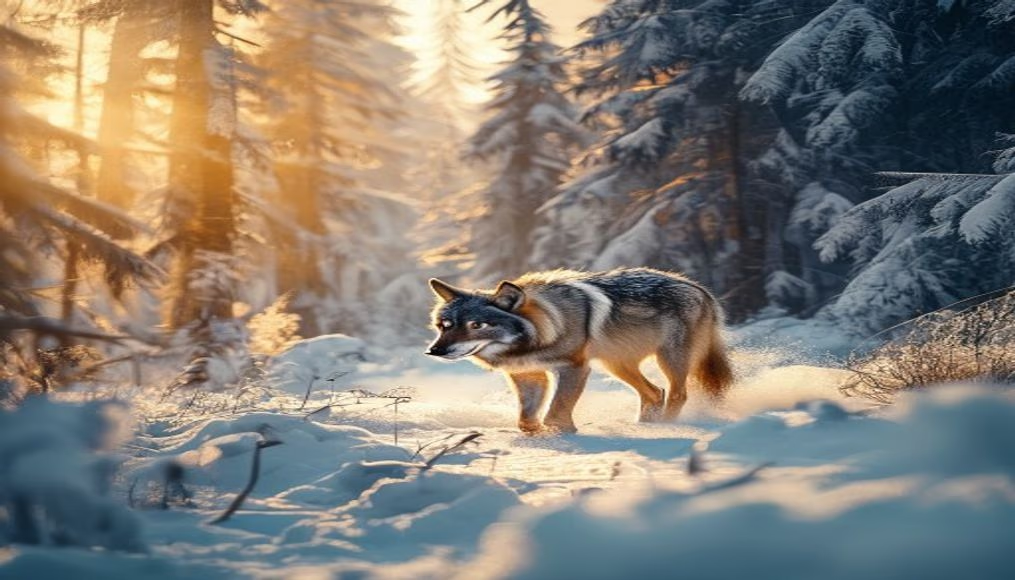
Wolves in snowy forests: behavior, habitat, and adaptations to harsh winter conditions.
About this subject
The gray wolf (Canis lupus) is one of the most iconic predators of boreal forests and snowy regions of the Northern Hemisphere. During winter, these canids face temperatures as low as -50°C, relying on a dense double coat for insulation. Their large paws act as snowshoes, distributing weight and allowing agile movement on frozen crust. Pack hunting becomes essential in this season, as prey like moose and caribou are larger and more resilient.
The gray wolf's geographic range spans from the forests of Canada and Alaska to Siberia and Scandinavia. Studies show that packs maintain territories that can exceed 1,000 km² in areas with low prey density. Communication occurs through howls, which can be heard up to 10 km away in open snowy landscapes. Howling not only marks territory but also coordinates movements and reinforces social bonds.
The relationship between wolves and snowy ecosystems is a classic example of a trophic cascade. In Yellowstone National Park, the reintroduction of wolves in 1995 changed elk behavior, causing them to avoid open valleys. This allowed willows and cottonwoods to regenerate, benefiting beavers and birds. In regions like Finnish Lapland, wolves coexist with semi-domesticated reindeer, leading to conflicts with herders. Conservation of the species, threatened in parts of Europe, depends on ecological corridors connecting protected areas.
Interestingly, Arctic wolves (subspecies Canis lupus arctos) have almost white fur, an adaptation for camouflage in perennial snow environments. Meanwhile, Siberian taiga wolves show grayish and brown hues that blend with low vegetation. Keen eyesight and smell allow them to locate prey hundreds of meters away even during heavy snowstorms. Pack hunting success rates range from 10% to 50%, depending on target species and weather conditions.
Frequently Asked Questions
What is the main adaptation of wolves to survive in snowy forests?
Wolves have a thick double coat for insulation from extreme cold and large paws that act as snowshoes for efficient movement on snow.
How did the reintroduction of wolves in Yellowstone affect the ecosystem?
The reintroduction reduced elk grazing pressure, allowing riparian vegetation to recover, which benefited beavers and various bird species.
What is the difference between the gray wolf and the Arctic wolf?
The Arctic wolf (Canis lupus arctos) is a subspecies adapted to the Arctic, with lighter fur and smaller size, while the gray wolf shows regional variations in color and size.
Direct URL
https://pub-c7d6a6ea828543ac903a74a341ccb2e1.r2.dev/imagens/wolf-in-snowy-forest-travel-photography-v10.avifHow to credit
Include a visible link back to UtilizAí. Copy one of the snippets below:
<a href="https://xn--utiliza-eza.com/en/midia/imagens/wolf-in-snowy-forest-travel-photography-v10">Wolf in snowy forest</a> by <a href="https://xn--utiliza-eza.com">UtilizAí</a>, licensed under <a href="https://creativecommons.org/licenses/by/4.0/">CC BY 4.0</a>.
[Wolf in snowy forest](https://xn--utiliza-eza.com/en/midia/imagens/wolf-in-snowy-forest-travel-photography-v10) by [UtilizAí](https://xn--utiliza-eza.com), CC BY 4.0
License: CC-BY-4.0