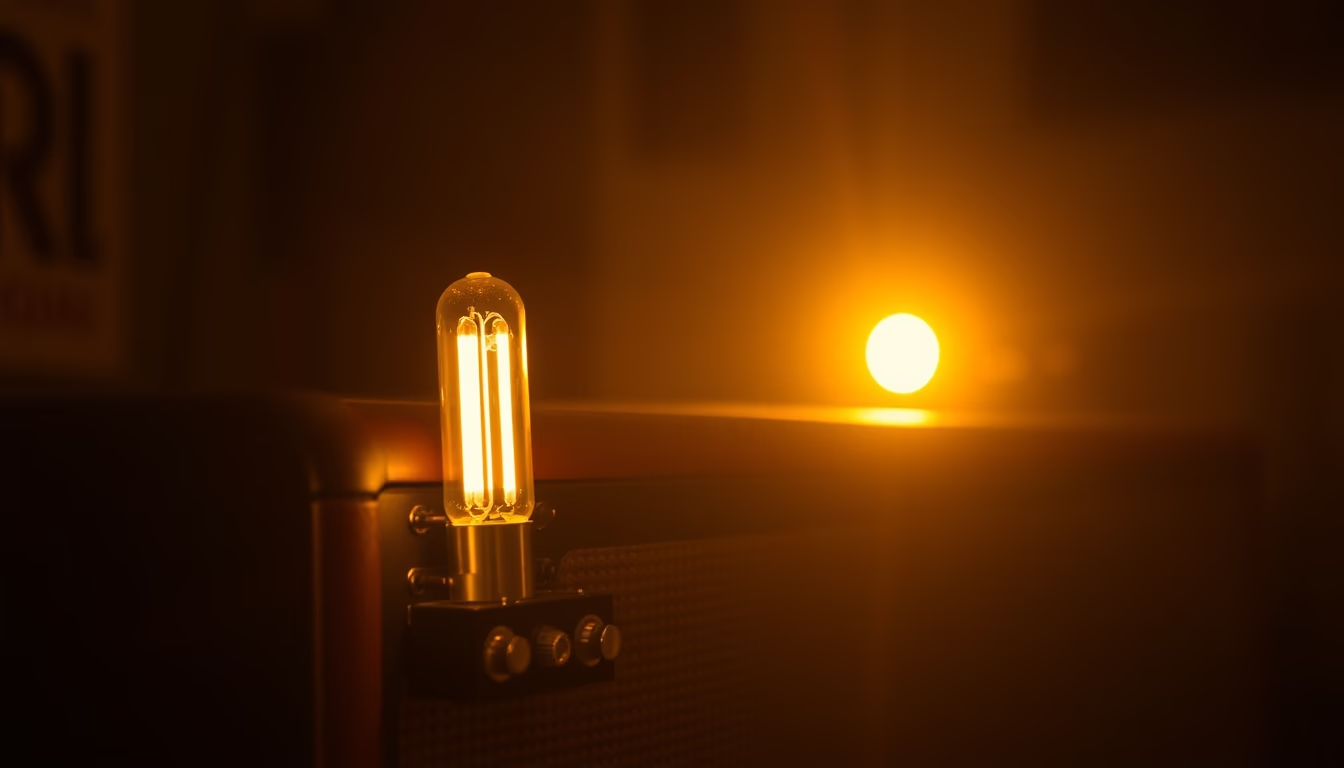
Tube amplifier glowing
1344×768 · AVIF · CC BY 4.0

Vacuum tube amplifiers produce sound by heating thermionic valves, a technology from the early 20th century still revered by audiophiles.
About this subject
Vacuum tube amplifiers, also known as valve amplifiers, use thermionic valves to amplify audio signals. The basic principle involves heating a cathode inside an evacuated glass envelope, which emits electrons that boost the signal. This process generates even-order harmonic distortion, often described as musical and pleasing to the ear. It is this characteristic that distinguishes tube sound from the colder, more precise transistor sound.
Historically, vacuum tubes were the foundation of electronics until the rise of transistors in the 1960s. However, from the 1990s onward, there was a resurgence of interest in tube amplifiers, especially among guitarists and audiophiles. Brands like Marshall, Fender, and Vox kept the tradition alive in guitar amps, while in the high-fidelity market, names like McIntosh, Audio Research, and Brazil's Interface continue to produce sophisticated models. Brazil played a notable role with companies such as Gradiente and Philco, which manufactured valve-based receivers in the 1950s and 1960s.
Culturally, the warm orange glow of lit tubes has become an aesthetic icon, associated with warm, vintage sound. Musicians and audio engineers value the dynamic response and natural compression that tubes provide. However, these amplifiers require care: tubes have a limited lifespan (typically thousands of hours) and consume more power than solid-state equivalents. Despite this, for many, the unique sonic experience justifies the maintenance and the extra heat they radiate.
Frequently Asked Questions
Why do the tubes in amplifiers glow?
The orange glow comes from the filament or cathode heated to high temperatures (around 1000 °C) inside the vacuum tube. This heating is necessary for electron emission.
What is the advantage of tube sound over transistor sound?
The even-order harmonic distortion produced by tubes is considered more musical and smooth, resulting in a warm, compressed timbre that is pleasing to the human ear, unlike the odd-order distortion of transistors.
Are tube amplifiers more fragile than solid-state ones?
Yes, tubes are components that can burn out and require gradual warm-up before use. They also consume more power and generate more heat, requiring proper ventilation.
Direct URL
https://pub-c7d6a6ea828543ac903a74a341ccb2e1.r2.dev/imagens/tube-amplifier-glowing-film-grain-authentic-fresh9.avifHow to credit
Include a visible link back to UtilizAí. Copy one of the snippets below:
<a href="https://xn--utiliza-eza.com/en/midia/imagens/tube-amplifier-glowing-film-grain-authentic-fresh9">Tube amplifier glowing</a> by <a href="https://xn--utiliza-eza.com">UtilizAí</a>, licensed under <a href="https://creativecommons.org/licenses/by/4.0/">CC BY 4.0</a>.
[Tube amplifier glowing](https://xn--utiliza-eza.com/en/midia/imagens/tube-amplifier-glowing-film-grain-authentic-fresh9) by [UtilizAí](https://xn--utiliza-eza.com), CC BY 4.0
License: CC-BY-4.0