Tube amplifier glowing
1344×768 · AVIF · CC BY 4.0
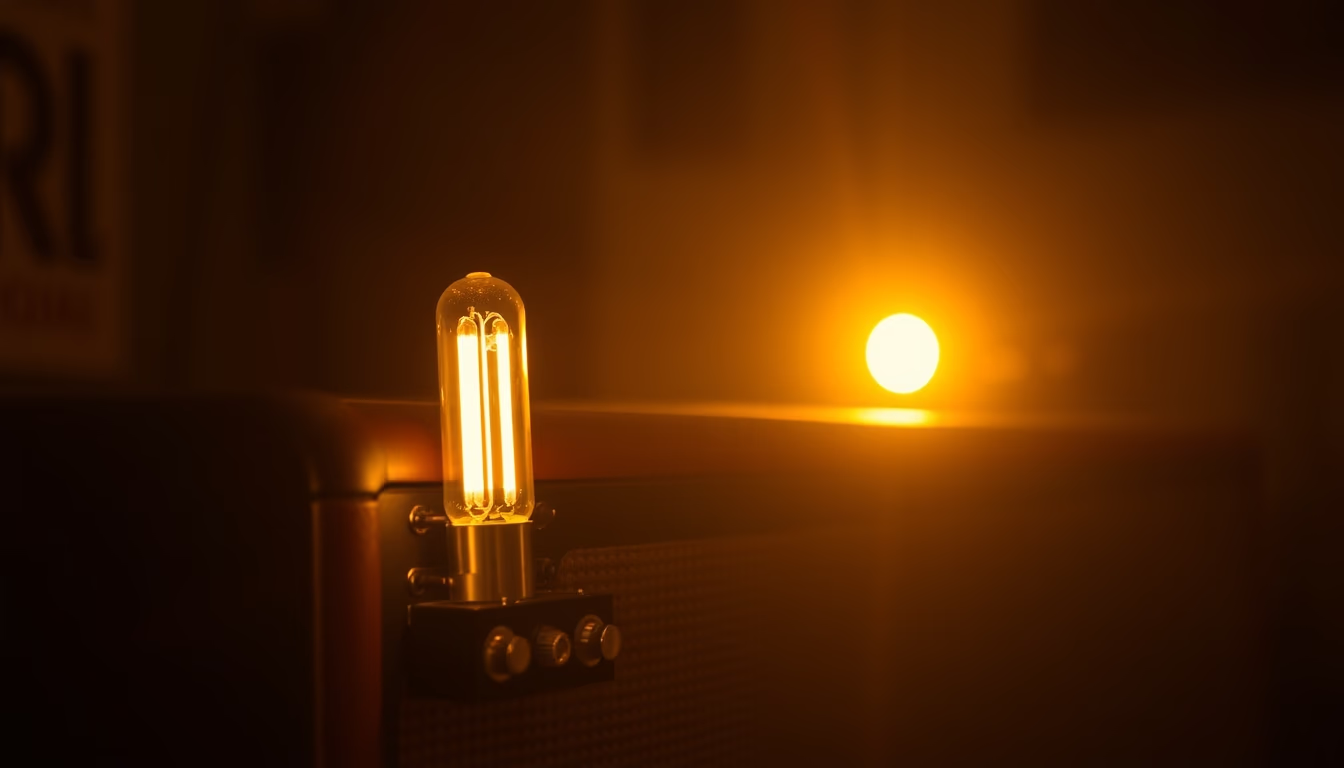
Glowing vacuum tubes in audio amplifiers: vintage technology that warms the sound and the hearts of audiophiles.
About this subject
Tube amplifiers, also known as valve amplifiers, use vacuum tubes to amplify audio signals. This technology, dominant from the 1920s to the 1960s, was gradually replaced by more efficient and compact transistors, but it never lost its appeal among enthusiasts. The reason lies in the so-called "valve sound," characterized by smooth harmonic distortion and a natural timbre that many consider more musical than solid-state amplification.
Historically, the first practical tube amplifier was developed by Lee De Forest in 1906 with the invention of the triode. During the golden age of radio and high fidelity, brands like McIntosh, Marantz, and Fisher set standards that remain benchmarks. From the 1970s onward, with the dominance of transistors, tubes were relegated to niches, but in the 1990s there was a resurgence driven by guitarists and audiophiles who rediscovered their sonic warmth.
Culturally, the tube amplifier is an icon of vintage industrial design. Its characteristic orange glow, produced by the heating of tungsten filaments, is not merely aesthetic: tubes need to reach temperatures around 200°C to function properly. This gradual heating also explains why many audiophiles leave the equipment constantly powered on to avoid thermal stress. Classic models like the Fender Twin Reverb and the VOX AC30 are revered in popular music, having been used by Jimi Hendrix and The Beatles, respectively.
Technically, tubes are gas-state devices that control electron flow between cathode and anode, requiring high voltage (typically 300-500V). Unlike transistors, they saturate gradually, producing a natural compression that pleases human ears. However, they have disadvantages: low energy efficiency, excessive heat generation, and limited lifespan (about 1,000 to 10,000 hours). Maintenance requires periodic tube replacement and careful biasing. Despite this, the market for new and NOS (New Old Stock) tubes remains active, with manufacturers like JJ Electronic, Tung-Sol, and Electro-Harmonix.
Frequently Asked Questions
What is the difference between tube and solid-state amplifiers?
Tube amplifiers use vacuum tubes to amplify the signal, producing a warmer sound with smooth harmonic distortion. Solid-state amplifiers use transistors, being more efficient, lighter, and with lower distortion, but sometimes considered colder or sterile.
How often do tubes need replacement?
A typical tube's lifespan ranges from 1,000 to 10,000 hours, depending on usage and quality. Replacement is needed when sound degrades, noise appears, or the glow weakens. Many audiophiles keep spare tubes at home.
Why are tube amplifiers so expensive?
The cost is high due to handcrafted production, high-quality components (transformers, imported tubes), and smaller manufacturing scale. Additionally, design and engineering require specialized knowledge, and demand for vintage or high-end equipment keeps prices elevated.
Direct URL
https://pub-c7d6a6ea828543ac903a74a341ccb2e1.r2.dev/imagens/tube-amplifier-glowing-cinematic-wide-shot-fresh18.avifHow to credit
Include a visible link back to UtilizAí. Copy one of the snippets below:
<a href="https://xn--utiliza-eza.com/en/midia/imagens/tube-amplifier-glowing-cinematic-wide-shot-fresh18">Tube amplifier glowing</a> by <a href="https://xn--utiliza-eza.com">UtilizAí</a>, licensed under <a href="https://creativecommons.org/licenses/by/4.0/">CC BY 4.0</a>.
[Tube amplifier glowing](https://xn--utiliza-eza.com/en/midia/imagens/tube-amplifier-glowing-cinematic-wide-shot-fresh18) by [UtilizAí](https://xn--utiliza-eza.com), CC BY 4.0
License: CC-BY-4.0