Rolleiflex tlr vintage
1344×768 · AVIF · CC BY 4.0
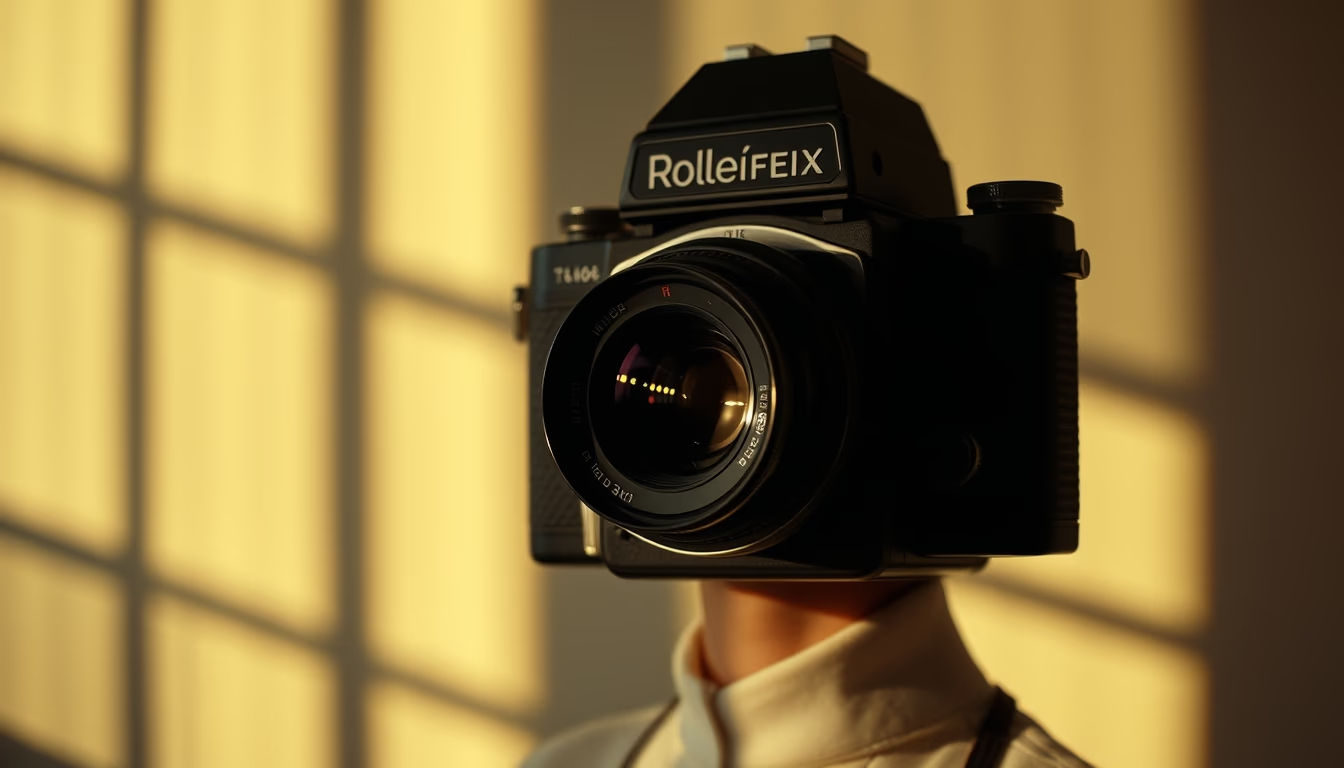
The Rolleiflex TLR is a classic medium-format camera, renowned for its twin-lens design and superior optical quality.
About this subject
The Rolleiflex TLR, short for Twin-Lens Reflex, was manufactured by the German company Franke & Heidecke starting in 1929. Its twin-lens system, one for viewing and one for taking, provided a waist-level finder with a parallax-free, bright image, ideal for street photography and portraits. The 6x6 cm square format on 120 film offered versatile composition without needing to rotate the camera.
Over the decades, the Rolleiflex became a status symbol among professional and amateur photographers. Models like the Rolleiflex 2.8F, fitted with Carl Zeiss Planar or Schneider Xenotar lenses, set standards for sharpness and contrast. It was widely used by post-war photojournalists such as Robert Capa, and by artists like Vivian Maier, who immortalized urban scenes with her Rolleiflex.
The camera influenced the design of other TLRs, such as the Yashica and Minolta Autocord, but the Rolleiflex remained a benchmark for its precise mechanical craftsmanship and durability. Production continued into the 2000s with limited editions. Today, it is still prized by collectors and enthusiasts, used in analog photography projects.
Interestingly, the TLR system was also adapted for stereo cameras and smaller format versions, like the Rolleicord, a more affordable variant. The Rolleiflex legacy endures as an icon of German optical engineering and a fundamental contribution to the history of photography.
Frequently Asked Questions
What does TLR stand for?
TLR stands for Twin-Lens Reflex. This camera design uses two lenses: one for viewing and one for taking the picture, eliminating parallax errors.
What film does the Rolleiflex use?
The Rolleiflex uses 120 roll film, producing 6x6 cm square images. Depending on the model, a roll yields 12 to 16 exposures.
Why is the Rolleiflex considered a legendary camera?
Due to its rugged build, exceptional lenses (like the Zeiss Planar), and innovative design that dominated photojournalism and artistic photography for much of the 20th century.
Direct URL
https://pub-c7d6a6ea828543ac903a74a341ccb2e1.r2.dev/imagens/rolleiflex-tlr-vintage-rembrandt-lighting-dramatic-shadows-fresh10.avifHow to credit
Include a visible link back to UtilizAí. Copy one of the snippets below:
<a href="https://xn--utiliza-eza.com/en/midia/imagens/rolleiflex-tlr-vintage-rembrandt-lighting-dramatic-shadows-fresh10">Rolleiflex tlr vintage</a> by <a href="https://xn--utiliza-eza.com">UtilizAí</a>, licensed under <a href="https://creativecommons.org/licenses/by/4.0/">CC BY 4.0</a>.
[Rolleiflex tlr vintage](https://xn--utiliza-eza.com/en/midia/imagens/rolleiflex-tlr-vintage-rembrandt-lighting-dramatic-shadows-fresh10) by [UtilizAí](https://xn--utiliza-eza.com), CC BY 4.0
License: CC-BY-4.0