Rocket launch night
1344×768 · AVIF · CC BY 4.0
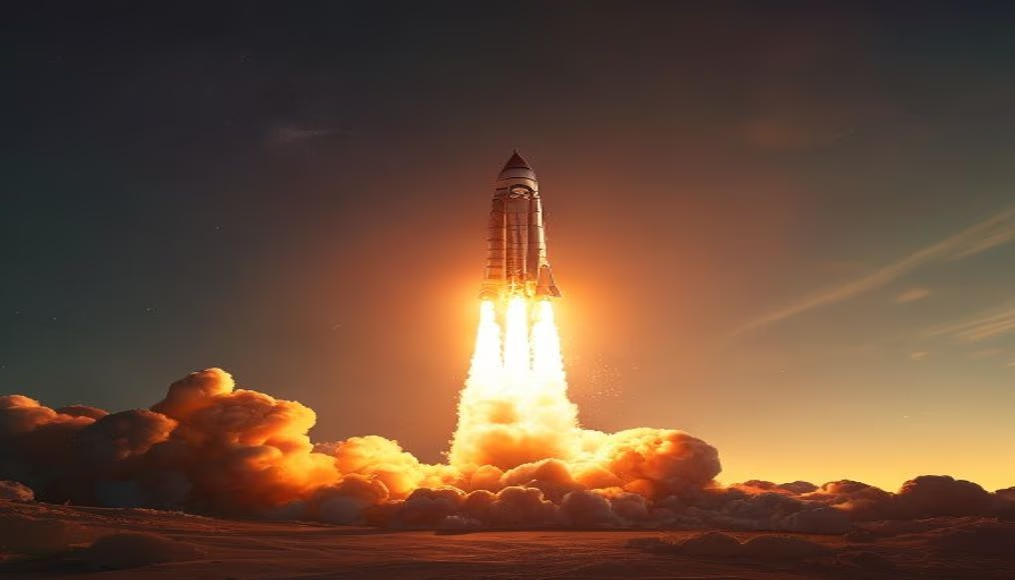
Night rocket launches offer stunning visual spectacles and are milestones of global space exploration.
About this subject
Night rocket launches are events that combine science, engineering, and an unforgettable visual spectacle. The darkness of the night sky contrasts with the bright glow of engines, creating luminous trails visible for miles. Launch sites such as Cape Canaveral in Florida and the Baikonur Cosmodrome in Kazakhstan frequently schedule night liftoffs to take advantage of favorable atmospheric conditions and precise orbital windows.
The choice of nighttime is not merely aesthetic: it allows better observation of ignition systems and stage separations, and facilitates optical tracking. Rockets like the Falcon 9 from SpaceX and the Russian Soyuz routinely perform night missions, carrying communication satellites, supplies to the International Space Station, or interplanetary probes. The phenomenon known as the "jellyfish" occurs when exhaust gases are illuminated by the Sun still below the horizon, forming a bright cloud.
Culturally, night launches inspire artists, photographers, and filmmakers. The iconic image of a rocket ascending against a starry sky has become a symbol of humanity's ability to surpass Earth's limits. In Brazil, the Alcântara Launch Center in Maranhão also conducts night operations, albeit on a smaller scale. The combination of cutting-edge technology and natural beauty makes these events unique moments at the frontier between science and emotion.
Frequently Asked Questions
Why are rockets launched at night?
Night launches take advantage of specific orbital windows and stable atmospheric conditions. Additionally, visual contrast aids in optical tracking of rocket stages.
What are the main night launch sites in the world?
Cape Canaveral (USA), Baikonur (Kazakhstan), Kourou (French Guiana), and Vandenberg (USA) are some of the primary centers that regularly conduct night launches.
How to photograph a rocket launch at night?
Use a camera with manual controls, tripod, and set low ISO with long exposure. The lens should capture the luminous trail without overexposing the sky. Practice and knowledge of trajectory are essential.
Direct URL
https://pub-c7d6a6ea828543ac903a74a341ccb2e1.r2.dev/imagens/rocket-launch-night-travel-photography-v10.avifHow to credit
Include a visible link back to UtilizAí. Copy one of the snippets below:
<a href="https://xn--utiliza-eza.com/en/midia/imagens/rocket-launch-night-travel-photography-v10">Rocket launch night</a> by <a href="https://xn--utiliza-eza.com">UtilizAí</a>, licensed under <a href="https://creativecommons.org/licenses/by/4.0/">CC BY 4.0</a>.
[Rocket launch night](https://xn--utiliza-eza.com/en/midia/imagens/rocket-launch-night-travel-photography-v10) by [UtilizAí](https://xn--utiliza-eza.com), CC BY 4.0
License: CC-BY-4.0