Public charging station
1344×768 · AVIF · CC BY 4.0
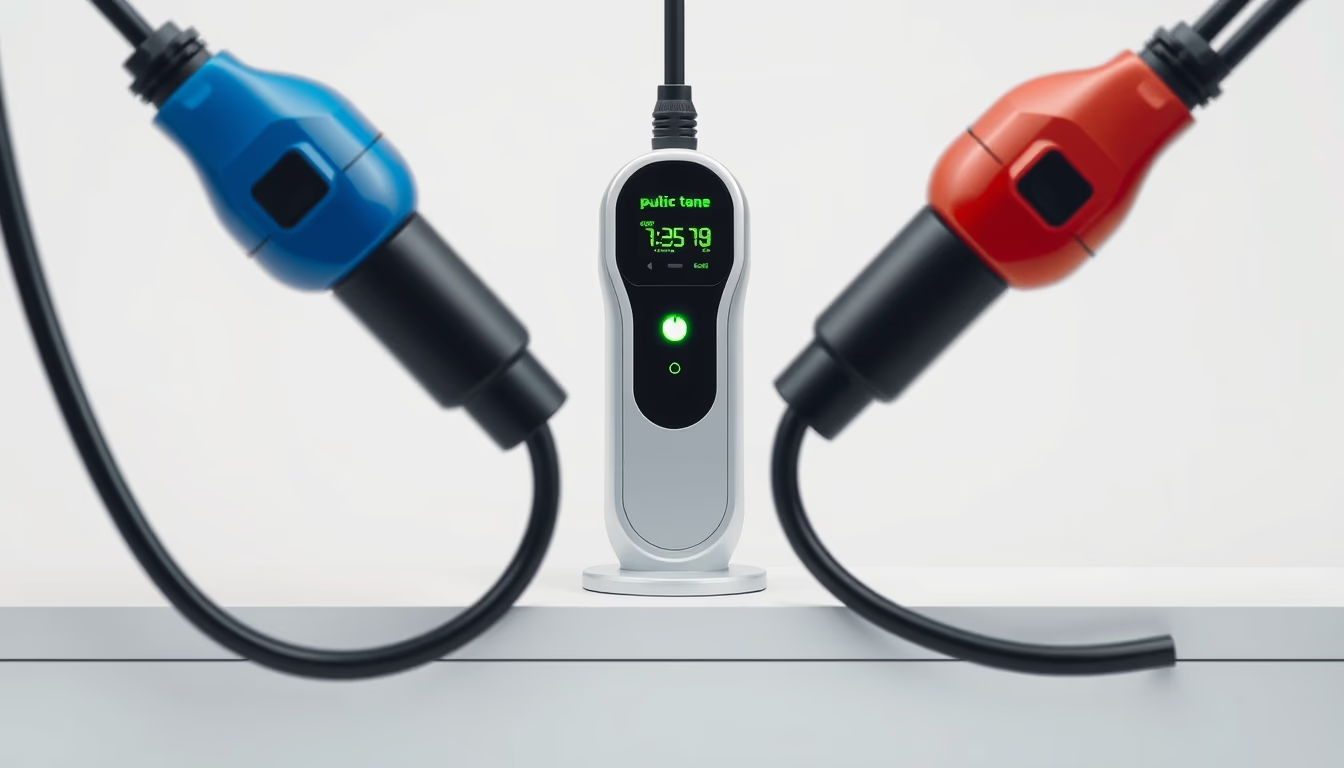
Public electric vehicle charging station, essential for sustainable urban mobility and the expansion of the electric fleet in Brazil.
About this subject
Public charging stations are critical infrastructure for the adoption of electric vehicles. In Brazil, the installation of these points has grown significantly in recent years, driven by incentive policies and environmental awareness. Currently, the country has over 3,000 public and semi-public charging points, mainly concentrated in the Southeast and South regions. These stations range from fast (DC) to slow (AC) chargers, with power outputs from 7 kW to 350 kW, enabling recharges in minutes or hours, depending on the vehicle model.
Strategic locations include shopping malls, supermarkets, highway service areas, and public parking lots. Companies such as EDP, CPFL, and Vibra Energia lead the installation of charging networks, often in partnership with automakers. The advancement of electromobility is also linked to renewable energy generation: most of Brazil's electricity matrix is hydroelectric, making electric vehicle charging an even cleaner option.
A persistent challenge is interoperability among different operators and the standardization of connectors (CCS2, CHAdeMO, Type 2). Initiatives like the Rota 2030 program and ANEEL regulations aim to standardize billing and facilitate usage. Additionally, residential charging still predominates, but the growth of public charging is essential for long-distance travel and for users without private garages.
Globally, countries like Norway and China lead in charging station density. Brazil, although behind, has potential to accelerate the energy transition, especially with the increasing availability of domestic and imported electric vehicles. The installation of public charging stations also boosts the economy, creating jobs in installation, maintenance, and data management.
Frequently Asked Questions
How long does it take to charge an electric vehicle at a public station?
The time varies depending on the charger power and battery capacity. Fast chargers (50 kW to 350 kW) can charge 80% of the battery in 20 to 40 minutes, while slow chargers (7 kW to 22 kW) take 2 to 8 hours.
Do I have to pay to use a public charging station in Brazil?
Yes, most public stations charge per kilowatt-hour (kWh) or per time of use. Some establishments offer free charging as a courtesy, but the trend is toward consumption-based billing.
Can all electric cars use any public charging station?
Not always. Connectors vary: CCS2 is the most common standard in Brazil, followed by CHAdeMO (used by Nissan Leaf). Most stations offer multiple connectors, but it is important to check compatibility before charging.
Direct URL
https://pub-c7d6a6ea828543ac903a74a341ccb2e1.r2.dev/imagens/public-charging-station-commercial-product-photography-p3.avifHow to credit
Include a visible link back to UtilizAí. Copy one of the snippets below:
<a href="https://xn--utiliza-eza.com/en/midia/imagens/public-charging-station-commercial-product-photography-p3">Public charging station</a> by <a href="https://xn--utiliza-eza.com">UtilizAí</a>, licensed under <a href="https://creativecommons.org/licenses/by/4.0/">CC BY 4.0</a>.
[Public charging station](https://xn--utiliza-eza.com/en/midia/imagens/public-charging-station-commercial-product-photography-p3) by [UtilizAí](https://xn--utiliza-eza.com), CC BY 4.0
License: CC-BY-4.0