Penguins on ice antarctica
1344×768 · AVIF · CC BY 4.0
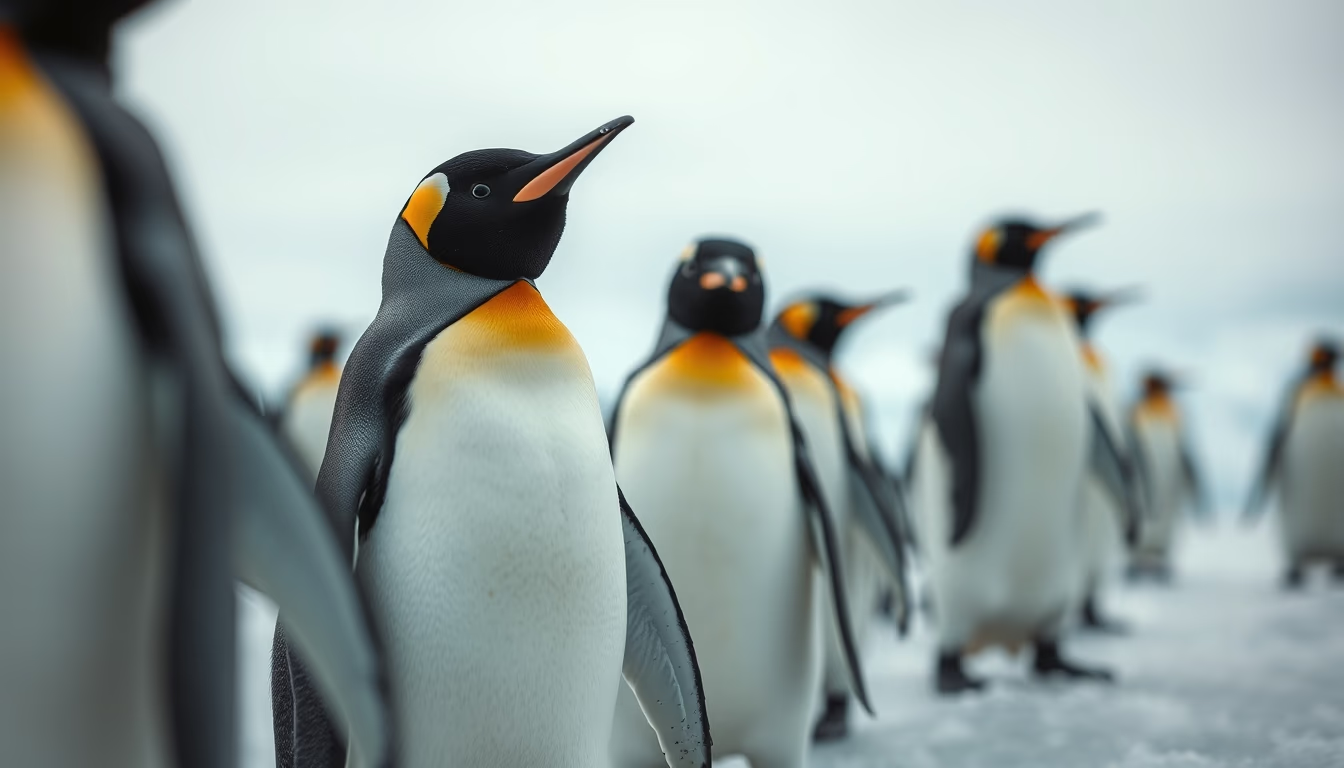
Emperor penguins gather on Antarctic ice shelves, forming dense colonies to survive the planet's harshest winter.
About this subject
Emperor penguins (Aptenodytes forsteri) are the largest penguin species, reaching up to 1.2 meters in height and 45 kg. They inhabit only Antarctica, where they endure temperatures below -60°C and winds up to 200 km/h. During the Antarctic winter, males incubate eggs on their feet, covered by a brood pouch, while females travel up to 100 km to feed in the ocean. This breeding cycle is the only one among birds to occur at the peak of the polar winter.
Antarctic ice shelves, such as the Ross Ice Shelf and the Filchner-Ronne Ice Shelf, serve as nurseries for thousands of chicks. Colonies can gather up to 20,000 breeding pairs, forming tight clusters that rotate positions to minimize heat loss. Sea ice is essential for the species' survival, but global warming has reduced its extent, threatening colonies. Studies indicate that if carbon emissions continue at the current rate, two out of three emperor penguin colonies could disappear by 2100.
Social behavior includes forming "huddles": individuals crowd together and slowly rotate so that all share body heat. This strategy reduces energy loss by up to 50%. Additionally, they have a dense, waterproof feather layer and a thick subcutaneous fat layer that insulates against extreme cold. Their plumage is black on the back (absorbs solar radiation) and white on the belly (camouflage against predators on the ice).
Antarctica is the coldest, driest, and windiest continent on Earth, with an area of 14 million km² covered by ice up to 4.8 km thick in places. The region hosts only cold-adapted species such as seals, whales, and seabirds. Tourism in Antarctica is strictly regulated by the Antarctic Treaty, with visitor limits per ship and rules to avoid disturbing wildlife. Close-up photographs of penguins are rare and require specialized equipment and environmental permits.
Frequently Asked Questions
How many emperor penguins are there in Antarctica?
It is estimated that there are between 400,000 and 600,000 adult individuals, distributed in about 60 colonies around the continent.
Why do emperor penguins huddle together?
They form tight clusters to conserve body heat during winter, reducing energy loss by up to 50% through a constant rotation of positions.
Does global warming affect emperor penguins?
Yes, melting sea ice reduces breeding and feeding areas. Climate models predict a population decline of up to 80% by 2100 if carbon emissions are not controlled.
Direct URL
https://pub-c7d6a6ea828543ac903a74a341ccb2e1.r2.dev/imagens/penguins-on-ice-antarctica-macro-closeup.avifHow to credit
Include a visible link back to UtilizAí. Copy one of the snippets below:
<a href="https://xn--utiliza-eza.com/en/midia/imagens/penguins-on-ice-antarctica-macro-closeup">Penguins on ice antarctica</a> by <a href="https://xn--utiliza-eza.com">UtilizAí</a>, licensed under <a href="https://creativecommons.org/licenses/by/4.0/">CC BY 4.0</a>.
[Penguins on ice antarctica](https://xn--utiliza-eza.com/en/midia/imagens/penguins-on-ice-antarctica-macro-closeup) by [UtilizAí](https://xn--utiliza-eza.com), CC BY 4.0
License: CC-BY-4.0