Origami crane delicate
1344×768 · AVIF · CC BY 4.0
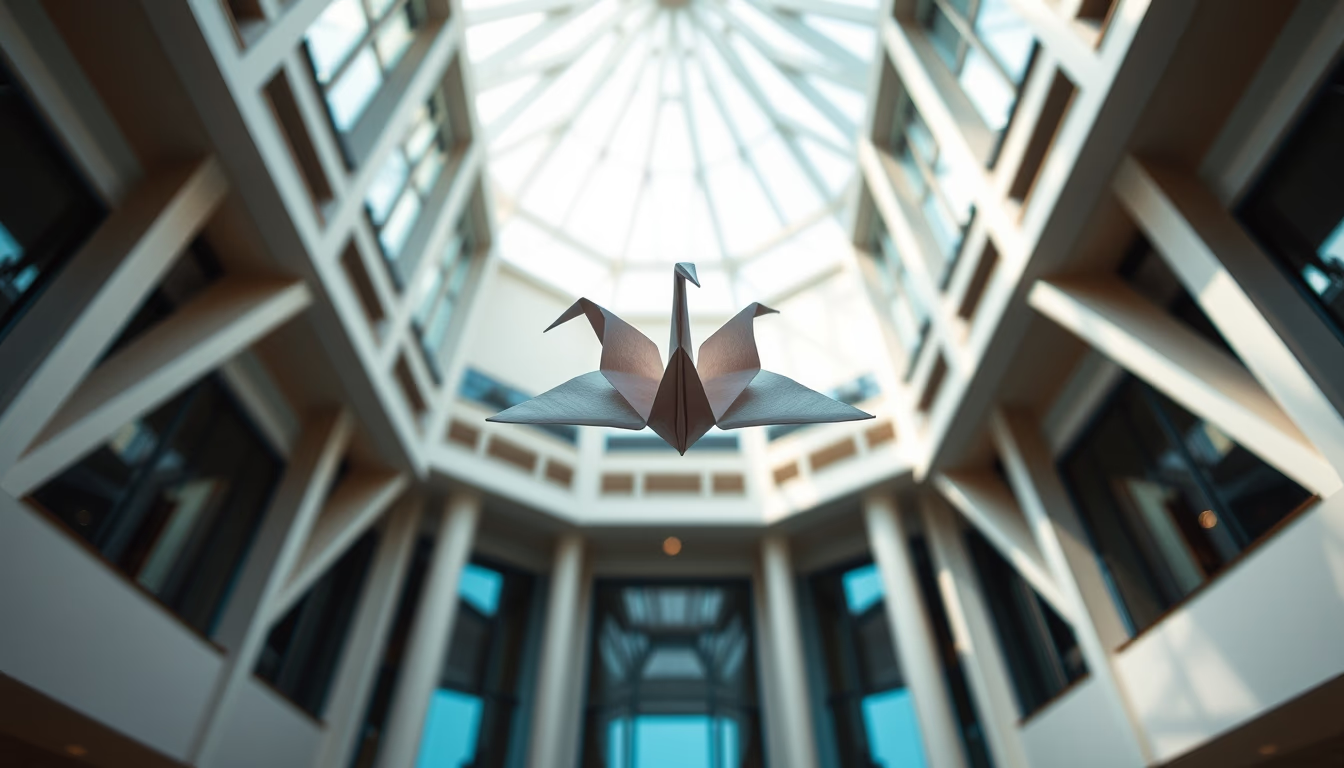
The origami crane, a thousand-year-old Japanese paper bird, symbolizes peace, health and longevity, serving as a global cultural icon.
About this subject
The tsuru, or paper crane, is the most iconic figure in origami, the Japanese art of paper folding. Its origins date back to the Edo period (1603-1868), when paper became more affordable and the practice gained popularity. Unlike other models, the tsuru is considered a base model, from which hundreds of other shapes can be derived. Japanese legend holds that folding a thousand cranes grants a wish, a belief that spread worldwide after the story of Sadako Sasaki, a Hiroshima bombing victim who attempted to fold a thousand cranes in search of healing. Today, the tsuru is a universal symbol of peace and resilience, found in memorials, ceremonies, and campaigns for a war-free world. The folding technique requires precision and patience: a traditional tsuru uses a single uncut square of paper, involving about 20 steps, resulting in elongated wings, tail, and neck. The image captures the delicacy of paper, with crisp lines and soft shadows, highlighting the pure geometry of the form. In architectural contexts, the tsuru inspires lightweight, modular structures, such as the Nagoya Convention Center, which evokes paper wings. The choice of thin, textured paper like washi gives the tsuru an almost organic appearance, contrasting with the clean background. Classified as 'architectural photography', this image explores the intersection of manual craft and minimalist design, where each crease is an aesthetic decision.
Frequently Asked Questions
What is the origin of the origami crane?
The tsuru originated in Japan during the Edo period (1603-1868) when paper became popular. The crane, a sacred bird symbolizing longevity, was adapted into a foldable figure.
How many folds are needed to make a tsuru?
A traditional tsuru requires about 20 folding steps, using a single uncut square of paper. The model is considered a base for other variations.
What does the legend of a thousand cranes mean?
Japanese legend says that folding a thousand cranes grants a wish. The story of Sadako Sasaki, who attempted this after the Hiroshima bombing, made the crane a peace symbol.
Direct URL
https://pub-c7d6a6ea828543ac903a74a341ccb2e1.r2.dev/imagens/origami-crane-delicate-architectural-photography.avifHow to credit
Include a visible link back to UtilizAí. Copy one of the snippets below:
<a href="https://xn--utiliza-eza.com/en/midia/imagens/origami-crane-delicate-architectural-photography">Origami crane delicate</a> by <a href="https://xn--utiliza-eza.com">UtilizAí</a>, licensed under <a href="https://creativecommons.org/licenses/by/4.0/">CC BY 4.0</a>.
[Origami crane delicate](https://xn--utiliza-eza.com/en/midia/imagens/origami-crane-delicate-architectural-photography) by [UtilizAí](https://xn--utiliza-eza.com), CC BY 4.0
License: CC-BY-4.0