Modular synthesizer rack
1344×768 · AVIF · CC BY 4.0
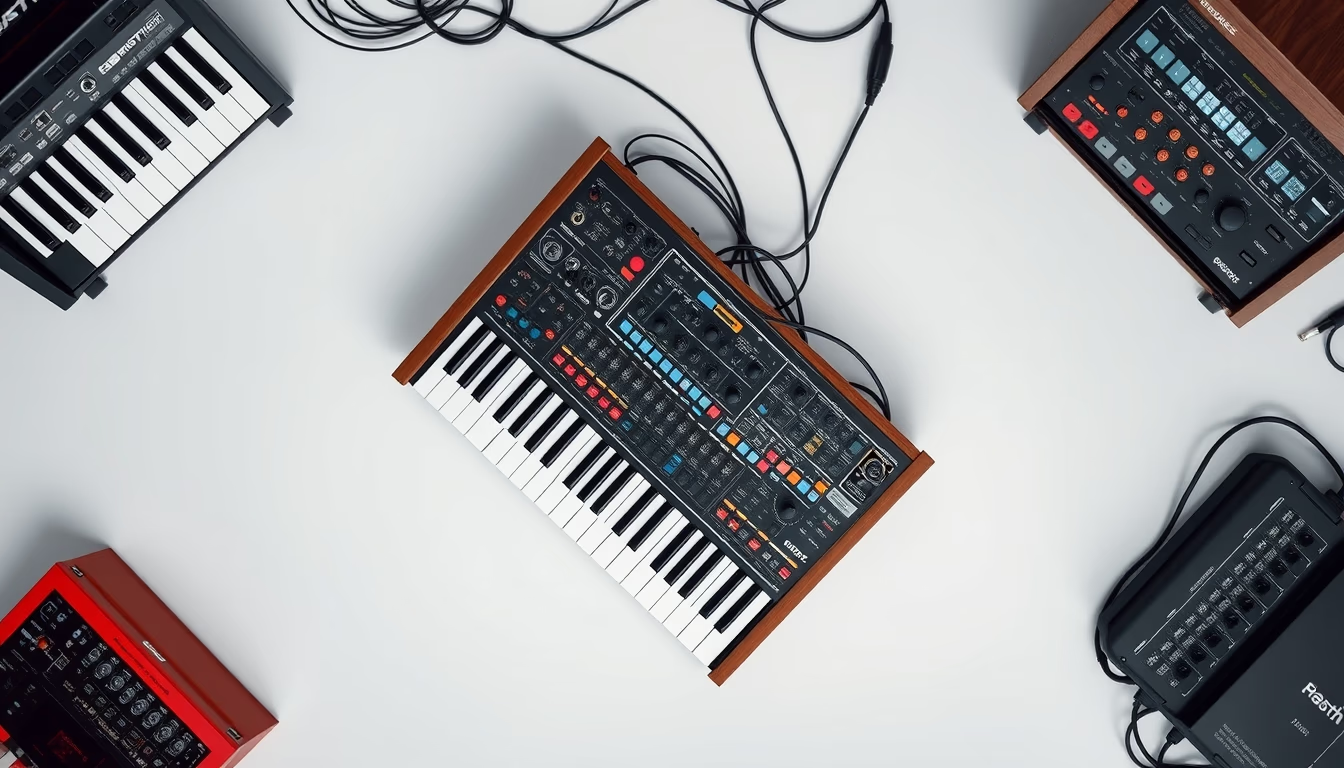
Dive into the world of modular synthesizers: customizable racks, patch cables, and modules that create unique sounds in electronic music.
About this subject
Modular synthesizers are sound synthesis systems composed of independent modules, each with a specific function, oscillators, filters, envelopes, sequencers, among others. Unlike integrated synthesizers where the signal flow is fixed, modulars allow the musician to manually connect modules using patch cables, creating fully customizable audio and control paths. This open architecture enables almost infinite sonic experimentation, forming the backbone of genres like experimental electronic music, ambient, techno, and industrial.
The concept dates back to the 1960s with Moog and Buchla systems, but it was the Eurorack format, introduced by Doepfer in 1996, that popularized modulars. Eurorack established a standard size (3U height) and power supply, allowing different manufacturers to create compatible modules. Today, there are thousands of modules from hundreds of brands, ranging from classic analog to complex digital processors. The modular community is known for its DIY culture, with many users building their own modules.
Artists like Trent Reznor (Nine Inch Nails), Suzanne Ciani, and Richard D. James (Aphex Twin) are known for extensive modular use. The initial cost can be high, but the expandability and sonic uniqueness justify the investment for many musicians. Beyond music, modulars are used in sound installations and sound design for film and games. The patching process is often compared to a performance art form, where physical connections represent the creative flow.
The modular scene has a strong online presence, with forums, tutorial videos, and platforms like ModularGrid for planning racks. Trade shows like Superbooth and Knobcon bring together manufacturers and enthusiasts. Despite the complexity, accessibility has increased with compact and affordable modules, allowing beginners to build small systems. The modular is not just an instrument but an ecosystem for sound creation that values exploration and unpredictability.
Frequently Asked Questions
What is a modular synthesizer?
It is a sound synthesis system made up of independent modules (oscillators, filters, etc.) connected by patch cables. It allows customized audio paths, resulting in unique and complex sounds.
What is the difference between a modular synthesizer and a regular synthesizer?
Regular (integrated) synthesizers have a fixed, pre-defined signal flow. In modular synths, the user decides the connections, offering greater flexibility and experimentation but requiring technical knowledge and investment.
Is Eurorack the only available format?
No, other formats exist like Moog, Buchla, and Frac Rack, but Eurorack is the most popular due to the vast range of modules from different manufacturers, compact size, and accessibility.
Direct URL
https://pub-c7d6a6ea828543ac903a74a341ccb2e1.r2.dev/imagens/modular-synthesizer-rack-isometric-flat-lay-p3.avifHow to credit
Include a visible link back to UtilizAí. Copy one of the snippets below:
<a href="https://xn--utiliza-eza.com/en/midia/imagens/modular-synthesizer-rack-isometric-flat-lay-p3">Modular synthesizer rack</a> by <a href="https://xn--utiliza-eza.com">UtilizAí</a>, licensed under <a href="https://creativecommons.org/licenses/by/4.0/">CC BY 4.0</a>.
[Modular synthesizer rack](https://xn--utiliza-eza.com/en/midia/imagens/modular-synthesizer-rack-isometric-flat-lay-p3) by [UtilizAí](https://xn--utiliza-eza.com), CC BY 4.0
License: CC-BY-4.0