Milky way stars
1344×768 · AVIF · CC BY 4.0
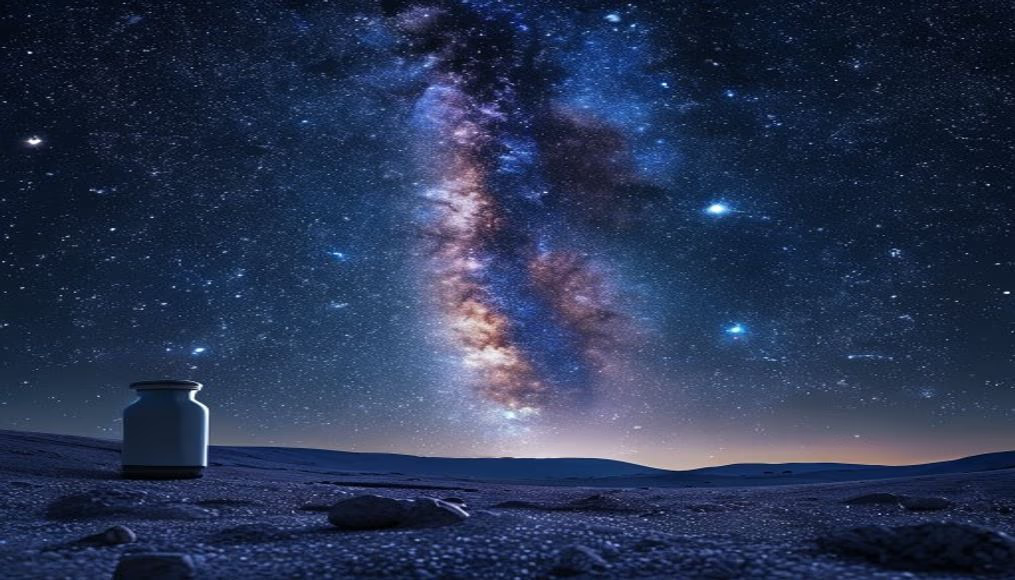
The Milky Way, our spiral galaxy, contains billions of stars and is visible to the naked eye in low light pollution areas.
About this subject
The Milky Way is the galaxy that hosts the Solar System, including Earth. With a diameter of about 100,000 light-years, it has a barred spiral structure, with arms extending from a dense core. It is estimated to contain between 100 and 400 billion stars, as well as gas, dust, and dark matter. To the naked eye, it appears as a milky band in the night sky, especially in rural or mountainous areas far from city lights.
Observing the Milky Way is an ancient practice, present in mythologies of various cultures, such as the Greeks, who called it 'milky road', and the Tupi-Guaraní, who saw it as a celestial river. In modern times, astrophotography has become a popular tool to capture its details, using DSLR or mirrorless cameras with wide-angle lenses and tripods. Techniques like stacking and long exposures reveal colors and structures invisible to the naked eye.
For those who want to photograph the Milky Way, planning is essential. It is recommended to use apps like PhotoPills or Stellarium to predict the galaxy's position and avoid the full moon. The southern hemisphere offers privileged views, with the galactic center higher in the winter. Places like the Atacama Desert in Chile or Chapada dos Veadeiros National Park in Brazil have minimal light pollution, ensuring impressive shots. Equipment with sensitive sensors and wide apertures (f/2.8 or smaller) are ideal.
Culturally, the Milky Way inspires songs and artworks, symbolizing infinity and the unknown. Scientifically, studying its stars and black holes helps understand the Universe's evolution. The ESA's Gaia mission maps billions of stars in the galaxy, creating the largest astrometric catalog ever made. Thus, the Milky Way is not only a visual spectacle but a cosmic laboratory of constant discovery.
Frequently Asked Questions
What is the Milky Way and how many stars does it have?
The Milky Way is the barred spiral galaxy that contains our Solar System. It is estimated to have between 100 and 400 billion stars, along with gas, dust, and dark matter.
How to photograph the Milky Way with a smartphone?
Use a tripod, enable manual mode with high ISO (800-3200), widest aperture, and exposure of 15-30 seconds. Apps like DeepSkyCamera help with control.
What is the best time of year to see the Milky Way in Brazil?
In the southern hemisphere, the galactic center is highest from March to September, peaking in June and July. Choose moonless nights away from light pollution.
Direct URL
https://pub-c7d6a6ea828543ac903a74a341ccb2e1.r2.dev/imagens/milky-way-stars-commercial-product-photography-v9.avifHow to credit
Include a visible link back to UtilizAí. Copy one of the snippets below:
<a href="https://xn--utiliza-eza.com/en/midia/imagens/milky-way-stars-commercial-product-photography-v9">Milky way stars</a> by <a href="https://xn--utiliza-eza.com">UtilizAí</a>, licensed under <a href="https://creativecommons.org/licenses/by/4.0/">CC BY 4.0</a>.
[Milky way stars](https://xn--utiliza-eza.com/en/midia/imagens/milky-way-stars-commercial-product-photography-v9) by [UtilizAí](https://xn--utiliza-eza.com), CC BY 4.0
License: CC-BY-4.0