Milky way stars
1344×768 · AVIF · CC BY 4.0
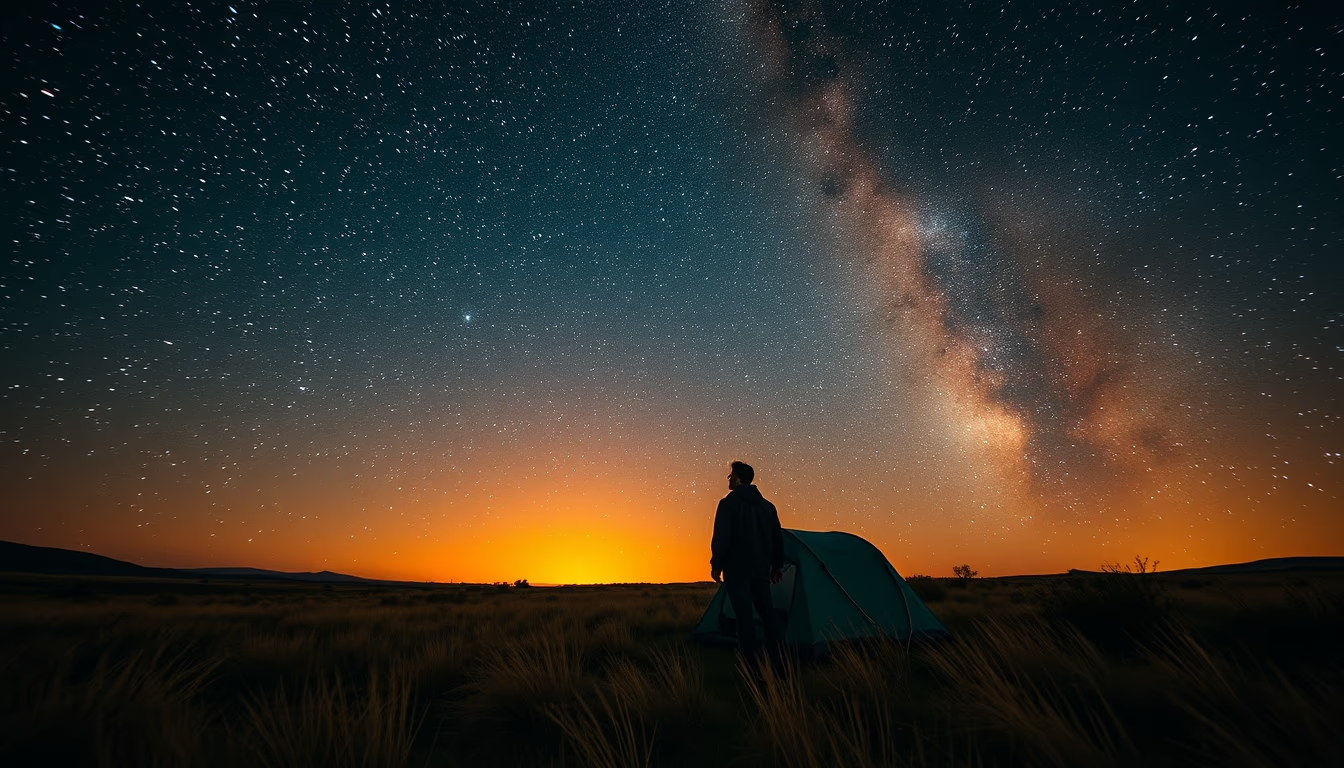
The Milky Way is the spiral galaxy that hosts the Solar System, composed of billions of stars visible on moonless nights away from light pollution.
About this subject
The Milky Way is a barred spiral galaxy containing between 100 and 400 billion stars, including the Sun. Its name comes from the Latin "via lactea," referring to its milky appearance in the night sky. The galaxy is estimated to have a diameter of about 100,000 light-years and a thickness of approximately 1,000 light-years. The Solar System is located in one of the spiral arms, the Orion Arm, about 27,000 light-years from the galactic center, which hosts a supermassive black hole known as Sagittarius A*.
Observing the Milky Way with the naked eye is possible in areas with low light pollution, such as rural regions or deserts. In Brazil, the Atacama Desert and the Chapada dos Veadeiros National Park are popular astrotourism destinations. The bright band we see is the galactic plane viewed from within, composed of stars, dust, and gas. Each year, new stars are born in the Milky Way from molecular clouds, while others explode as supernovae, enriching the interstellar medium with heavy elements.
The Milky Way is part of the Local Group, a collection of over 80 galaxies, including Andromeda and the Triangulum Galaxy. Studies indicate that in about 4 billion years, the Milky Way will collide with the Andromeda Galaxy, forming a new elliptical galaxy. Astronomers use telescopes such as Hubble and James Webb to study the structure and evolution of our galaxy, revealing details about star formation and dark matter.
Frequently Asked Questions
How many stars are in the Milky Way?
The Milky Way is estimated to contain between 100 and 400 billion stars, depending on astronomical models.
Where is the Solar System located in the Milky Way?
The Solar System is located in the Orion Arm, about 27,000 light-years from the galactic center.
What is the best place in Brazil to observe the Milky Way?
Locations with low light pollution, such as the Atacama Desert or Chapada dos Veadeiros National Park, are ideal for observation.
Direct URL
https://pub-c7d6a6ea828543ac903a74a341ccb2e1.r2.dev/imagens/milky-way-stars-cinematic-wide-shot-v2.avifHow to credit
Include a visible link back to UtilizAí. Copy one of the snippets below:
<a href="https://xn--utiliza-eza.com/en/midia/imagens/milky-way-stars-cinematic-wide-shot-v2">Milky way stars</a> by <a href="https://xn--utiliza-eza.com">UtilizAí</a>, licensed under <a href="https://creativecommons.org/licenses/by/4.0/">CC BY 4.0</a>.
[Milky way stars](https://xn--utiliza-eza.com/en/midia/imagens/milky-way-stars-cinematic-wide-shot-v2) by [UtilizAí](https://xn--utiliza-eza.com), CC BY 4.0
License: CC-BY-4.0