Mars rover surface
1344×768 · AVIF · CC BY 4.0
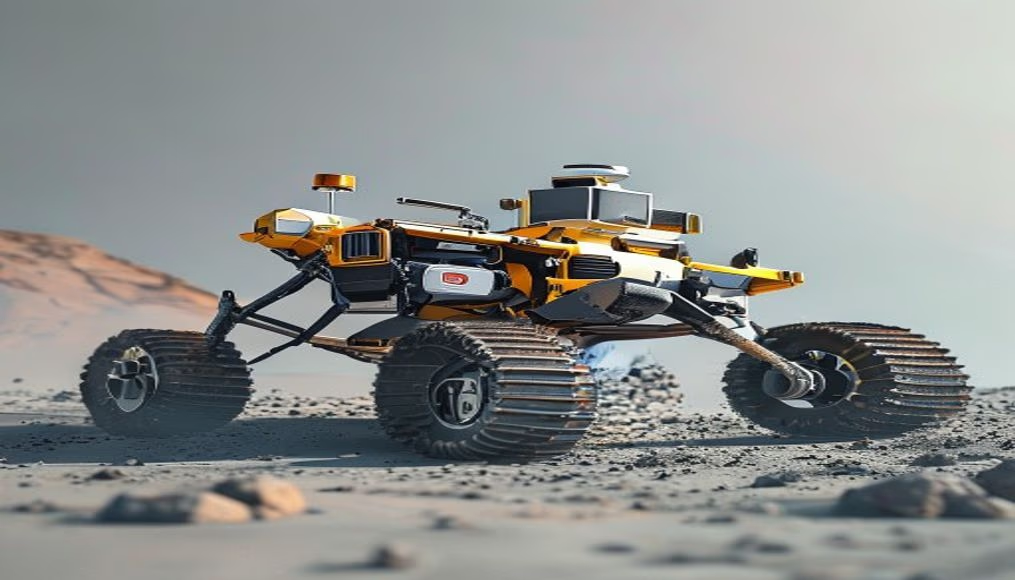
Discover the Mars rovers that explore the surface of Mars, their discoveries, and technical challenges in missions by NASA and other agencies.
About this subject
Mars rovers are robotic vehicles designed to traverse the surface of Mars, collect data, and perform scientific experiments. Since Sojourner landed in 1997 as part of the Mars Pathfinder mission, NASA has sent five successful rovers: Spirit, Opportunity, Curiosity, Perseverance, and most recently, China's Zhurong. Each mission has contributed fundamental discoveries about the planet's geology, atmosphere, and potential habitability.
The Curiosity rover, active since 2012, has traveled over 25 kilometers in Gale Crater, identifying organic compounds and evidence of ancient lakes. Meanwhile, Perseverance, which landed in 2021, collects rock and soil samples for a future return-to-Earth mission and tested the Ingenuity helicopter, the first powered flight on another world. China's Zhurong explored Utopia Planitia and detected signs of recent water activity.
Technical challenges include communication delays of 4 to 24 minutes, intense radiation, and temperatures ranging from plus 20 to minus 130 degrees Celsius. Rovers use nuclear batteries or solar panels, rely on autonomous navigation systems, and must avoid hazardous craters and rocks. Each sol (Martian day), the vehicles send data that expand our knowledge of the red planet.
Beyond science, robotic exploration inspires technologies for future crewed missions. Space agencies plan to send astronauts to Mars in the 2030s, and current rovers serve as precursors, mapping resources like subsurface water and testing materials for habitats. The arid, dusty Martian surface holds secrets that may reveal the history of the solar system.
Frequently Asked Questions
How many rovers have successfully landed on Mars?
As of 2023, six rovers have successfully landed on Mars: Sojourner (1997), Spirit (2004), Opportunity (2004), Curiosity (2012), Perseverance (2021), and Zhurong (2021). All were operated by NASA except Zhurong, from China.
What is the difference between the Curiosity and Perseverance rovers?
Curiosity focuses on geology and searching for organic compounds, while Perseverance collects samples for return to Earth and tests technologies for human missions, such as oxygen production and the Ingenuity helicopter.
How do rovers move on the Martian surface?
They use motorized wheels and suspension systems adapted for rocky terrain. Navigation is autonomous with cameras and lasers, supplemented by commands from Earth, considering the communication delay.
Direct URL
https://pub-c7d6a6ea828543ac903a74a341ccb2e1.r2.dev/imagens/mars-rover-surface-commercial-product-photography-v9.avifHow to credit
Include a visible link back to UtilizAí. Copy one of the snippets below:
<a href="https://xn--utiliza-eza.com/en/midia/imagens/mars-rover-surface-commercial-product-photography-v9">Mars rover surface</a> by <a href="https://xn--utiliza-eza.com">UtilizAí</a>, licensed under <a href="https://creativecommons.org/licenses/by/4.0/">CC BY 4.0</a>.
[Mars rover surface](https://xn--utiliza-eza.com/en/midia/imagens/mars-rover-surface-commercial-product-photography-v9) by [UtilizAí](https://xn--utiliza-eza.com), CC BY 4.0
License: CC-BY-4.0