Lidar sensor on car roof
1344×768 · AVIF · CC BY 4.0
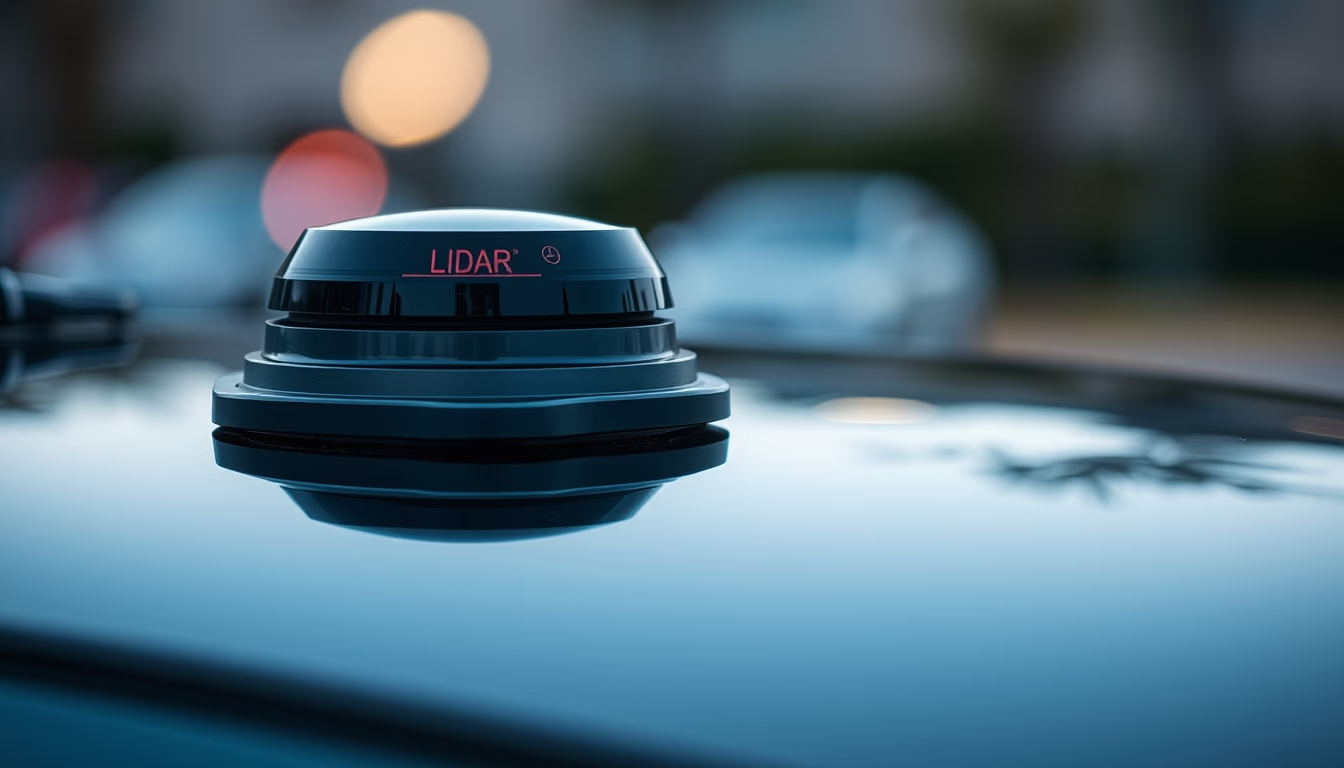
LiDAR sensor on the car roof captures 3D point clouds for autonomous navigation, using laser pulses to map the environment in real time.
About this subject
The LiDAR (Light Detection and Ranging) sensor mounted on the roof of autonomous vehicles operates as a three-dimensional scanner. It emits laser pulses that reflect off surrounding objects and return to the sensor, allowing distance calculations with millimeter precision. This technology is essential for level 4 and 5 autonomous vehicle perception, as it provides depth data independent of lighting conditions.
Roof mounting is strategic to achieve a 360-degree field of view without obstructions. Modern sensors, such as those from Velodyne or Hesai, rotate internally to scan the horizon, generating thousands of points per second. Each point represents a 3D pixel, forming a point cloud that the autonomous driving system interprets to identify pedestrians, cyclists, vehicles, and obstacles.
By 2026, LiDARs are becoming more compact and affordable, with companies like Luminar and Innoviz competing for the mass production car sensor market. Once limited to research prototypes, they now equip models from brands like Volvo, BMW, and Mercedes-Benz. In Brazil, tests with LiDAR-equipped autonomous vehicles occur in controlled environments such as university campuses and gated communities, but regulation still restricts public road circulation.
LiDAR precision is complemented by cameras and radar in a sensor fusion approach. However, challenges like heavy rain and dust can degrade the signal. Recent advances include solid-state LiDARs with no moving parts, promising greater durability and lower cost, accelerating large-scale adoption.
Frequently Asked Questions
What is the difference between LiDAR and radar in autonomous vehicles?
LiDAR uses laser pulses (light) to create high-resolution 3D maps, while radar uses radio waves, which are better for detecting objects at long range and in adverse weather. They are often used together in autonomous vehicles to complement each other's strengths and weaknesses.
Why is the LiDAR sensor usually placed on the car roof?
The roof position provides an unobstructed 360-degree field of view, essential for the sensor to map the entire surroundings of the vehicle without blockage from other car components like the hood or fenders.
Is LiDAR mandatory for autonomous cars?
No, it is not mandatory, but it is widely used in advanced autonomy levels (4 and 5) due to its precision in 3D perception. Some companies, like Tesla, opt to use only cameras and radar, though there is debate about the safety of that approach.
Direct URL
https://pub-c7d6a6ea828543ac903a74a341ccb2e1.r2.dev/imagens/lidar-sensor-on-car-roof-macro-closeup-p6.avifHow to credit
Include a visible link back to UtilizAí. Copy one of the snippets below:
<a href="https://xn--utiliza-eza.com/en/midia/imagens/lidar-sensor-on-car-roof-macro-closeup-p6">Lidar sensor on car roof</a> by <a href="https://xn--utiliza-eza.com">UtilizAí</a>, licensed under <a href="https://creativecommons.org/licenses/by/4.0/">CC BY 4.0</a>.
[Lidar sensor on car roof](https://xn--utiliza-eza.com/en/midia/imagens/lidar-sensor-on-car-roof-macro-closeup-p6) by [UtilizAí](https://xn--utiliza-eza.com), CC BY 4.0
License: CC-BY-4.0