Kodak brownie box camera
1344×768 · AVIF · CC BY 4.0
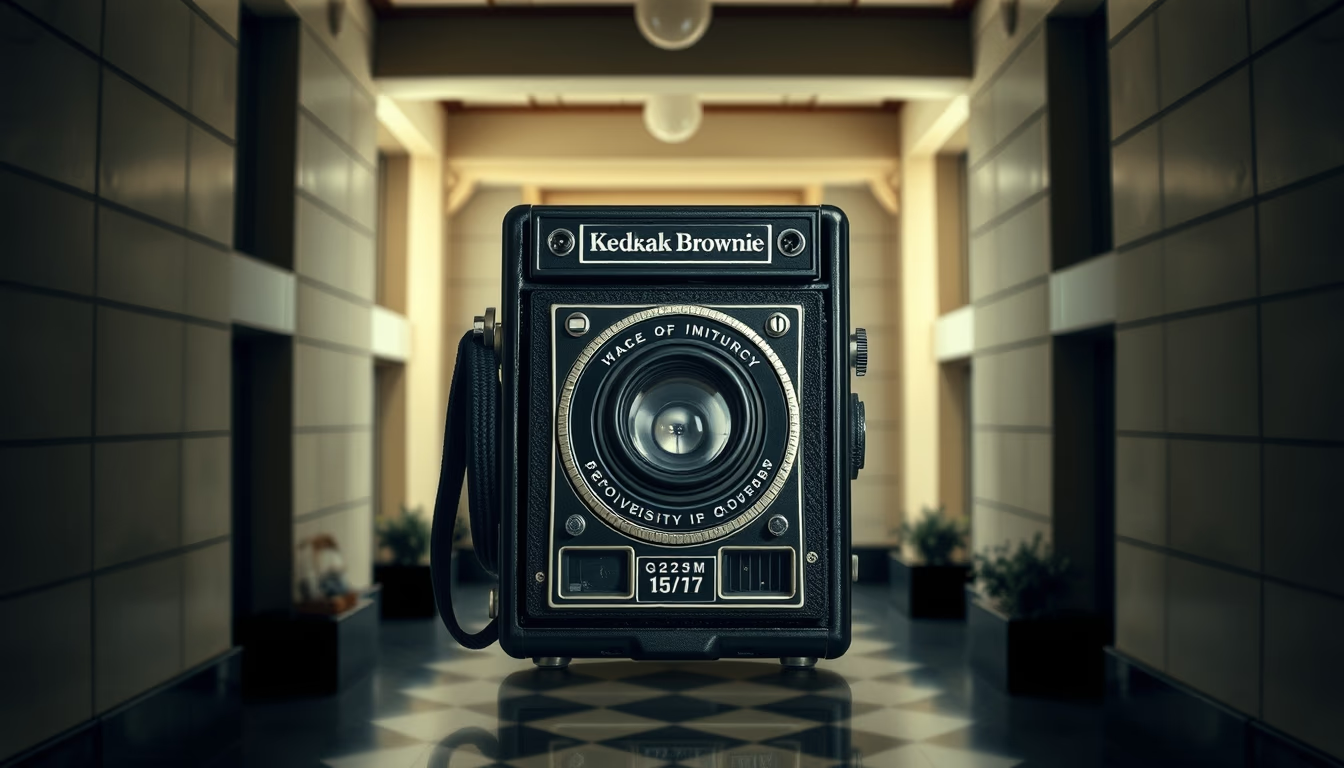
The Kodak Brownie Box Camera revolutionized amateur photography in the early 20th century, making snapping pictures accessible to millions.
About this subject
Introduced in 1900 by the Eastman Kodak Company, the Brownie Box Camera was a milestone in the democratization of photography. Priced at only one dollar, it put cameras into the hands of ordinary families, eliminating the need for expensive and complex equipment. Its name comes from the impish characters created by Palmer Cox, the Brownies, reinforcing the idea of simplicity and fun. The camera used 117 roll film, producing 2 1/4 x 2 1/4 inch (approx. 6x6 cm) negatives. Operation was basic: two aperture settings (f/11 and f/16) and a single-speed shutter of about 1/25 second, with no focus adjustment. The Brownie was produced for over 60 years, with variations like the Brownie 2 and Brownie Hawkeye, selling millions of units worldwide. Its cultural impact is immense: it popularized photojournalism, family records, and even travel photography, as it was light and portable. In architecture, images taken with the Brownie have a distinctive aesthetic: due to optical limitations, photos show edge vignetting and nearly infinite depth of field, resulting in a documentary representation of urban and rural structures. Many amateur photographers used the Brownie to capture city transformations in the early 20th century, creating a valuable historical archive. The camera also inspired later model designs and is remembered as a cultural icon.
Frequently Asked Questions
What is the Kodak Brownie Box Camera?
It is a box camera launched by Eastman Kodak in 1900, notable for its low cost ($1) and simplicity, which popularized amateur photography.
How did the Brownie impact architectural photography?
It enabled amateurs to document urban and rural structures with a documentary look, due to great depth of field and vignetting. This created a vast visual archive of early 20th-century architecture.
What film did the Brownie use and what was image quality like?
It used 117 roll film, 6x6 cm format. Images had dark corners (vignetting) and fixed focus, giving a distinctive but not sharp look. The camera had no exposure control.
Direct URL
https://pub-c7d6a6ea828543ac903a74a341ccb2e1.r2.dev/imagens/kodak-brownie-box-camera-architectural-photography-fresh18.avifHow to credit
Include a visible link back to UtilizAí. Copy one of the snippets below:
<a href="https://xn--utiliza-eza.com/en/midia/imagens/kodak-brownie-box-camera-architectural-photography-fresh18">Kodak brownie box camera</a> by <a href="https://xn--utiliza-eza.com">UtilizAí</a>, licensed under <a href="https://creativecommons.org/licenses/by/4.0/">CC BY 4.0</a>.
[Kodak brownie box camera](https://xn--utiliza-eza.com/en/midia/imagens/kodak-brownie-box-camera-architectural-photography-fresh18) by [UtilizAí](https://xn--utiliza-eza.com), CC BY 4.0
License: CC-BY-4.0