Kaaba mecca aerial
1344×768 · AVIF · CC BY 4.0
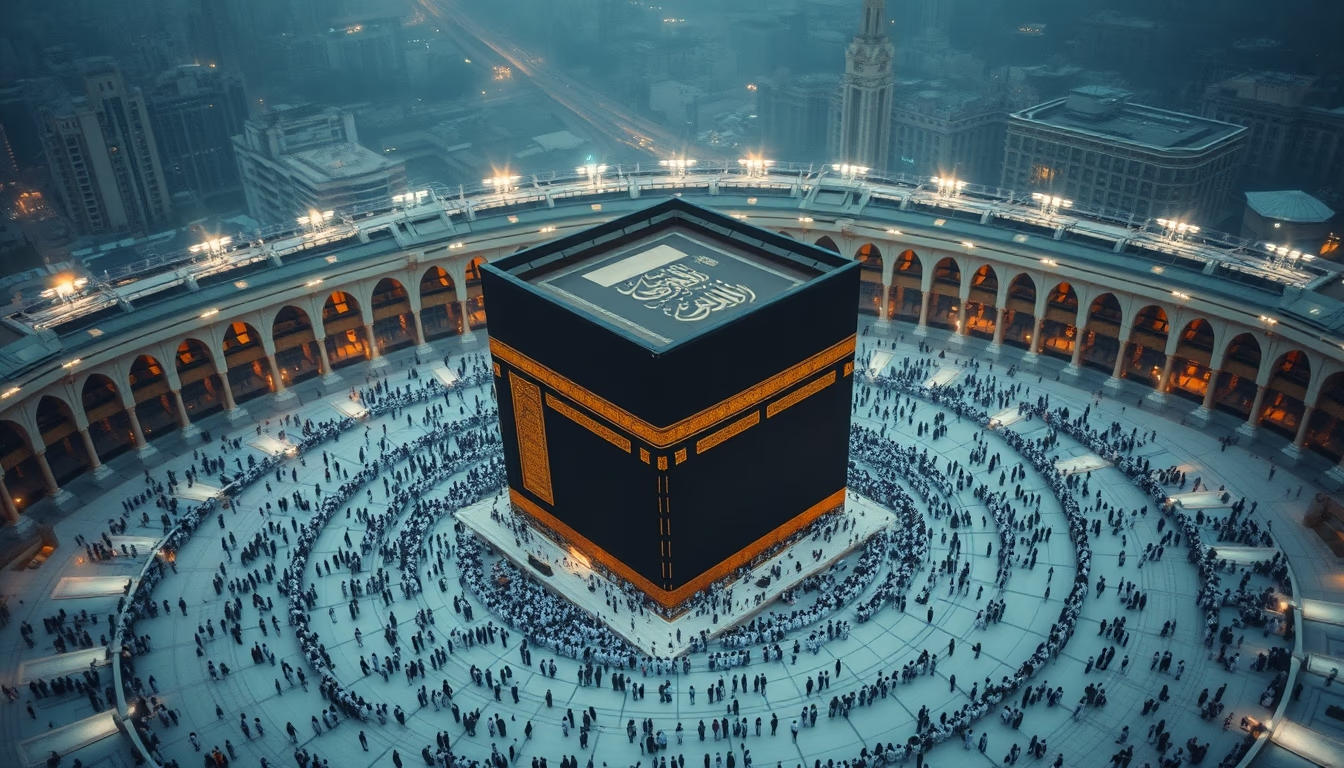
The Kaaba in Mecca, seen from above, is the center of the Al-Masjid al-Haram mosque and the holiest site in Islam, towards which Muslims turn five times a day in prayer.
About this subject
The Kaaba is a cube-shaped building located at the center of the Great Mosque (Al-Masjid al-Haram) in Mecca, Saudi Arabia. Considered the House of God (Baitullah) in Islam, it is the direction towards which Muslims worldwide turn for their daily prayers. The structure stands approximately 13.1 meters tall, with sides ranging from 11.03 to 12.86 meters. It is covered by a black silk and gold curtain called the Kiswah, replaced annually during the Hajj pilgrimage.
Islamic tradition holds that the Kaaba was originally built by the prophet Abraham and his son Ishmael as a monotheistic place of worship. Before Islam, it housed over 360 pagan idols. In 630 AD, the prophet Muhammad purified the Kaaba, establishing it as the center of Islam. The Black Stone (Hajar al-Aswad), embedded in the eastern corner, is venerated and kissed by pilgrims.
During the Hajj, the annual pilgrimage required of all able-bodied Muslims, pilgrims perform the Tawaf: circling the Kaaba seven times counterclockwise. The Kaaba also serves as the focal point for the Qibla, the prayer direction for over 1.8 billion Muslims. The surrounding mosque has seen multiple expansions, now accommodating over two million worshippers. The aerial view reveals the concentric geometry of prayer spaces, with the Kaaba at the epicenter.
Frequently Asked Questions
Why is the Kaaba considered the center of Islam?
The Kaaba is seen as the house of God on Earth, built by Abraham and Ishmael. Muslims believe it is the focal point of worship to Allah, and all believers pray facing its direction (Qibla).
What is the Black Stone and its significance?
The Black Stone (Hajar al-Aswad) is a fragment of rock, supposedly of celestial origin, set in the eastern corner of the Kaaba. According to tradition, it was given to Abraham by the angel Gabriel. During Hajj, pilgrims attempt to kiss or touch it as an act of devotion.
How is the annual replacement of the Kiswah carried out?
The Kiswah, the black cloth covering the Kaaba, is crafted annually at a special factory in Mecca. During a ceremony at the start of Hajj, the new Kiswah is raised over the structure while the old one is removed and cut into pieces distributed as blessings.
Direct URL
https://pub-c7d6a6ea828543ac903a74a341ccb2e1.r2.dev/imagens/kaaba-mecca-aerial-high-fashion-editorial-p7.avifHow to credit
Include a visible link back to UtilizAí. Copy one of the snippets below:
<a href="https://xn--utiliza-eza.com/en/midia/imagens/kaaba-mecca-aerial-high-fashion-editorial-p7">Kaaba mecca aerial</a> by <a href="https://xn--utiliza-eza.com">UtilizAí</a>, licensed under <a href="https://creativecommons.org/licenses/by/4.0/">CC BY 4.0</a>.
[Kaaba mecca aerial](https://xn--utiliza-eza.com/en/midia/imagens/kaaba-mecca-aerial-high-fashion-editorial-p7) by [UtilizAí](https://xn--utiliza-eza.com), CC BY 4.0
License: CC-BY-4.0