Kaaba mecca aerial
1344×768 · AVIF · CC BY 4.0
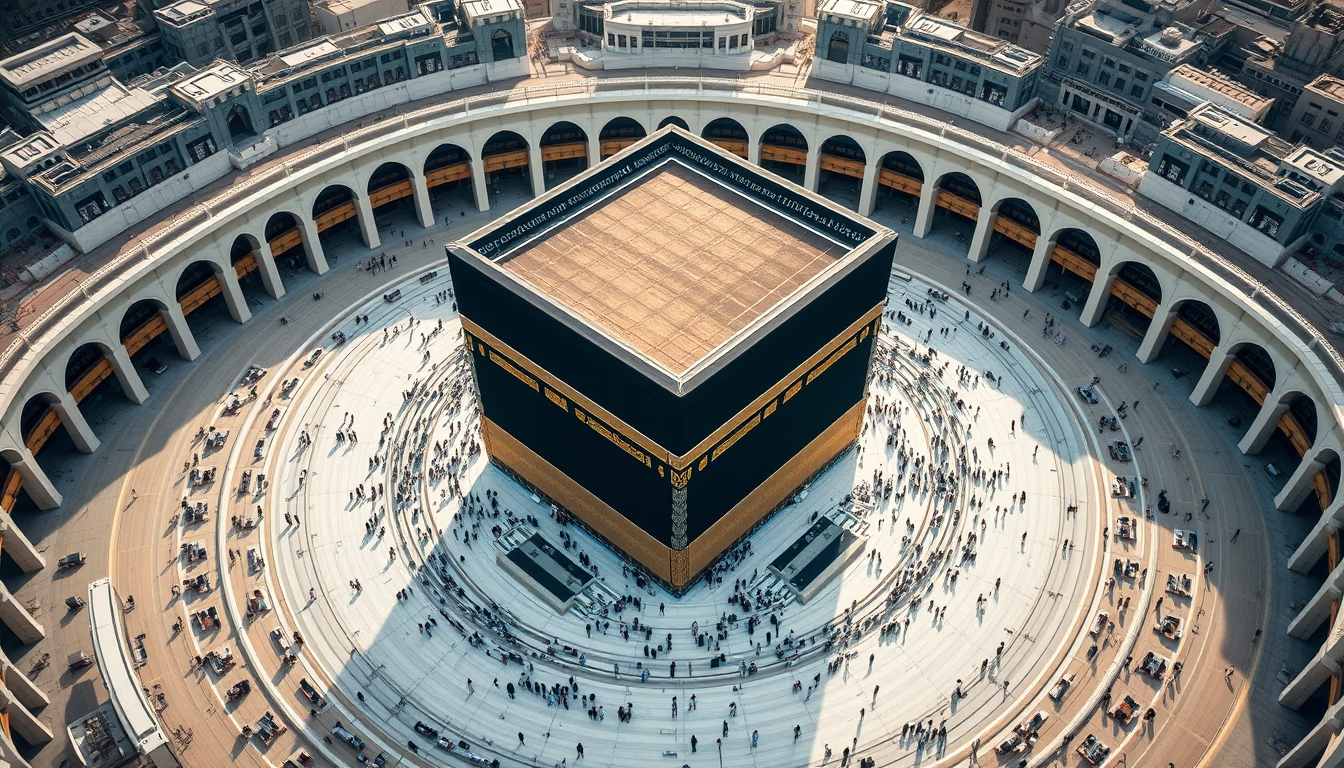
Aerial view of the Kaaba in Mecca, the sacred center of Islam and destination of the annual Hajj pilgrimage.
About this subject
The Kaaba is a cubic structure located at the center of the Grand Mosque (Masjid al-Haram) in Mecca, Saudi Arabia. Considered the House of God (Baitullah) in Islam, Muslims around the world face it during their daily prayers (salat). The structure is about 13.1 meters high, with sides measuring 11.03 by 12.86 meters, and is covered by a black silk cloth embroidered with gold, called the kiswah, which is replaced annually.
According to Islamic tradition, the Kaaba was originally built by the prophet Abraham (Ibrahim) and his son Ishmael (Ismail) as a place of worship for the one God. Before the advent of Islam, it housed idols of various Arab tribes. In 630 CE, the Prophet Muhammad purified the Kaaba by removing the idols and reestablishing monotheism. Since then, it has been the holiest site in Islam, where pilgrims from around the world gather for Hajj and Umrah.
The building sits within a large courtyard that can accommodate millions of worshippers. Next to it is the Black Stone (al-Hajar al-Aswad), a rock fragment believed to have been sent from paradise. Pilgrims attempt to kiss or touch it during the Tawaf, the circumambulation around the Kaaba. The structure itself has no windows; its door, made of solid gold, is raised about 2 meters above the ground.
The region of Mecca lies in an arid valley, but the city is one of the most important urban centers in Saudi Arabia. The aerial view of the Kaaba highlights the contrast between the dark building and the white marble courtyard, surrounded by modern skyscrapers and hotels. Every year, millions of Muslims perform the pilgrimage, making the Kaaba a symbol of unity and devotion.
Frequently Asked Questions
Why is the Kaaba considered the holiest site in Islam?
The Kaaba is considered the House of God (Baitullah) and the focal point of Muslim prayers. According to tradition, it was built by Abraham and Ishmael and purified by Prophet Muhammad, representing the unity of monotheism.
What is the Black Stone and its significance?
The Black Stone (al-Hajar al-Aswad) is set into the eastern corner of the Kaaba. Islamic tradition holds that it was sent from paradise and that touching or kissing it during Tawaf is a means of seeking blessings, though it is not obligatory.
How is the kiswah, the cloth covering the Kaaba, replaced?
The kiswah is produced annually in a special factory in Mecca. The replacement occurs during Hajj on the 9th day of Dhu al-Hijjah. The old cloth is cut into pieces and distributed as gifts.
Direct URL
https://pub-c7d6a6ea828543ac903a74a341ccb2e1.r2.dev/imagens/kaaba-mecca-aerial-architectural-photography-p8.avifHow to credit
Include a visible link back to UtilizAí. Copy one of the snippets below:
<a href="https://xn--utiliza-eza.com/en/midia/imagens/kaaba-mecca-aerial-architectural-photography-p8">Kaaba mecca aerial</a> by <a href="https://xn--utiliza-eza.com">UtilizAí</a>, licensed under <a href="https://creativecommons.org/licenses/by/4.0/">CC BY 4.0</a>.
[Kaaba mecca aerial](https://xn--utiliza-eza.com/en/midia/imagens/kaaba-mecca-aerial-architectural-photography-p8) by [UtilizAí](https://xn--utiliza-eza.com), CC BY 4.0
License: CC-BY-4.0