Jadeite imperial ring burmese
1344×768 · AVIF · CC BY 4.0
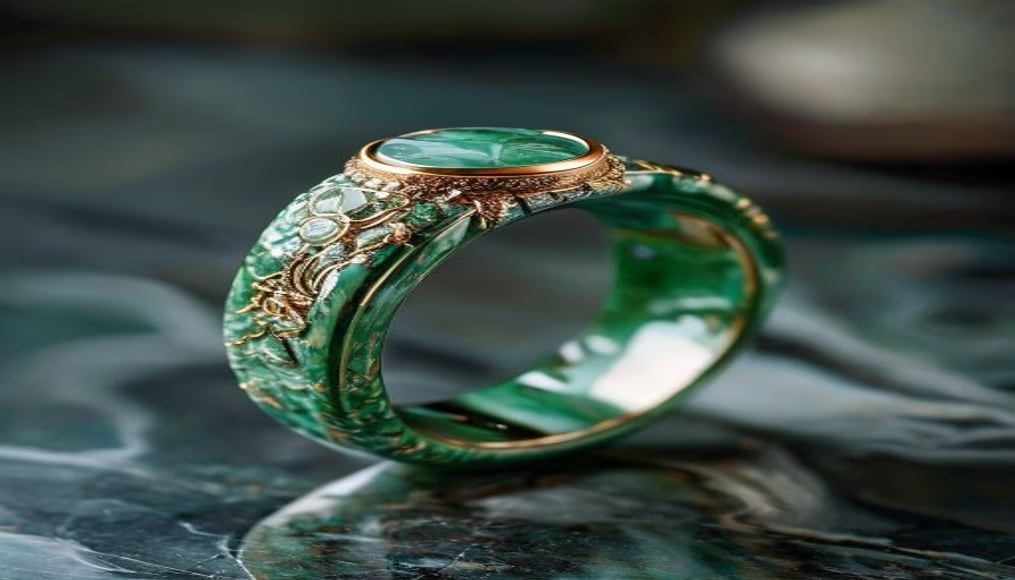
Burmese imperial jadeite is one of the world's most valuable gemstones, prized for its intense green color and exceptional translucency.
About this subject
Burmese imperial jadeite, sourced from the Mogok region in Myanmar, is considered the highest grade of jadeite. Its vivid emerald-green color, caused by chromium content, combined with a glassy and nearly transparent texture, sets it apart from other varieties. The formation of this mineral occurs under specific geological conditions of high pressure and low temperature, making its extraction rare and challenging.
In Chinese culture, jade symbolizes virtues such as purity, courage, and wisdom, used for millennia in jewelry and ceremonial objects. Emperor Qianlong (18th century) was a known connoisseur, and pieces from his collection reach millions at auctions. Today, Burmese imperial jadeite rings are coveted by collectors and investors, with values that can surpass those of the finest diamonds.
The evaluation of imperial jadeite takes into account four main criteria: color, transparency, texture, and purity. The ideal color is an intense, uniform green without grayish or bluish spots. Maximum translucency allows light to pass through the stone, revealing an internal glow known as "gelatin luster." The texture must be fine and homogeneous, without visible inclusions, and purity means no cracks or fractures.
The market for Burmese imperial jadeite is heavily influenced by Asian demand, especially from China, where the gem is seen as a symbol of status and spiritual protection. Auctions at Sotheby's and Christie's frequently feature historical pieces, and the scarcity of new sources has consistently driven prices up. For those seeking an investment in luxury jewelry, a Burmese imperial jadeite ring represents a combination of beauty, rarity, and cultural value.
Frequently Asked Questions
Why is Burmese imperial jadeite so valuable?
Burmese imperial jadeite is extremely rare, with an intense translucent green color, fine texture, and high purity. Its origin in the Mogok region of Myanmar and strong cultural demand in China drive its value, often surpassing that of diamonds.
How can you identify genuine imperial jadeite?
Genuine imperial jadeite can be identified by its uniform vivid green color, high translucency, and lack of inclusions. Gemological tests include refractive index measurement (1.66, 1.68), density (3.30, 3.38), and spectroscopy to detect chromium.
What is the symbolism of jade in Chinese culture?
In Chinese culture, jade symbolizes virtues such as purity, benevolence, integrity, and wisdom. It is used in jewelry for spiritual protection and as a good luck charm. Emperor Qianlong believed jade had properties that balanced yin and yang.
Direct URL
https://pub-c7d6a6ea828543ac903a74a341ccb2e1.r2.dev/imagens/jadeite-imperial-ring-burmese-marble-surface-luxury-still-life-luxo0.avifHow to credit
Include a visible link back to UtilizAí. Copy one of the snippets below:
<a href="https://xn--utiliza-eza.com/en/midia/imagens/jadeite-imperial-ring-burmese-marble-surface-luxury-still-life-luxo0">Jadeite imperial ring burmese</a> by <a href="https://xn--utiliza-eza.com">UtilizAí</a>, licensed under <a href="https://creativecommons.org/licenses/by/4.0/">CC BY 4.0</a>.
[Jadeite imperial ring burmese](https://xn--utiliza-eza.com/en/midia/imagens/jadeite-imperial-ring-burmese-marble-surface-luxury-still-life-luxo0) by [UtilizAí](https://xn--utiliza-eza.com), CC BY 4.0
License: CC-BY-4.0