Humanoid robot in clean white lab
1344×768 · AVIF · CC BY 4.0
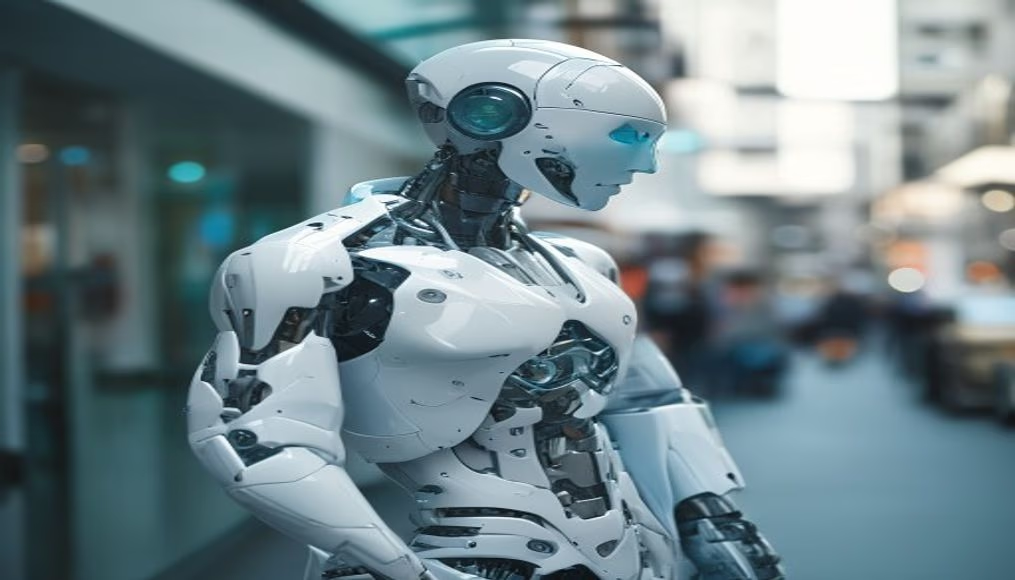
Humanoid robots are machines designed to mimic the human body, used in research, assistance, and industry.
About this subject
Humanoid robots are robotic systems with a body shape similar to humans, including a torso, head, arms, and often legs. The first modern humanoid robot was WABOT-1, developed in Japan in 1973, which already had bipedal locomotion and basic communication capabilities. Since then, projects like Honda's ASIMO and Boston Dynamics' Atlas have driven significant advances in dynamic balance and artificial intelligence. Today, these robots are used in areas such as customer service, where models like Pepper interact with people in stores and hospitals, and space exploration, with NASA testing humanoids for Mars missions.
In Brazil, the development of humanoids gained prominence with the Laura Robot Project at the University of São Paulo, focused on social interaction and elderly assistance. Another example is the Poppy humanoid, used in bipedal locomotion research at the Federal University of ABC. Despite progress, building humanoid robots still faces enormous technical challenges, such as locomotion on uneven terrain and recognition of human emotions. Companies like Hanson Robotics created Sophia, which combines artificial intelligence with realistic facial expressions, sparking debates about ethics and social impact.
The presence of humanoids in daily life is still limited but promising. In healthcare, they can assist in surgeries and physical rehabilitation, while in industry they perform repetitive tasks with high precision. High cost and maintenance complexity are barriers, but research into lightweight materials and cheaper sensors is making the technology more accessible. With the evolution of cloud computing and machine learning, humanoid robots are expected to become more autonomous and integrated into human environments, revolutionizing everything from domestic service to scientific exploration.
Frequently Asked Questions
What differentiates a humanoid robot from other types of robots?
The main difference is the body shape: humanoid robots mimic the human structure, with a torso, head, arms, and legs, allowing interaction in environments designed for people. Other robots, such as industrial ones, have specialized forms for specific tasks.
What are the main challenges in building humanoid robots?
The biggest challenges include maintaining balance during bipedal locomotion, achieving smooth and natural movements, and developing artificial intelligence that enables social interaction and real-time decision-making. The cost of sensors and actuators is also an obstacle.
Where are humanoid robots most used today?
They are employed in academic research, customer service (as receptionists), elderly and disabled assistance, space exploration, and entertainment. Examples include ASIMO in demonstrations and Pepper in stores and hospitals.
Direct URL
https://pub-c7d6a6ea828543ac903a74a341ccb2e1.r2.dev/imagens/humanoid-robot-in-clean-white-lab-street-photography-v11.avifHow to credit
Include a visible link back to UtilizAí. Copy one of the snippets below:
<a href="https://xn--utiliza-eza.com/en/midia/imagens/humanoid-robot-in-clean-white-lab-street-photography-v11">Humanoid robot in clean white lab</a> by <a href="https://xn--utiliza-eza.com">UtilizAí</a>, licensed under <a href="https://creativecommons.org/licenses/by/4.0/">CC BY 4.0</a>.
[Humanoid robot in clean white lab](https://xn--utiliza-eza.com/en/midia/imagens/humanoid-robot-in-clean-white-lab-street-photography-v11) by [UtilizAí](https://xn--utiliza-eza.com), CC BY 4.0
License: CC-BY-4.0