Helicopter heliport rooftop
1344×768 · AVIF · CC BY 4.0
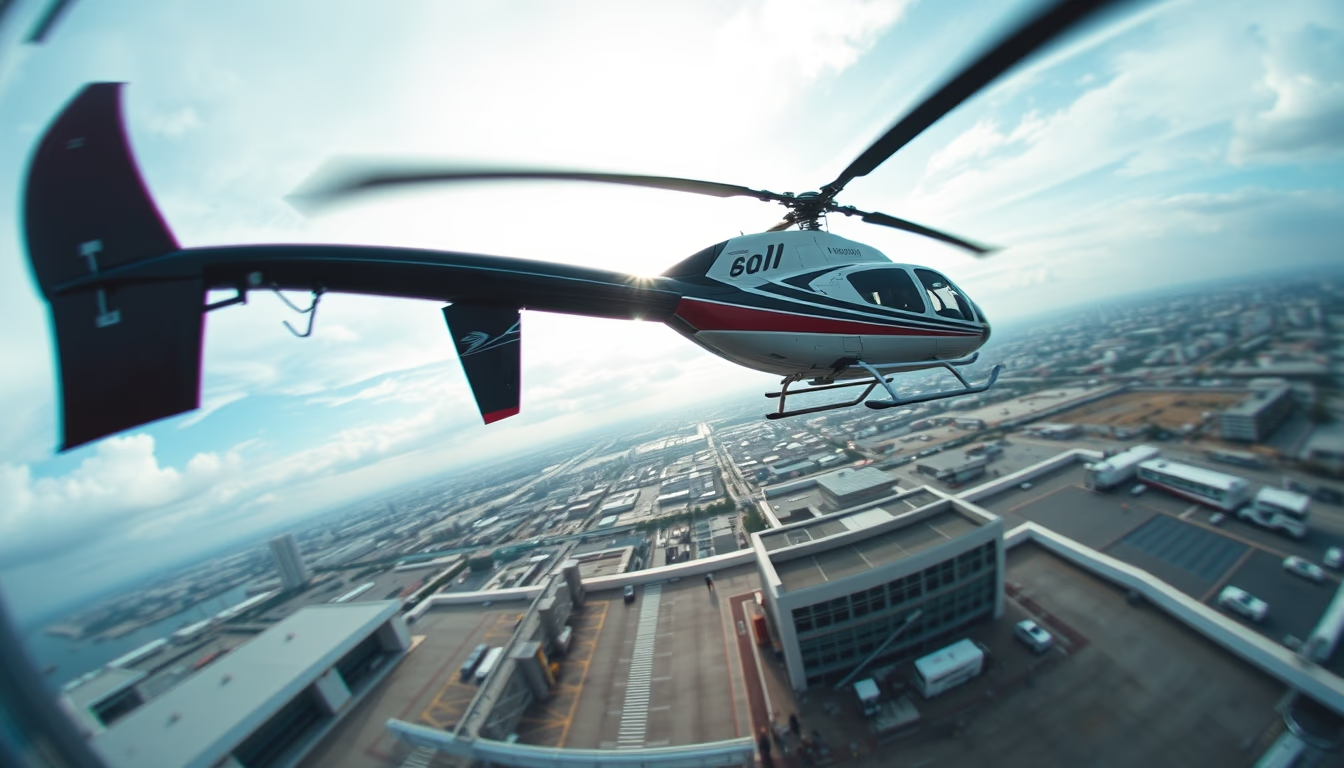
Rooftop heliports are structures designed for helicopter landing and takeoff in dense urban areas, combining precision engineering with strict safety regulations.
About this subject
Rooftop heliports are a common solution in dense urban centers where horizontal space is limited. They support executive air travel, emergency medical services, and rescue operations in hard-to-reach areas. Constructing a rooftop heliport requires careful structural analysis, as the weight of the helicopter, dynamic loads during landing and takeoff, and constant vibration must be supported by the slab. Materials such as reinforced concrete and steel are often used, and the surface must be non-slip and marked with standardized visual signals, such as a circle with the letter "H".
In Brazil, the National Civil Aviation Agency (ANAC) and the Department of Airspace Control (DECEA) regulate these heliports, requiring obstacle analysis, safety distances, and approach procedures. In cities like São Paulo and Rio de Janeiro, rooftop heliports are common in hospitals, financial centers, and luxury hotels. The increasing use of drones and eVTOLs (electric vertical takeoff and landing aircraft) has driven the modernization of these structures, with charging systems and connectivity for autonomous vehicles.
Interestingly, the world's first certified rooftop heliport was established in 1947 on a building in Manhattan, New York. Since then, design has evolved to include fire suppression systems, peripheral safety nets, and low-impact nighttime lighting. Periodic maintenance includes crack inspections, drainage checks, and fire resistance tests. Temporary heliports are also used for events or construction, assembled from metal modules.
The fisheye angle used in the photograph highlights the curvature of the horizon and the expanse of the heliport, emphasizing the integration of engineering and architecture. Such imagery is useful for technical manuals, training materials, or reports on urban mobility. The presence of rooftop heliports reflects the need for vertical transportation solutions in increasingly vertical cities.
Frequently Asked Questions
What are the basic requirements for building a rooftop heliport?
A feasibility study, obstacle analysis, standardized visual markings, and compliance with ANAC and DECEA regulations are required. The surface must support the helicopter's maximum weight and include drainage and fire suppression systems.
Are rooftop heliports safe in dense urban areas?
Yes, if designed according to strict regulations. They include safety nets, proper lighting, and specific approach procedures. Accidents are rare but require constant maintenance and pilot training.
What is the difference between a heliport and a helipad?
A heliport is a complete facility for helicopter operations, including fueling and hangar areas. A helipad is a simpler landing and takeoff area, often found on rooftops.
Direct URL
https://pub-c7d6a6ea828543ac903a74a341ccb2e1.r2.dev/imagens/helicopter-heliport-rooftop-fish-eye-wide-angle-fresh11.avifHow to credit
Include a visible link back to UtilizAí. Copy one of the snippets below:
<a href="https://xn--utiliza-eza.com/en/midia/imagens/helicopter-heliport-rooftop-fish-eye-wide-angle-fresh11">Helicopter heliport rooftop</a> by <a href="https://xn--utiliza-eza.com">UtilizAí</a>, licensed under <a href="https://creativecommons.org/licenses/by/4.0/">CC BY 4.0</a>.
[Helicopter heliport rooftop](https://xn--utiliza-eza.com/en/midia/imagens/helicopter-heliport-rooftop-fish-eye-wide-angle-fresh11) by [UtilizAí](https://xn--utiliza-eza.com), CC BY 4.0
License: CC-BY-4.0