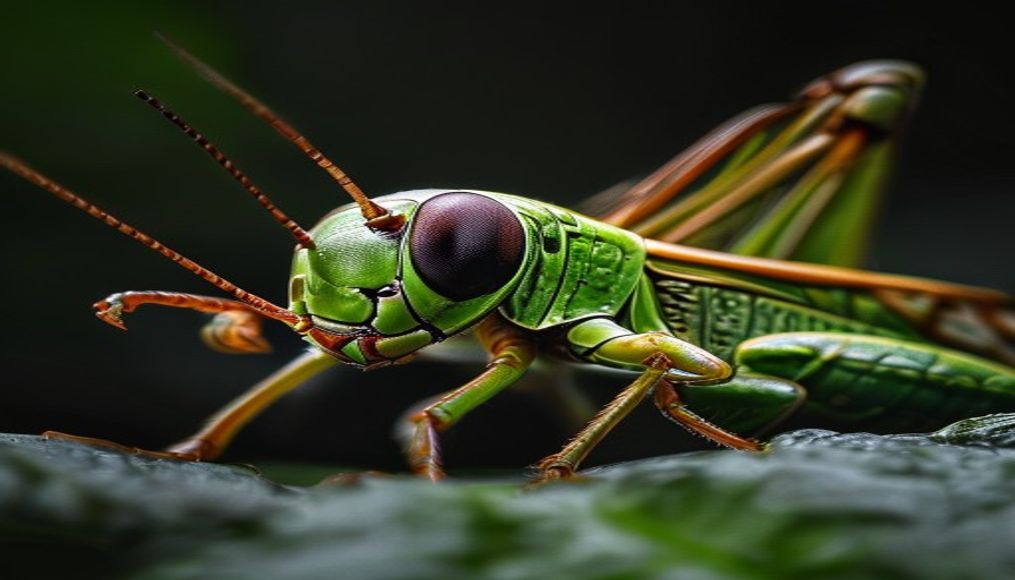
Grasshopper macro side
1344×768 · AVIF · CC BY 4.0

Detailed macro photograph of a grasshopper's profile reveals the complex anatomy and evolutionary adaptations of these jumping insects.
About this subject
Grasshoppers belong to the order Orthoptera and are renowned for their long hind legs adapted for jumping. Over 11,000 species are described worldwide, inhabiting environments from tropical grasslands to temperate regions. In Brazil, species such as the South American locust (Rhammatocerus schistocercoides) can form migratory swarms that cause significant agricultural damage, especially to sugarcane and soybean crops.
The lateral anatomy of a grasshopper reveals specialized structures. The pronotum (dorsal shield) protects the thorax, while folded wings cover the body. Grasshoppers have compound eyes with thousands of ommatidia, providing panoramic vision crucial for predator detection. Their filiform antennae are sensory, capturing vibrations and odors. Hearing organs, called tympana, are located on the first abdominal segment beneath the wings.
About 10% of grasshopper species exhibit gregarious behavior, shifting from solitary to gregarious phase under high population density. Triggered by tactile and chemical stimuli, this phenomenon results in swarms that can travel hundreds of kilometers. The migratory locust (Locusta migratoria) is a classic example, with historical records of devastation in Africa and Asia.
Reproduction involves egg-laying in pods buried in the soil, coated with a foam secreted by the female. Nymphs go through 5 to 6 instars (molts) before becoming winged adults. Adult lifespan ranges from a few weeks to months, depending on species and environmental conditions. Studying grasshoppers contributes to applied entomology, especially in developing biological control methods and population monitoring.
Frequently Asked Questions
How many species of grasshoppers exist worldwide?
There are over 11,000 described species of grasshoppers, found on all continents except Antarctica.
How do grasshoppers hear?
Grasshoppers have auditory organs called tympana, located on the first abdominal segment beneath the wings. They detect vibrations and sounds in the environment.
What causes grasshopper swarms?
Swarm formation occurs when certain species shift from solitary to gregarious phase due to high population density, triggered by physical contact and chemical stimuli.
Direct URL
https://pub-c7d6a6ea828543ac903a74a341ccb2e1.r2.dev/imagens/grasshopper-macro-side-aerial-drone-shot-p1.avifHow to credit
Include a visible link back to UtilizAí. Copy one of the snippets below:
<a href="https://xn--utiliza-eza.com/en/midia/imagens/grasshopper-macro-side-aerial-drone-shot-p1">Grasshopper macro side</a> by <a href="https://xn--utiliza-eza.com">UtilizAí</a>, licensed under <a href="https://creativecommons.org/licenses/by/4.0/">CC BY 4.0</a>.
[Grasshopper macro side](https://xn--utiliza-eza.com/en/midia/imagens/grasshopper-macro-side-aerial-drone-shot-p1) by [UtilizAí](https://xn--utiliza-eza.com), CC BY 4.0
License: CC-BY-4.0