GPU cluster in cooling data center
1344×768 · AVIF · CC BY 4.0
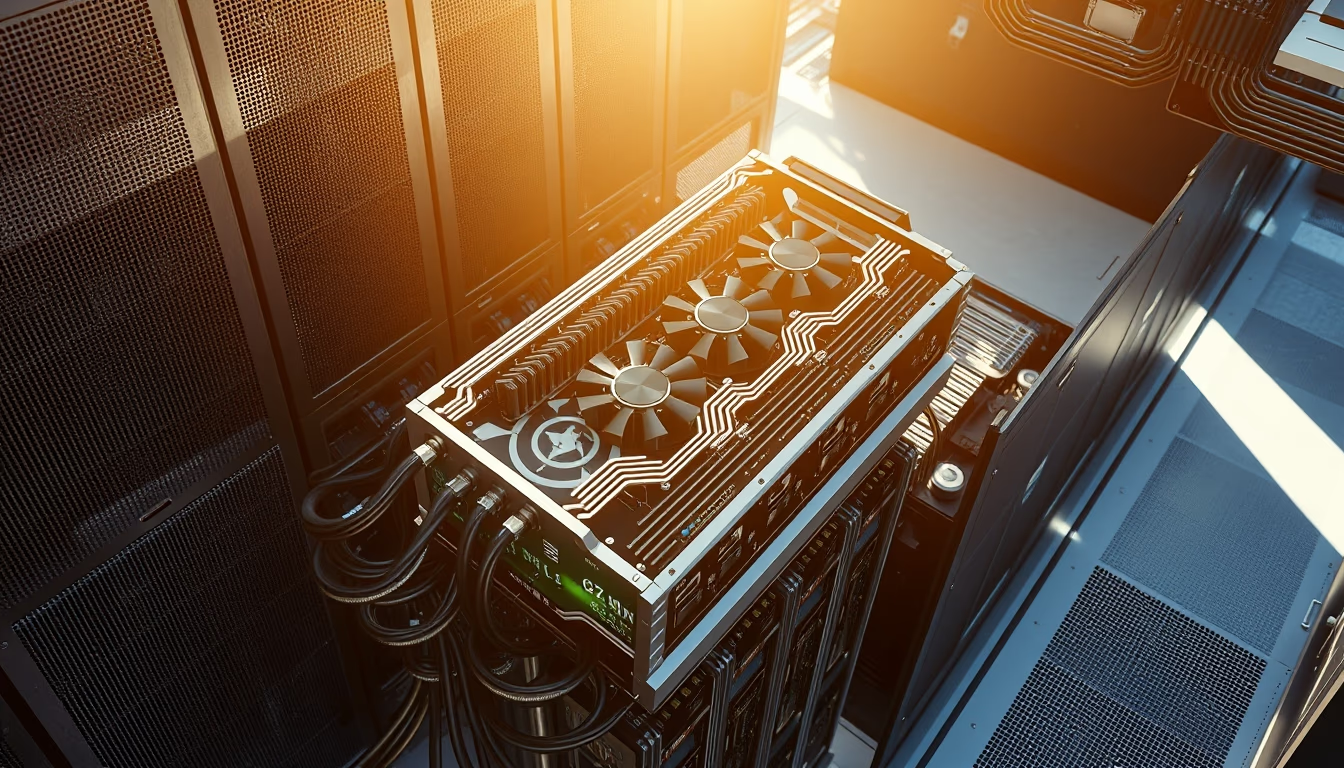
GPU cluster in a liquid-cooled data center, essential technology for large-scale artificial intelligence training.
About this subject
GPU clusters (Graphics Processing Units) are the backbone of modern artificial intelligence training, powering models like GPT-4 and BERT. Unlike traditional CPUs, GPUs contain thousands of parallel cores that process matrix operations simultaneously, reducing training time from weeks to days. Data centers housing these clusters face extreme thermal challenges: a single GPU can consume up to 700W, and entire racks generate heat comparable to an industrial furnace. To address this, direct-to-chip liquid cooling or dielectric immersion systems have become standard, especially in hyperscale facilities run by NVIDIA, Google, and Meta.
Data center location is strategically planned. Cold regions like the Nordic countries or sites near hydroelectric plants (e.g., Washington state, USA) are preferred to lower cooling costs and carbon footprint. In Brazil, São Paulo state concentrates much of the infrastructure, but recent projects in Ceará and Rio Grande do Sul aim to leverage renewable energy. A GPU cluster's energy consumption can exceed 30 MW, equivalent to a small town, sparking sustainability debates. Companies like Microsoft have tested underwater data centers to harness natural cooling.
Interestingly, GPU demand surged not only for AI but also for cryptocurrency mining and 3D rendering. The chip shortage in 2021-2023 delayed global projects and drove up prices. Conversely, advances in energy efficiency, such as NVIDIA's H100 GPUs (with 700W TDP), and distributed parallelism techniques (e.g., pipeline parallelism) allow scaling models with less hardware. Maintenance of these clusters requires autonomous robots and predictive monitoring systems, as extreme heat accelerates component degradation.
Frequently Asked Questions
Why are GPUs better than CPUs for training AI?
GPUs have thousands of smaller cores optimized for parallel operations, while CPUs have few powerful cores for sequential tasks. AI training involves massive matrix multiplications, which greatly benefit from GPU parallelism.
How much energy does a GPU cluster consume?
An average cluster can consume between 5 and 30 MW, depending on the number of GPUs and workload. For comparison, a typical home uses about 1 kW. Hyperscale data centers can reach hundreds of MW.
Is liquid cooling safe near electronic components?
Yes, as long as dielectric (non-conductive) fluids or closed-loop systems with deionized water are used. Total immersion in mineral oil or fluorocarbons is a well-established and safe technique, though it requires specialized maintenance.
Direct URL
https://pub-c7d6a6ea828543ac903a74a341ccb2e1.r2.dev/imagens/gpu-cluster-in-cooling-data-center-aerial-drone-shot-bright-midday-sun.avifHow to credit
Include a visible link back to UtilizAí. Copy one of the snippets below:
<a href="https://xn--utiliza-eza.com/en/midia/imagens/gpu-cluster-in-cooling-data-center-aerial-drone-shot-bright-midday-sun">GPU cluster in cooling data center</a> by <a href="https://xn--utiliza-eza.com">UtilizAí</a>, licensed under <a href="https://creativecommons.org/licenses/by/4.0/">CC BY 4.0</a>.
[GPU cluster in cooling data center](https://xn--utiliza-eza.com/en/midia/imagens/gpu-cluster-in-cooling-data-center-aerial-drone-shot-bright-midday-sun) by [UtilizAí](https://xn--utiliza-eza.com), CC BY 4.0
License: CC-BY-4.0