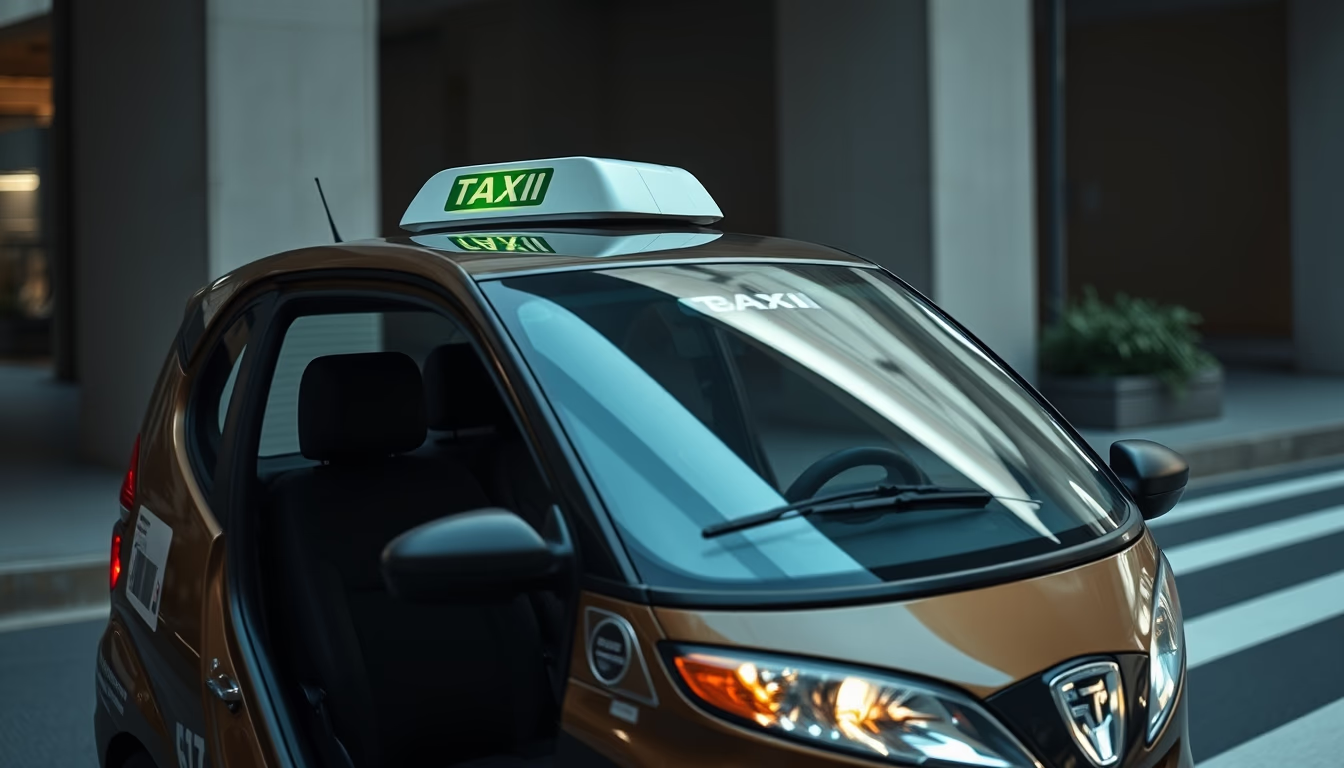
Flying taxi concept urban
1344×768 · AVIF · CC BY 4.0

Urban flying taxi concepts aim to revolutionize city mobility with electric vertical takeoff and landing (eVTOL) vehicles.
About this subject
The concept of urban flying taxis, based on electric vertical takeoff and landing (eVTOL) vehicles, represents one of the most promising areas of Advanced Air Mobility (AAM). Companies like Brazilian Eve Air Mobility (a subsidiary of Embraer), German Volocopter, and Chinese EHang are already testing prototypes, aiming for commercial operations in major urban centers by the end of this decade. Unlike traditional helicopters, eVTOLs are designed to be quieter, more sustainable, and with lower operating costs, using distributed electric motors with multiple rotors.
Integrating these vehicles into urban spaces requires specific infrastructure: vertiports, landing platforms located on rooftops, parking lots, or dedicated terminals. Cities like São Paulo, Dubai, and Los Angeles are among the first to plan routes and regulations. In Brazil, Eve Air Mobility has partnered with helicopter operators and city governments for feasibility studies, highlighting the potential to reduce travel time between metropolitan regions. The global Urban Air Mobility (UAM) market could reach US$1.5 trillion by 2040, according to Morgan Stanley projections.
Technical and regulatory challenges still need to be overcome, such as airworthiness certification by agencies like ANAC and FAA, low-altitude air traffic management, and public acceptance regarding safety and noise. Prototypes like Volocopter's VoloCity have already performed manned flights, but current average range is between 30 and 50 kilometers. The expectation is that first commercial routes will connect airports to financial centers, offering a quick alternative to ground traffic.
Beyond technology, flying taxi design reflects a futuristic aesthetic, with spacious cabins and panoramic windows, prioritizing passenger experience. Concept art of these vehicles, often classified as fine art photography or design render, explores idealized urban scenarios with skyscrapers and clean skies to visualize a future where individual air transport is accessible. These representations influence public perception and investor interest, anticipating an integrated mobility ecosystem between ground and air.
Frequently Asked Questions
How long will it take for flying taxis to become a commercial reality in Brazil?
Estimates suggest the first commercial routes in Brazil may start between 2026 and 2028, depending on ANAC certification and vertiport infrastructure. Eve Air Mobility plans to begin operations by 2026.
What is the difference between an eVTOL and a regular helicopter?
eVTOLs are electric, quieter, and have multiple distributed rotors, reducing vibration and noise during vertical takeoff and landing. They also have lower operating costs due to full electric propulsion.
Will flying taxis be autonomous or piloted?
Initially, early models will have pilots to ensure safety and public acceptance. In the long term, evolution towards autonomous flights with remote control and AI is expected, but this depends on advanced regulation.
Direct URL
https://pub-c7d6a6ea828543ac903a74a341ccb2e1.r2.dev/imagens/flying-taxi-concept-urban-fine-art-photography-p1.avifHow to credit
Include a visible link back to UtilizAí. Copy one of the snippets below:
<a href="https://xn--utiliza-eza.com/en/midia/imagens/flying-taxi-concept-urban-fine-art-photography-p1">Flying taxi concept urban</a> by <a href="https://xn--utiliza-eza.com">UtilizAí</a>, licensed under <a href="https://creativecommons.org/licenses/by/4.0/">CC BY 4.0</a>.
[Flying taxi concept urban](https://xn--utiliza-eza.com/en/midia/imagens/flying-taxi-concept-urban-fine-art-photography-p1) by [UtilizAí](https://xn--utiliza-eza.com), CC BY 4.0
License: CC-BY-4.0