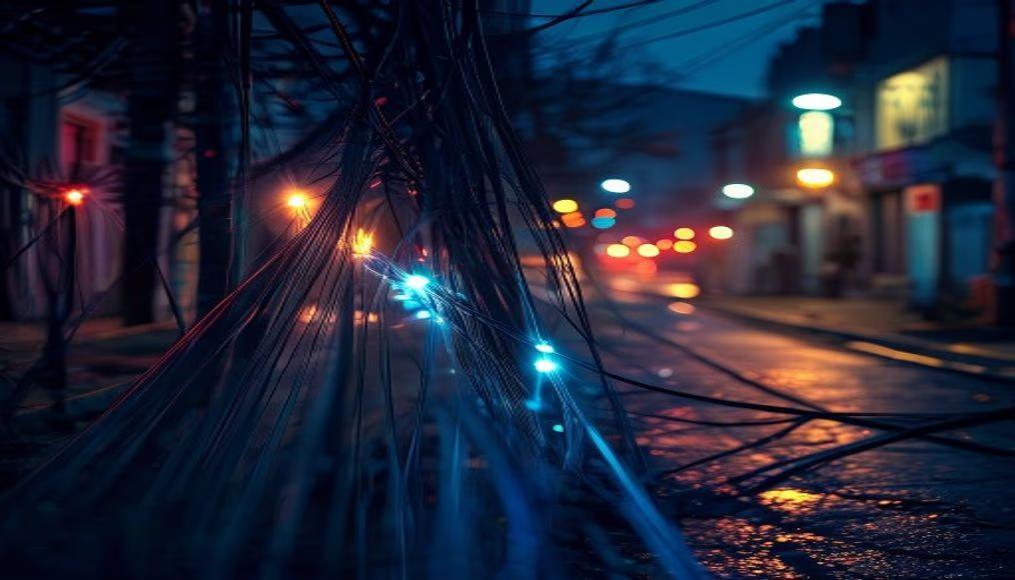
Fiber optic cables glowing in dark
1344×768 · AVIF · CC BY 4.0
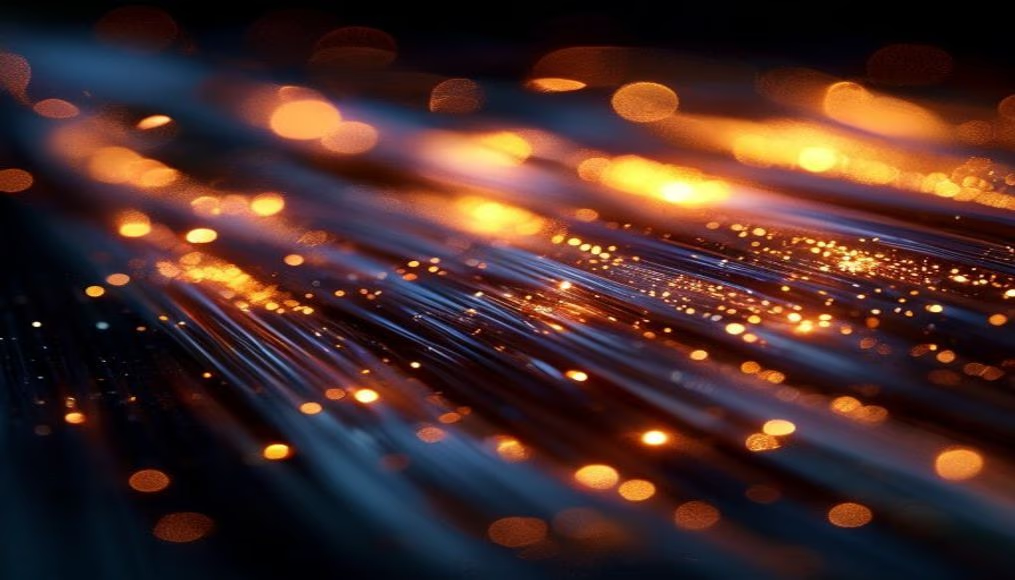
Fiber optic cables, made of pure glass, transmit data as light pulses, revolutionizing global internet and enabling gigabit speeds.
About this subject
Fiber optic technology uses thin strands of pure glass or plastic to transmit information as light pulses. Each cable consists of a core, where light travels, and a cladding that reflects rays back into the core, guiding the signal over long distances with minimal loss. This principle of total internal reflection enables data to travel kilometers without frequent amplification. Invented in the 1970s, fiber optics gradually replaced copper cables in telecommunications, offering much higher bandwidth and immunity to electromagnetic interference.
The primary advantage of fiber optics is its transmission capacity. While a traditional copper cable may handle a few megabits per second, a single fiber can carry terabits of data per second, enough for thousands of simultaneous phone calls or hundreds of high-definition TV channels. This is possible because light can be modulated at very high frequencies, and different wavelengths can be multiplexed onto the same fiber using a technique called WDM (Wavelength Division Multiplexing). Today, most high-speed internet connections, such as those offered by operators in Brazil (e.g., Vivo, Claro, Oi), use fiber to the home (FTTH).
Globally, fiber optics form the backbone of the internet. Submarine cables, such as Monet (connecting Brazil to the US) and SACS (South Atlantic Cable System), cross oceans with thousands of kilometers of fiber, enabling instant intercontinental communication. Beyond telecommunications, fiber optics are used in medicine (endoscopes, laser surgery), sensing (temperature and pressure monitoring in structures), decorative lighting, and data center networks. Producing these cables requires extremely pure glass, free of impurities that would attenuate the signal; a common transmission window operates at 1550 nm, where loss is minimal.
Interestingly, the concept of transmitting light through fibers dates back to the 19th century, but it became practical only with the advent of lasers and low-loss fibers in the 1970s. The 2009 Nobel Prize in Physics was awarded to Charles K. Kao for his pioneering work demonstrating the feasibility of glass fibers for communication. Today, the demand for broadband, streaming, and IoT continues to drive the expansion of fiber optic networks worldwide, including projects in rural areas of Brazil.
Frequently Asked Questions
How does fiber optics transmit data so fast?
Fiber optics transmit data using laser light pulses traveling at about 200,000 km/s in glass. The high frequency of light allows modulation of billions of bits per second on a single fiber.
Is fiber optic better than copper cable for internet?
Yes. Fiber offers higher speed, greater bandwidth, lower latency, and immunity to electromagnetic interference. Signals can also travel much longer distances without degradation.
Can fiber optics be installed in a home?
Yes, many providers offer FTTH (Fiber to the Home). A technician installs an optical terminal at the residence, connecting the fiber cable directly to the router, enabling speeds up to 1 Gbps or more.
Direct URL
https://pub-c7d6a6ea828543ac903a74a341ccb2e1.r2.dev/imagens/fiber-optic-cables-glowing-in-dark-travel-photography-v10.avifHow to credit
Include a visible link back to UtilizAí. Copy one of the snippets below:
<a href="https://xn--utiliza-eza.com/en/midia/imagens/fiber-optic-cables-glowing-in-dark-travel-photography-v10">Fiber optic cables glowing in dark</a> by <a href="https://xn--utiliza-eza.com">UtilizAí</a>, licensed under <a href="https://creativecommons.org/licenses/by/4.0/">CC BY 4.0</a>.
[Fiber optic cables glowing in dark](https://xn--utiliza-eza.com/en/midia/imagens/fiber-optic-cables-glowing-in-dark-travel-photography-v10) by [UtilizAí](https://xn--utiliza-eza.com), CC BY 4.0
License: CC-BY-4.0