Factory robot arm assembly
1344×768 · AVIF · CC BY 4.0
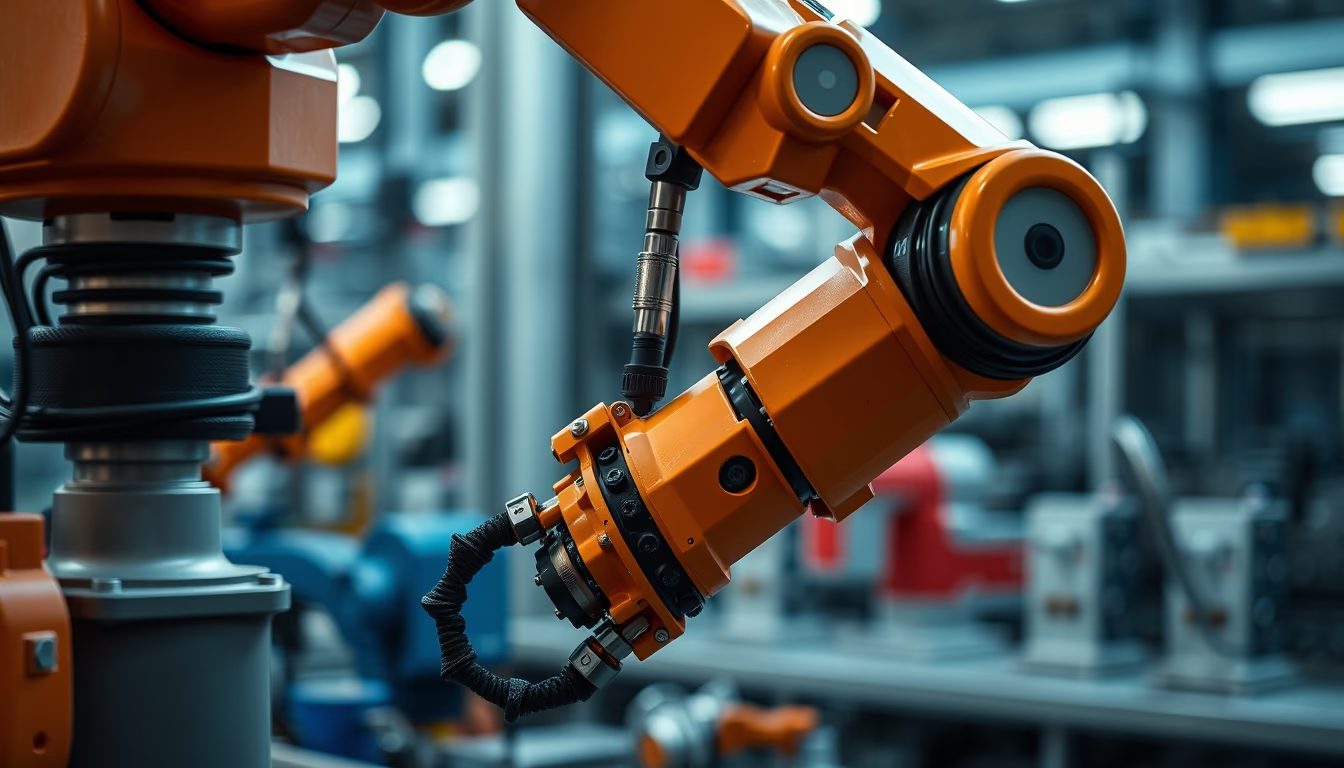
Industrial robots revolutionize modern manufacturing by replacing manual processes on global assembly lines with precision and efficiency.
About this subject
Industrial robotic arms, commonly seen in automotive and electronics manufacturing, are automated systems capable of performing repetitive tasks with sub-millimeter precision. Developed since the 1970s, they evolved from simple welding machines to intelligent systems integrated with IoT and machine learning. In automotive assembly lines, robotic arms position parts with 0.02 mm tolerance, reducing rework by up to 40% according to World Robotics 2022 studies.
Germany leads in industrial robot density with 345 units per 10,000 workers in 2023, per the International Federation of Robotics. These systems operate in controlled environments, using LiDAR sensors and high-resolution cameras to avoid collisions. Technical trivia: modern robotic arms have up to 7 degrees of freedom, enabling complex movements similar to human limbs. Japan's electronics industry uses 30% more robots than the global average, driven by legislation that encourages automation in highly competitive sectors.
Industrial automation reduces workplace accidents by 70% according to ILO, but requires worker upskilling. By 2025, 85% of Silicon Valley factories will use collaborative robots (cobots) trained through machine reinforcement learning, capable of adapting to unprogrammed tasks. Sustainability is also impacted: automated factories consume 15% less energy by optimizing production cycles.
Frequently Asked Questions
Which industrial sectors use robotic arms most frequently?
The automotive industry leads with 28% of the global robot fleet, followed by electronics (22%) and food (15%), according to IFR 2023 data.
What's the difference between industrial robots and cobots?
Industrial robots operate in isolated environments, while cobots (collaborative robots) work alongside humans with advanced safety sensors. Cobots represent 18% of new installations in 2024.
How many degrees of freedom does a modern robotic arm typically have?
Most have between 4-7 degrees of freedom (DOF), with advanced models reaching 12 DOF for complex 3D assembly tasks.
Direct URL
https://pub-c7d6a6ea828543ac903a74a341ccb2e1.r2.dev/imagens/factory-robot-arm-assembly-magazine-editorial-v8.avifHow to credit
Include a visible link back to UtilizAí. Copy one of the snippets below:
<a href="https://xn--utiliza-eza.com/en/midia/imagens/factory-robot-arm-assembly-magazine-editorial-v8">Factory robot arm assembly</a> by <a href="https://xn--utiliza-eza.com">UtilizAí</a>, licensed under <a href="https://creativecommons.org/licenses/by/4.0/">CC BY 4.0</a>.
[Factory robot arm assembly](https://xn--utiliza-eza.com/en/midia/imagens/factory-robot-arm-assembly-magazine-editorial-v8) by [UtilizAí](https://xn--utiliza-eza.com), CC BY 4.0
License: CC-BY-4.0